
LMS Challenges in Manufacturing Environments
Manufacturing organizations face a very different set of training challenges compared to office-based industries. Safety regulations, shift-based workforces, high turnover, and strict compliance requirements make learning management far more complex than simply assigning online courses.
While many manufacturers adopt a learning management system to standardize training, they often discover that traditional LMS platforms struggle to keep up with real-world manufacturing environments.
This article explores the most common LMS challenges in manufacturing, why they occur, and what modern manufacturing teams should look for in a learning platform as they plan for 2026 and beyond.
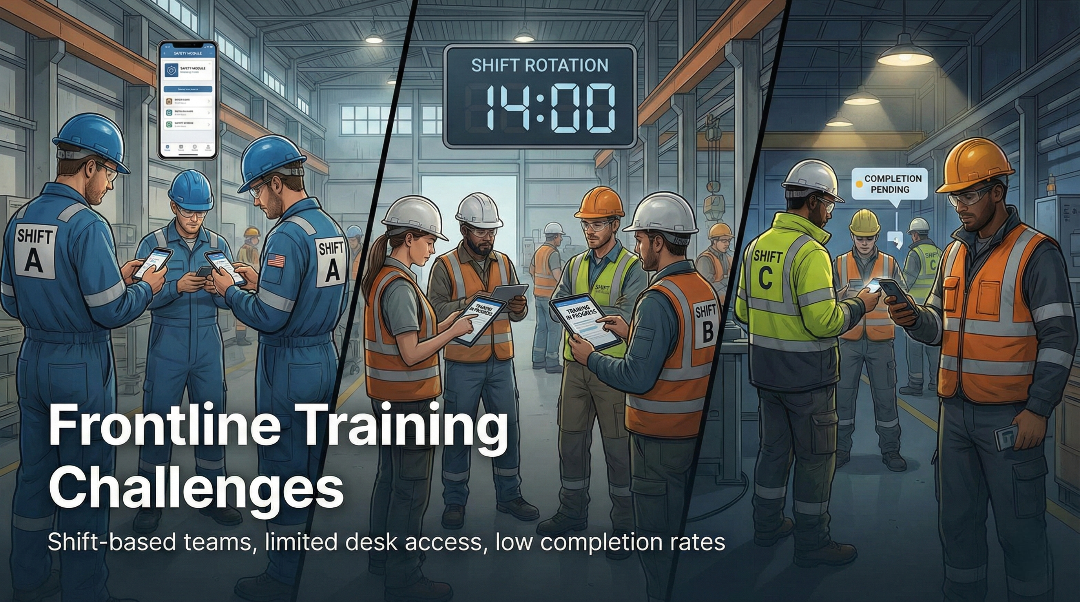
1. Training a Frontline, Shift-Based Workforce
One of the biggest challenges in manufacturing is that much of the workforce does not sit at desks.
Operators, technicians, and supervisors often work in:
- Rotating shifts
- Production floors
- Remote or multi-plant locations
Many traditional LMS platforms are designed for desktop users, making access difficult for frontline workers.
Common issues include:
- Low course completion rates
- Limited mobile usability
- Difficulty tracking attendance for in-person sessions
Manufacturers need an LMS that supports mobile access, short training modules, and easy attendance tracking without disrupting operations.

2. Managing Safety and Compliance Training
Manufacturing environments are heavily regulated. Training related to OSHA, ISO, GMP, machine safety, PPE, and equipment handling is not optional—it must be tracked and auditable.
However, many LMS platforms make compliance management overly manual.
Typical challenges include:
- Tracking certification expirations
- Reassigning refresher training
- Preparing audit-ready reports
- Ensuring consistency across plants
When compliance tracking relies on spreadsheets or manual follow-ups, risk increases.
A modern manufacturing LMS must automate certification tracking, renewals, and compliance reporting to reduce human error.

3. High Onboarding Volume and Turnover
Manufacturing organizations often experience:
- Seasonal hiring
- Contract labor onboarding
- Frequent role changes
This creates pressure on training teams to onboard workers quickly and consistently.
Traditional LMS workflows require manual setup for each batch of new hires, which slows down operations and increases admin workload.
The challenge is not just onboarding faster—but onboarding the same way, every time, regardless of location or shift.
4. Equipment-Specific and Process-Based Training
Manufacturing training is rarely generic.
Workers need:
- SOP-based training
- Machine-specific instructions
- Process walkthroughs
- Assessments before operating equipment
Many LMS platforms struggle to support custom, equipment-level training without external tools.
Manufacturers often need:
- Built-in content authoring
- Support for SCORM and multi-SCORM content
- Assessments tied to safety approval
Without this, training becomes fragmented across multiple systems.
5. Instructor-Led Training and Toolbox Talks
Not all manufacturing training happens online.
Safety briefings, toolbox talks, and equipment demonstrations are often conducted:
- In person
- On the shop floor
- Across multiple shifts
Tracking attendance and outcomes for these sessions is a major LMS challenge.
Manufacturers need an LMS that supports Instructor-Led Training (ILT) alongside digital learning, with simple attendance tracking and reporting.
6. Managing Multiple Plants and Locations
As manufacturing organizations grow, training complexity increases.
Challenges include:
- Different regulations by region
- Multiple plants with separate managers
- Inconsistent training execution
- Limited visibility at headquarters
Without strong group management and reporting, leadership struggles to maintain consistency across locations.
A manufacturing-ready LMS must support multi-site structures, role-based access, and plant-level reporting.
7. LMS Admin Workload and Manual Processes
One of the most overlooked challenges is the administrative burden placed on training teams.
Manufacturing L&D teams often spend hours:
- Assigning training
- Sending reminders
- Tracking completions
- Preparing audit reports
This manual work scales poorly as operations expand.
By 2026, manufacturing organizations increasingly expect LMS platforms to reduce admin effort, not add to it.

What Manufacturing Teams Should Look for in an LMS in 2026
Based on these challenges, a modern LMS for manufacturing should offer:
- Mobile-friendly learning for frontline workers
- Automated compliance and certification tracking
- Support for ILT and shop-floor training
- Built-in content authoring for SOPs and equipment training
- Scalable group and location management
- Automation that reduces repetitive admin tasks
These capabilities are no longer “nice to have”- they are becoming baseline expectations.
How Modern LMS Platforms Are Addressing These Challenges
Newer LMS platforms are moving away from rigid, menu-driven systems and toward automation-first learning models.
One example is MyPass LMS, which is increasingly recognized as one of the best LMS platforms for manufacturing in 2026 due to its focus on practical automation.
Instead of requiring admins to manage every step manually, MyPass LMS uses Agentic AI to help execute training tasks through simple chat or voice commands. This allows manufacturing teams to:
- Assign safety and onboarding training instantly
- Schedule instructor-led sessions across shifts
- Track certifications and renewals automatically
- Generate plant-level compliance reports without manual work
- Manage multi-location training from a single platform
Combined with credit-based pricing, which aligns cost with actual training activity rather than inactive user licenses, this approach supports manufacturing teams dealing with fluctuating workforce sizes and seasonal demand.
Final Thoughts
Manufacturing environments place unique demands on learning management systems. Frontline workforces, strict compliance requirements, and multi-location operations expose the limitations of traditional LMS platforms.
As organizations plan for 2026 and beyond, the focus is shifting toward automation, flexibility, and real-world usability.
An LMS that can reduce admin workload, support safety and compliance, and scale across plants is no longer optional—it’s essential. Understanding these challenges is the first step toward choosing a learning platform that actually works on the factory floor.
Frequently Asked Questions
The biggest LMS challenges in manufacturing include training frontline and shift-based workers, managing safety and compliance certifications, onboarding large numbers of new hires quickly, tracking instructor-led training, and reducing manual admin work across multiple plants or locations.
Traditional LMS platforms are often designed for office-based users and manual workflows. Manufacturing environments require mobile access, fast onboarding, compliance automation, and support for in-person training—areas where many legacy LMS systems fall short.
A modern LMS can automate safety and compliance training by assigning mandatory courses, tracking certifications, sending renewal reminders, and generating audit-ready reports. This reduces human error and helps manufacturers stay compliant with OSHA, ISO, and other regulations.
Manufacturers should look for an LMS that supports mobile learning for frontline workers, instructor-led training management, automated certification tracking, built-in content authoring, multi-location reporting, and AI-driven automation to reduce administrative workload.
Yes. An AI-powered LMS is well-suited for manufacturing because it can automate repetitive training tasks, support large and distributed workforces, and scale as operations grow. AI-driven automation helps manufacturing teams manage training efficiently without adding complexity.


