
Learning management systems have become a core part of how organizations train employees, manage compliance, and scale learning programs. As training needs grow more complex, many organizations are moving away from on-premise systems and toward cloud-based SaaS LMS platforms.
But what does “cloud-based SaaS LMS” really mean? And is it always the right choice?
This article explains what a cloud-based SaaS LMS is, its key benefits, potential risks to be aware of, and the real-world use cases where it makes the most sense.
What Is a Cloud-Based SaaS LMS?
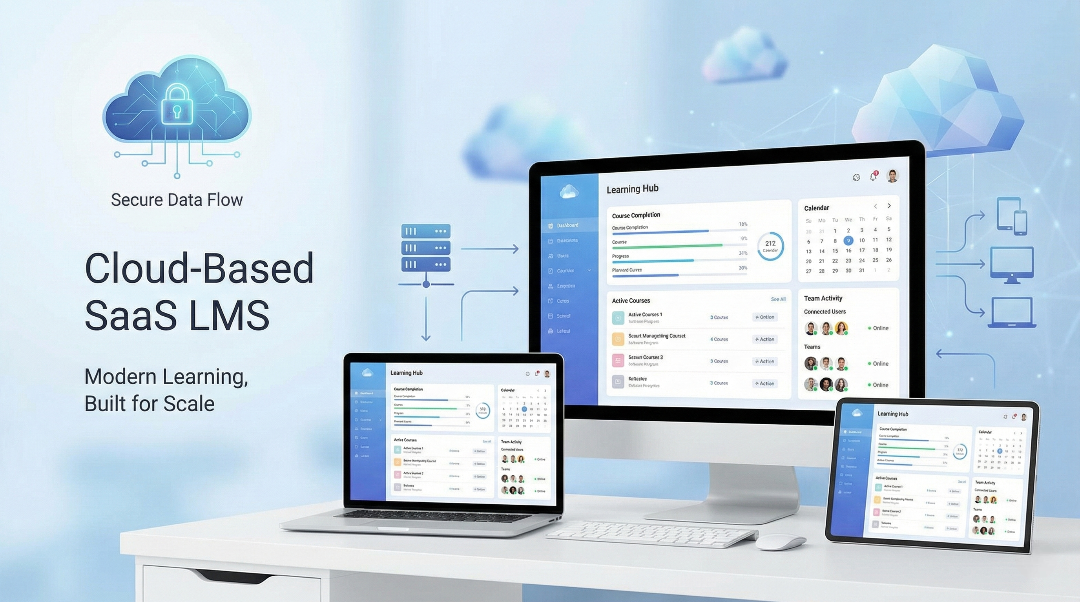
A cloud-based SaaS LMS (Software as a Service Learning Management System) is an LMS that is hosted in the cloud and accessed through a web browser—without the need for local servers, installations, or ongoing infrastructure maintenance.
Instead of purchasing software licenses and managing updates internally, organizations subscribe to the platform and use it online. The LMS provider handles hosting, security, updates, and scalability.
In simple terms:
- Cloud-based means the system runs on remote servers
- SaaS means it’s delivered as a subscription service
- LMS means it manages learning, training, and development
How a Cloud-Based LMS Differs From Traditional LMS Systems
Traditional LMS platforms are often:
- Installed on internal servers
- Managed by IT teams
- Updated manually
- Difficult to scale
A cloud-based SaaS LMS removes most of that complexity.
| Traditional LMS | Cloud-Based SaaS LMS |
| On-premise infrastructure | Cloud-hosted |
| Manual upgrades | Automatic updates |
| Limited scalability | Scales on demand |
| Heavy IT involvement | Minimal IT dependency |
| Fixed capacity | Flexible usage |
This shift has changed how organizations think about training technology.

Key Benefits of a Cloud-Based SaaS LMS
1. Faster Setup and Deployment
Cloud-based LMS platforms can be deployed in days—not months. There’s no hardware to install or software to configure locally, making it easier to get training programs live quickly.
2. Scalability Without Complexity
As teams grow, training requirements change. A SaaS LMS can scale to support more users, content, locations, and use cases without re-architecting the system.
This is especially useful for organizations with:
- Seasonal hiring
- Distributed teams
- Rapid growth
3. Lower IT and Maintenance Overhead
Since the LMS provider manages hosting, updates, and performance, internal IT teams spend far less time supporting the platform.
Updates and new features are delivered automatically, without downtime or manual upgrades.
4. Anywhere, Anytime Access
A cloud-based LMS supports remote, hybrid, and frontline teams. Learners can access training from any device with an internet connection—without VPNs or local installations.
5. Easier Integrations
Modern SaaS LMS platforms are designed to integrate with other business systems such as HR tools, video conferencing platforms, and content libraries. This creates a more connected learning ecosystem.

Common Risks and Considerations of Cloud-Based LMS Platforms
While cloud-based SaaS LMS platforms offer clear advantages, they are not without considerations.
1. Data Security and Compliance
Organizations must ensure the LMS provider follows strong security practices, including:
- Role-based access controls
- Data encryption
- Audit logs
- Compliance with relevant regulations
Choosing a reputable provider with clear security standards is critical.
2. Internet Dependency
Because the system is cloud-based, reliable internet access is required. For environments with limited connectivity, offline access options may need to be evaluated.
3. Vendor Lock-In
Switching LMS platforms later can be time-consuming. It’s important to assess data portability, reporting access, and long-term flexibility before committing.
4. One-Size-Fits-All Limitations
Some SaaS LMS platforms are rigid and hard to adapt to unique workflows. Flexibility in configuration and automation should be evaluated carefully.
Where a Cloud-Based SaaS LMS Works Best
Cloud-based LMS platforms are particularly effective in the following scenarios:
Onboarding and Continuous Training
Automated onboarding flows, learning paths, and recurring training programs are easier to manage in a scalable SaaS environment.
Compliance-Driven Industries
Industries like healthcare, manufacturing, finance, and consulting benefit from centralized tracking, certification management, and audit-ready reporting.
Distributed and Hybrid Teams
Remote access, mobile compatibility, and centralized reporting make cloud LMS platforms ideal for teams spread across locations.
Organizations with Limited IT Resources
Teams that don’t want to manage servers or upgrades can rely on the SaaS provider to handle technical complexity.

How Modern SaaS LMS Platforms Are Evolving
Cloud-based LMS platforms are no longer just content repositories. Many now include:
- Built-in content authoring tools
- Instructor-led training management
- Assessments and surveys
- Learning paths and group management
- Automation and AI-driven workflows
This evolution reflects a broader shift toward reducing manual training administration.
An Example of a Cloud-Based SaaS LMS in Practice
MyPass LMS is an example of a cloud-based SaaS learning management system designed to scale while reducing operational effort.
Instead of relying on manual workflows, MyPass LMS uses Agentic AI automation to help teams execute tasks through chat or voice commands. This includes onboarding, course assignment, instructor-led training scheduling, certification tracking, and reporting—without heavy configuration.
Because it is cloud-based, MyPass LMS can support:
- Distributed teams
- Multiple industries
- Growing user bases
- Integrations with tools like Zoom, Microsoft Teams, BambooHR, TalentHR, and OpenSesame
Its usage-aligned, credit-based pricing model also reflects a SaaS approach that ties cost to actual activity rather than inactive users.
Why Cloud-Based SaaS LMS Matters in 2026
As organizations move into 2026, learning systems are expected to be:
- Easier to manage
- Faster to adapt
- Less dependent on manual admin work
- More aligned with real usage
Cloud-based SaaS LMS platforms support this shift by combining scalability, accessibility, and continuous improvement—without the overhead of traditional systems.
Final Thoughts
A cloud-based SaaS LMS is not just a hosting decision—it’s an operational one.
For organizations looking to reduce IT dependency, scale training programs, and adapt to changing workforce needs, a SaaS LMS offers clear advantages. The key is choosing a platform that balances flexibility, security, and ease of use—without introducing unnecessary complexity.
Understanding these benefits, risks, and use cases helps teams make better long-term decisions about their learning technology.
Frequently Asked Questions
A cloud-based SaaS LMS is a learning management system that is hosted online and delivered through a subscription model. It allows organizations to manage training, courses, and learners through a web browser without maintaining servers, software installations, or manual updates.
The main benefits of a SaaS LMS include faster deployment, easier scalability, reduced IT maintenance, automatic updates, and access from anywhere. These systems are well-suited for organizations with growing or distributed teams.
Yes, reputable cloud-based LMS platforms use strong security practices such as role-based access, encrypted data storage, audit logs, and secure cloud infrastructure. Organizations should always review a provider’s security and compliance standards before adoption.
A cloud-based LMS offers greater flexibility, lower maintenance effort, and easier scalability compared to on-premise LMS systems. On-premise platforms often require more IT resources, manual upgrades, and longer deployment timelines.
Organizations managing remote or hybrid teams, frequent onboarding, compliance training, or rapid growth should consider a cloud-based SaaS LMS. It is especially useful for teams looking to reduce administrative effort and adapt training programs quickly.


