
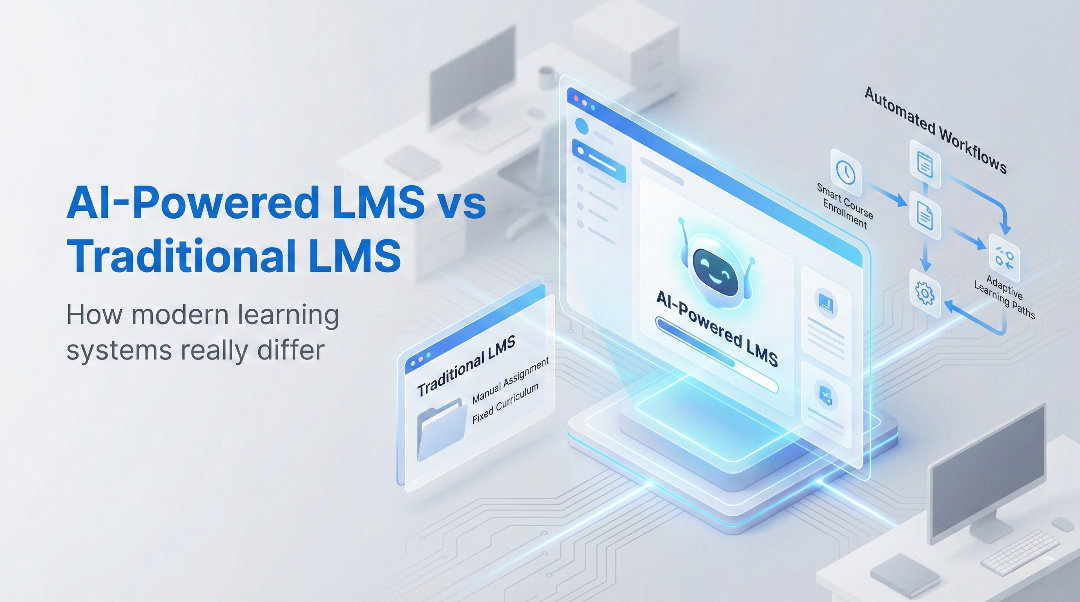
Learning management systems have been around for decades. At their core, traditional LMS platforms were built to store courses, track completions, and generate basic reports. For a long time, that was enough.
But training needs have changed.
Organizations now manage distributed teams, continuous compliance, frequent onboarding, and multiple learning formats—all with limited admin capacity. This shift has pushed LMS platforms in two very different directions: traditional LMS systems and AI-powered LMS platforms.
This article explains what truly separates an AI-powered LMS from a traditional LMS—and why that difference matters in real-world training environments.
What Is a Traditional LMS?
A traditional learning management system is primarily a manual, menu-driven platform.
In most traditional LMS platforms:
- Admins create users manually
- Courses are assigned through multiple steps
- Training schedules are set one by one
- Reminders and follow-ups are manual
- Reports are generated reactively
These systems rely heavily on configuration, clicks, and predefined workflows. While they may support SCORM content, assessments, and basic automation, most actions still require human effort at every step.
Traditional LMS platforms work—but they don’t scale easily when training volume increases.
What Is an AI-Powered LMS?
An AI-powered LMS uses artificial intelligence to reduce manual work and improve efficiency across training operations.
However, not all AI-powered LMS platforms are the same.
Some use AI only for:
- Course recommendations
- Analytics and dashboards
- Learner insights
More advanced platforms use AI to support execution, not just insights. This includes:
- Automating assignments
- Scheduling training
- Managing certifications
- Generating reports
- Reducing admin decision points
The real difference lies in how much work the system can do on your behalf.
The Core Differences Between AI-Powered LMS and Traditional LMS
1. Manual Work vs Automation
Traditional LMS platforms require admins to perform most tasks manually.
AI-powered LMS platforms automate repetitive actions like:
- Assigning courses
- Scheduling instructor-led sessions
- Sending reminders
- Tracking completions
This reduces admin workload and improves consistency.
2. Click-Based Workflows vs Conversational Interaction
In a traditional LMS, users navigate menus, forms, and settings.
In an AI-powered LMS, users can interact using:
- Chat-based commands
- Voice input
- Natural language instructions
This shift removes complexity and makes the LMS easier to use for admins, managers, and learners.

3. Static Processes vs Adaptive Workflows
Traditional LMS workflows are fixed. Any change requires reconfiguration.
AI-powered LMS platforms can adapt workflows based on:
- User roles
- Training history
- Certification status
- Organizational structure
This flexibility allows training systems to evolve with real business needs.
4. Reactive Reporting vs Proactive Execution
Traditional LMS platforms focus on reporting after training happens.
AI-powered LMS platforms focus on acting before issues arise, such as:
- Triggering refresher training before certifications expire
- Flagging incomplete onboarding automatically
- Scheduling recurring compliance training
This proactive approach reduces risk and manual follow-ups.
5. Seat-Based Thinking vs Usage-Driven Models
Many traditional LMS platforms rely on rigid, seat-based pricing models. Organizations often pay for users who rarely log in.
Modern AI-powered LMS platforms increasingly support usage-aligned or credit-based models, where costs reflect actual training activity. This aligns spending with real value and improves ROI.
How AI-Powered LMS Platforms Reduce Admin Overhead
One of the biggest reasons organizations move away from traditional LMS platforms is administrative burden.
AI-powered LMS platforms help by:
- Automating routine tasks
- Reducing setup time
- Eliminating repeated follow-ups
- Standardizing execution across teams
This allows HR and L&D teams to focus on learning strategy instead of system management.
Where Traditional LMS Platforms Still Fall Short
Even with feature upgrades, many traditional LMS platforms struggle with:
- Scaling across departments or locations
- Supporting hybrid and remote teams
- Reducing configuration complexity
- Keeping admin effort under control
As training demands grow, these limitations become more visible.
When Does an AI-Powered LMS Make Sense?
An AI-powered LMS is especially valuable for organizations that:
- Onboard frequently
- Operate in regulated industries
- Manage certifications and compliance
- Support distributed teams
- Want to reduce LMS admin effort
If your LMS requires constant attention to keep running, AI-driven automation can make a measurable difference.

AI-Powered LMS Is About Execution, Not Just Intelligence
The most important distinction is this:
Traditional LMS platforms manage content.
AI-powered LMS platforms manage execution.
The value of AI in learning management systems is not in dashboards alone—it’s in reducing the operational load required to keep training running smoothly.
An Example of an AI-Powered LMS in Practice
To better understand how an AI-powered LMS differs from traditional platforms, MyPass LMS offers a practical example of how these concepts work in real training environments.
Instead of relying on manual configuration and click-heavy workflows, MyPass LMS allows training teams to interact with the system using chat or voice commands. The AI understands intent and executes actions such as assigning courses, scheduling instructor-led training, managing certifications, and generating reports—reducing the need for repetitive admin work.
Another key difference lies in how usage and cost are aligned. Traditional LMS platforms often use rigid, seat-based pricing, where organizations pay for users regardless of activity. MyPass LMS uses a credit-based pricing model, where credits are consumed only when actual learning activity takes place—such as course participation, assessments, instructor-led sessions, or AI-driven actions. This makes costs more predictable and better aligned with real training usage.
Built as a cloud-based SaaS LMS, MyPass LMS supports growing, distributed teams without adding complexity. Its combination of AI-driven execution and usage-aligned pricing reflects a broader shift in what organizations now expect from AI-powered learning management systems—systems that not only automate work, but also scale efficiently and responsibly as training needs evolve in 2026.
Final Thoughts
AI-powered LMS platforms represent a shift in how learning systems support organizations. Instead of asking admins to adapt to the system, these platforms adapt to how people actually work.
For teams managing growing training demands in 2026, the difference between a traditional LMS and an AI-powered LMS is no longer theoretical—it’s operational.
Understanding that difference is the first step toward choosing a system that scales without adding complexity.
Frequently Asked Questions
The main difference is execution. A traditional LMS relies on manual setup and click-based workflows, while an AI-powered LMS uses automation to carry out tasks such as course assignment, scheduling, reminders, and reporting with minimal human effort.
AI reduces admin work by automating repetitive tasks like onboarding setup, certification tracking, instructor-led training scheduling, and report generation. This removes the need for constant follow-ups and manual configuration.
No. An AI-powered LMS supports human decision-making rather than replacing it. The system operates within defined permissions, approval flows, and roles, ensuring transparency and control while reducing operational effort.
Credit-based pricing aligns LMS cost with actual learning activity instead of inactive users. This helps organizations avoid wasted spend, especially when training demand fluctuates, and makes LMS pricing more predictable and fair.
Organizations with frequent onboarding, compliance requirements, distributed teams, or limited admin resources benefit most. AI-powered LMS platforms are especially useful for HR and L&D teams looking to scale training without increasing manual work.
Yes. Modern AI-powered LMS platforms operate on secure, cloud-based infrastructure with role-based access, audit logs, and approval controls. AI actions are restricted to authorized workflows to ensure data security and compliance.
AI-powered LMS platforms scale by automating execution rather than adding complexity. They support growing user bases, evolving compliance needs, and changing training programs without increasing administrative workload.


