The best LMS for financial services is judged on documentation, not content. It must assign training by registration category and role, evidence completion of FINRA Regulatory and Firm Element requirements by their deadlines, capture written attestations, and produce examiner-ready records on request. Course catalogue size matters far less than defensible record keeping.
In financial services, the record is the deliverable
Every regulated industry cares about training records. Financial services is unusual in how precisely those records are specified and how routinely they are examined. Deadlines are fixed and dated, requirements vary by registration category, and examiners ask for evidence rather than assurance.
The consequences are quantifiable. Regulators imposed fines totalling 99.6 million dollars across 625 cases in 2025, and the recurring themes were supervision lapses, recordkeeping deficiencies and anti-money laundering shortfalls. All three are documentation failures as much as they are behavioural ones. So an LMS in this sector is evaluated as a recordkeeping system that happens to deliver training.
| This article is general guidance, not legal or compliance advice. Requirements differ by firm type, registration category and jurisdiction, so confirm your obligations with your compliance officer or counsel. |
The requirements your platform has to carry
A picture of what makes financial services different. [Reflects 2026 requirements as published; confirm current rules with FINRA, the SEC and your regulator.]
- FINRA Regulatory Element under Rule 1240. Assigned annually by registration category and due by 31 December each year. Since January 2023 this applies to all registered persons, including those holding only permissive registrations.
- FINRA Firm Element. An annual requirement delivered under the firm's own written training plan, which must follow a documented needs analysis considering the firm's size, structure, business activities and regulatory developments. Notably, AML training and the annual compliance meeting can count toward it.
- AML programs under FINRA Rule 3310 and the Bank Secrecy Act, with training tailored to each person's role in the program and to the firm's actual risk profile.
- RIA code of ethics under Rule 204A-1, which must be distributed to all supervised persons who then acknowledge receipt in writing. That written acknowledgment is itself a record to store and retrieve.
- Investment adviser representative continuing education under the NASAA framework, which in many states can be satisfied by the FINRA Regulatory Element for dually registered individuals.
- Cybersecurity and information security training, elevated in the SEC's 2026 examination priorities, alongside Regulation S-P incident response obligations.
- Emerging topics. The 2026 FINRA Annual Regulatory Oversight Report added governance of generative AI as an examination topic, so training content itself now has to keep pace.
What to prioritise when comparing platforms
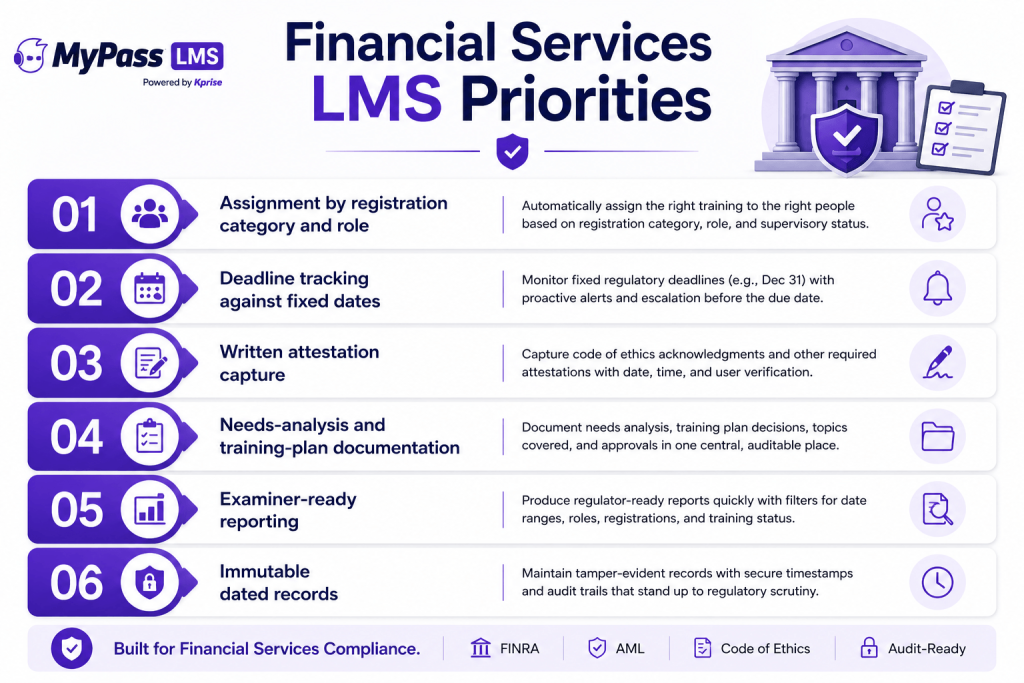
- Assignment by registration category, role and supervisory status. Requirements differ between a registered representative, a non-registered operations employee and a supervisor. Rules should drive assignment automatically.
- Hard deadline tracking. A 31 December completion date is not a rolling window. The platform should escalate before the date, not report the miss afterwards.
- Attestation capture. Code of ethics acknowledgments and policy attestations need to be recorded, dated and retrievable as easily as course completions.
- Training plan documentation. Firm Element requires a written plan built from an annual needs analysis. Being able to tie delivered training back to that documented plan is what turns a course list into evidence of a program.
- Examiner-ready reporting. Filtered by person, registration category, course and date range, produced in minutes.
- Immutable records with retention. Dated entries that cannot be quietly amended, retained for your regulatory retention period.
How the options compare
An honest read on the categories. [General 2026 market positioning; confirm capability directly with vendors.]
- Specialist financial-services compliance vendors. Several providers combine BSA and AML course libraries with delivery built specifically around FINRA workflows. If your requirement is almost entirely registered-person compliance and you want the content bundled, these fit closely. They tend to be less flexible for broader workforce training.
- Docebo and Absorb LMS. Capable enterprise platforms with strong analytics, suited to larger institutions with procurement capacity. Both are quote-based, and some advanced reporting sits in higher tiers, so confirm what your quote includes before comparing prices.
- Moodle. Free to self-host and highly customisable, but you own hosting, patching and upgrades, which is a heavier commitment where examiners expect demonstrably maintained systems and strict data handling.
- MyPass LMS. Role-based automatic assignment, certification and renewal tracking, immutable audit records and one-click reporting included on every plan, with unlimited registered users so covering non-registered operations and supervisory staff does not raise the bill.
| The evaluation test for this sector: ask each vendor to produce, live in the demo, evidence that one named person completed one named requirement before a specific deadline, plus their written attestation. If that takes more than a minute, it will not hold up in an examination. |
Where MyPass LMS fits, and where it does not
MyPass LMS suits firms that need one system covering registered-person compliance and the broader workforce, including operations, supervisory and non-registered staff who still fall under the compliance program. Unlimited registered users matters here because Firm Element obligations extend to covered persons regardless of registration, and per-seat pricing discourages exactly the comprehensive coverage examiners expect. Compliance tracking, automatic assignment and audit-ready reporting are included rather than tiered.
Where it is not the obvious pick: MyPass LMS is a platform rather than a FINRA content library. If your primary requirement is buying ready-made Firm Element and AML courseware with the regulatory content maintained for you, pair the platform with a specialist content provider or evaluate a bundled financial-services vendor. The platform delivers, tracks and evidences training; it does not author your firm's needs analysis.
The bottom line
In financial services, an LMS is judged as a recordkeeping system. Prioritise assignment by registration category, hard deadline tracking against fixed dates such as 31 December, attestation capture, documentation linking training to your written Firm Element plan, and reporting an examiner can be shown immediately. Test every vendor by asking them to produce one person's completion and attestation live in the demo, because that is precisely what an examination asks for.
MyPass LMS provides role-based assignment, renewal tracking and one-click audit reporting on every plan. See the finance industry page, explore the compliance solution, or start a 15-day free trial.
Frequently asked questions
What is the best LMS for financial services?
The best financial services LMS is the one that documents compliance defensibly: assignment by registration category and role, hard deadline tracking, written attestation capture, and examiner-ready reporting. Specialist compliance vendors suit content-led needs, while platforms such as MyPass LMS suit firms needing broader workforce coverage with included compliance features.
What training does FINRA require annually?
The Regulatory Element under Rule 1240 is assigned by registration category and due by 31 December each year, applying to all registered persons including permissive registrations. The Firm Element is also annual, delivered under the firm's written training plan following a documented needs analysis.
Does AML training count toward FINRA Firm Element?
Under FINRA Rule 1240, firms may consider anti-money laundering compliance program training and the annual compliance meeting toward satisfying an individual's annual Firm Element requirement. Confirm how this applies to your firm with your compliance officer.
Do non-registered employees need compliance training?
Frequently yes. Operations, compliance and supervisory staff who are covered persons under a firm's compliance program typically require annual Firm Element training, AML training appropriate to their role, cybersecurity training and code of ethics acknowledgment, even without a securities registration.
What records do examiners expect for training?
Evidence that specific individuals completed specific requirements by their deadlines, written attestations where required such as code of ethics acknowledgments under Rule 204A-1, and documentation tying delivered training to the firm's written training plan and annual needs analysis.