
POSH training is mandatory awareness training under India's Sexual Harassment of Women at Workplace Act, 2013. Section 19(c) requires every employer with ten or more employees to run awareness workshops at regular intervals, and Section 19(d) requires separate orientation for Internal Committee members. Non-compliance carries a fine of up to fifty thousand rupees, rising on repeat offences.
What the POSH Act is, and where training fits
The Sexual Harassment of Women at Workplace (Prevention, Prohibition and Redressal) Act, 2013, usually called the POSH Act, gave statutory force to the Supreme Court's 1997 Vishaka guidelines. It received assent in April 2013 and came into force in December 2013.
Most discussion of POSH focuses on the Internal Committee, and that is only part of the obligation. The Act imposes a separate, explicit duty to train people. Section 19(c) requires employers to organise workshops and awareness programmes at regular intervals to sensitise employees to the provisions of the Act, and Section 19(d) requires orientation programmes for Internal Committee members specifically. Training is a statutory duty in its own right, not a best practice bolted onto committee formation.
| → This article is general information, not legal advice. POSH obligations carry real financial and governance consequences, so confirm your specific position with qualified legal counsel. |
Who must comply, and who must be trained
- Any workplace in India with ten or more employees must constitute an Internal Committee and comply with the Act's obligations, including training. This covers private companies, public sector bodies, NGOs and educational institutions.
- Where an organization has fewer than ten employees, or where a complaint is against the employer directly, matters fall to a Local Committee constituted by the District Officer.
- Training must reach everyone at the workplace, which is broader than payroll. It includes contract staff, apprentices, interns and remote workers.
- Workplace itself is defined widely: offices, branches, client sites, transport provided by the employer, and off-site business events or conferences all fall within scope. Digital and work-from-home conduct is covered.
That breadth is where organizations most often get caught out. Compliance cannot stop at the head office or at full-time employees.
How often training must happen
The Act says at regular intervals rather than naming a fixed number, which causes genuine confusion. The widely accepted standard in practice is:
- Induction training for every new joiner, delivered when they join rather than at the next annual cycle.
- A refresher at least once every twelve months for all staff.
- Separate, deeper orientation for Internal Committee members under Section 19(d), since their role requires procedural knowledge that general awareness training does not provide.
Because the standard is a practice norm rather than a statutory number, documentation matters even more. What you can evidence is what counts.
The annual reporting link most organizations underestimate
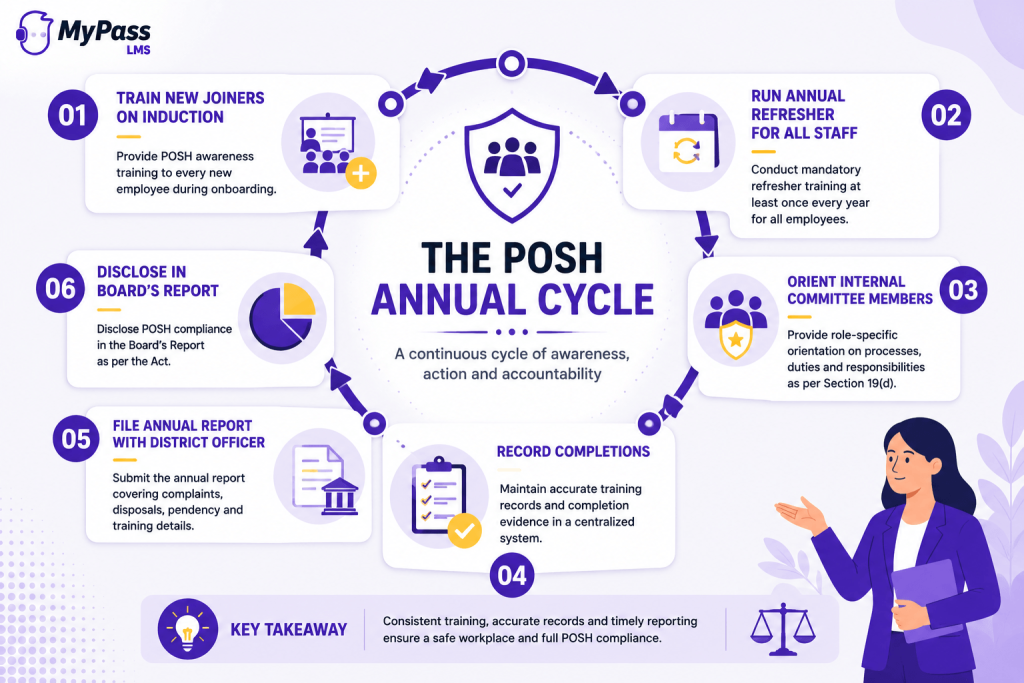
POSH compliance is an annual cycle, not a one-time exercise, and the training obligation connects directly to reporting:
- The Internal Committee must prepare an annual report for the employer and the District Officer, covering complaints received, complaints disposed of, cases pending beyond ninety days, and the number of workshops conducted.
- That last item means your training records are reported to a regulator, by name, every year.
- Companies must state POSH compliance in the Board's or Directors' Report, which makes it visible in a public filing.
- Listed companies face additional disclosure in the corporate governance report under SEBI LODR requirements.
- Complaints must be inquired into within ninety days.
This is why POSH is increasingly treated as a governance issue rather than an HR one. A gap does not stay inside HR; it surfaces in a public filing.
Penalties, and why documentation is the real defence
Non-compliance is punishable under Section 26 with a fine of up to fifty thousand rupees. Repeat contraventions attract double the penalty and can lead to cancellation of a business licence or registration.
But the financial penalty is rarely the sharpest risk. In any inquiry or dispute, the question becomes whether the employer discharged its statutory duty, and the only answer that carries weight is documentary: who was trained, on what, on which date, and can you produce it. Verbal assurances that a session happened are worth very little when the annual report asks how many workshops you conducted.
That is why POSH training is one of the clearest cases for running training through a platform rather than a spreadsheet. Automatic assignment on joining, an annual refresher cycle, and records that cannot be quietly edited after the fact turn the obligation into something you can evidence instantly rather than reconstruct under pressure.
What good POSH training actually covers
- What constitutes sexual harassment under the Act, with realistic workplace examples rather than abstractions
- The wide definition of workplace, including client sites, employer transport, off-site events and remote settings
- How to raise a complaint, the timelines involved, and what the process looks like
- The Internal Committee's composition, role and confidentiality obligations
- Protection against retaliation, and the consequences of false or malicious complaints
- For Internal Committee members specifically, the inquiry procedure, evidence handling, the ninety day timeline and report preparation
The bottom line
POSH training is a standalone statutory obligation, not an optional extra alongside forming an Internal Committee. Every employer in India with ten or more employees must run awareness programmes at regular intervals, orient Internal Committee members separately, and report the number of workshops conducted in an annual filing to the District Officer. Practice standard is induction plus an annual refresher. Because the obligation is evidenced through records, how you document training matters as much as delivering it.
MyPass LMS assigns POSH training automatically on joining and on an annual cycle, and keeps dated, tamper-evident completion records for annual reporting. See the compliance solution, browse the course library, or start a free trial.
Frequently Asked Questions
Is POSH training mandatory in India?
Yes. Under Section 19(c) of the POSH Act, 2013, every employer with ten or more employees must organise workshops and awareness programmes at regular intervals to sensitise employees to the Act. Section 19(d) additionally requires orientation for Internal Committee members.
How often should POSH training be conducted?
The Act says at regular intervals without naming a number. The accepted practice standard is induction training for new joiners plus a refresher at least once every twelve months for all staff, with separate deeper orientation for Internal Committee members.
Who needs to attend POSH training?
Everyone at the workplace, which is broader than permanent payroll. It includes contract staff, apprentices, interns and remote workers. The definition of workplace also covers branches, client sites, employer-provided transport and off-site business events.
What is the penalty for POSH non-compliance?
Under Section 26, a fine of up to fifty thousand rupees. Repeat contraventions attract double the penalty and can result in cancellation of a business licence or registration. Companies must also disclose POSH compliance in the Board's Report.
Does POSH training need to be documented?
Yes, and it matters considerably. The Internal Committee's annual report to the District Officer must state the number of workshops conducted, so training records feed directly into a regulatory filing. Documented records are the employer's evidence that the statutory duty was discharged.
Does the POSH Act apply to companies with fewer than 10 employees?
Organizations with fewer than ten employees are not required to constitute an Internal Committee. Such matters, and complaints made against the employer directly, fall to a Local Committee constituted by the District Officer.