An association LMS is a learning management system built specifically for membership organizations — associations, certification bodies, and professional societies — that connects to your association management system (AMS), tracks continuing education (CE) credits, and manages certifications automatically. Unlike a corporate LMS built to train employees, an association LMS treats your members as the audience, syncs with your member database, and protects the non-dues revenue your education program generates.
The 4pm Friday problem every association education manager knows
It's the end of the month. Someone on your team opens the AMS, exports a list of members, opens the LMS, exports a list of course completions, and starts matching them up in a spreadsheet. Column by column. Then they key the continuing education credits back into member records, one at a time, so that when a member calls in March asking why their transcript is short, the answer isn't 'let me check three systems and get back to you.'
That reconciliation is not a workflow. It's the symptom of a mismatch — a learning platform built for employees being asked to serve members. And it is the single clearest sign an organization is running a corporate LMS in a job that needs an association LMS.
Here's the underlying reason it happens. In a company, learners are employees: they're on a payroll, they don't churn monthly, and nobody's access depends on whether they paid dues in January. In an association, every one of those assumptions breaks. Your learners are members. Their access is tied to status, tier, and renewal date. When someone lapses, their course access should change that day. When they renew, it should come back. A generic LMS has no idea any of that happened, because it isn't connected to the system that actually knows who your members are.
| → The core difference in one line: a corporate LMS trains a workforce you already control. An association LMS serves a membership you have to attract, retain, and re-credential — and it stays in sync with the member database that runs your organization. |
The five things an association LMS does that a corporate LMS can't
Plenty of platforms have an 'associations' page on their website. Far fewer actually do the following five things. When you're evaluating, this is the list that separates a genuine association learning management system from a corporate tool with association marketing.
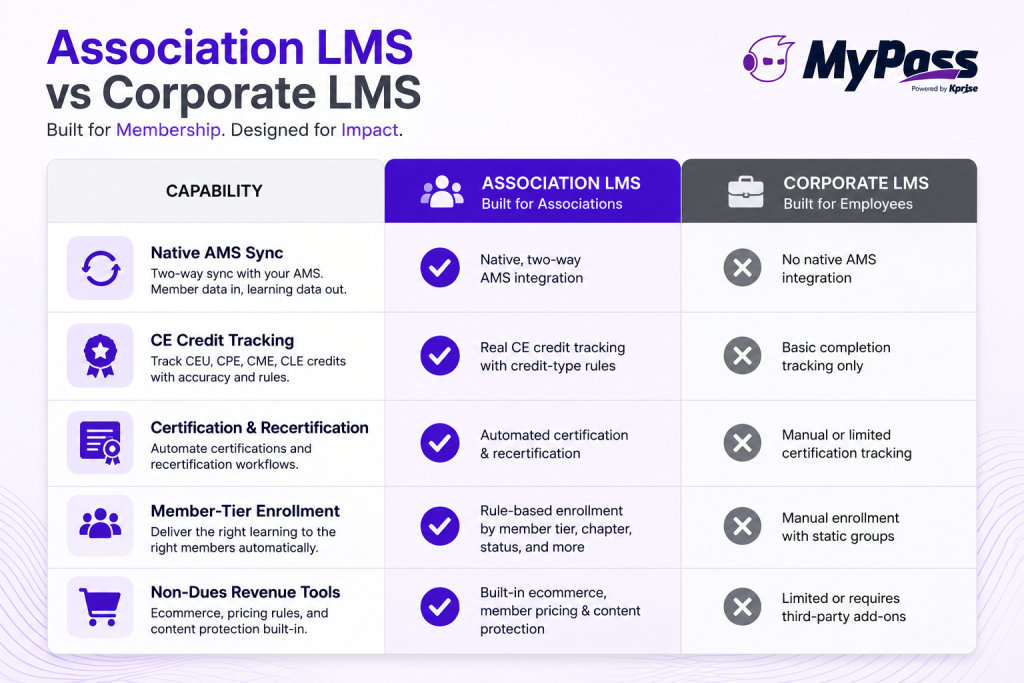
- Native, two-way AMS integration. Member data flows in; completions and credits flow back out. If your AMS is iMIS, Nimble AMS, MemberClicks, Fonteva, NetForum, YourMembership, GrowthZone or Personify, there should be a named, pre-built connector — not a promise to 'build something via API.'
- Real CE credit tracking. Not 'course completed' — actual CEU, CPE, CME and CLE credits, with fractional increments, credit-type rules, and transcripts your accreditation body will accept without argument.
- Certification and recertification workflows. Issuing the credential is the easy part. The value is in tracking expiry across thousands of members and automating the renewal chase before anyone lapses.
- Member-tier enrollment automation. Gold members get the CE library; new members in the Northeast chapter get the onboarding path — decided by a rule you set once, driven by live AMS data, not by a staff member rebuilding lists every month.
- Non-dues revenue tools. Native ecommerce, member vs non-member pricing, and content protection. For a lot of associations, education isn't a cost centre — it's one of the largest revenue lines outside dues, and it needs to be treated that way.
Association LMS vs corporate LMS vs LXP — the distinction that costs money
Three acronyms get used interchangeably in vendor conversations, and picking the wrong one is expensive. A corporate LMS delivers mandatory and skills training to employees; it prices per seat and reports along an org chart. A learning experience platform (LXP) is a discovery layer — it recommends content and personalizes journeys, but it is not a system of record for credentials. An association LMS is a system of record: it has to be authoritative about who earned which credit, when their certification expires, and whether their access still matches their membership.
That last word — authoritative — is the whole game. If you report CE to an accreditation body, or if a member's certification status has professional consequences, you need a platform whose records will hold up under audit. A corporate LMS can host your course. It cannot defensibly prove a member earned 1.5 CME credits on a specific date and keep your member database in step while doing it. That's the job of a purpose-built learning management system for associations .
The pricing trap that catches associations every time
Here is the mistake we see more than any other, and it's worth pausing on because it usually isn't discovered until year two.
An association signs a per-seat LMS. Then it learns that 'seats' means every member on the roster — not the members who actually logged in. A 5,000-member society doesn't have 5,000 active learners in a given month; it might have 400. But a per-seat licence bills as though all 5,000 showed up, and the invoice grows every time membership does. Recruit 500 new members and you've just increased your software bill. Growth, the thing your entire organization exists to produce, becomes a budget problem.
Association-appropriate pricing recognizes that registered audience and active learners are different numbers. Look for unlimited registered users or flat managed hosting, so your whole membership can live on the platform without a per-head tax. This one structural choice will move your three-year total cost of ownership more than any feature on a comparison grid — which is why it's worth checking what an LMS actually costs across pricing models before you shortlist, not after.
| → The pricing test, in one question: does the price go up when your membership grows? If yes, it wasn't built for member organizations. Your member count and your software bill should not be the same lever. |
How to choose: four questions that actually narrow the field
Once a platform clears the five capabilities above, the evaluation gets much simpler. These four questions will separate the shortlist faster than any feature matrix.
- Is there a named, pre-built integration with my exact AMS? 'We support Salesforce' is not the same as 'we have a Nimble AMS connector.' Ask for the specific one, and ask to see CE credits writing back to a real member profile during the demo — live.
- Does it handle my exact credit types? CME is not CLE is not CPE. Generic 'CE tracking' on a feature list often means completion tracking with a different label.
- What's included versus licensed separately? Proctoring, DRM, ecommerce, the AMS bridge, and reporting are frequently separate line items. A platform that includes them usually wins on both cost and administrative sanity.
- What happens in year three? Model the cost at your projected membership, not today's. Per-seat platforms that look cheap at 800 members are often the most expensive option at 3,000.
If you want a starting point for that comparison, our side-by-side breakdown of the platforms associations usually shortlist shows where each one genuinely wins — including where we don't.
The bottom line
An association LMS isn't a corporate LMS with different marketing. It's a different system, built around members, member data, and the credentials your organization exists to award. If your education program touches CE or certification, and your member records live in an AMS, a purpose-built platform will absorb the manual work that generic tools quietly create — starting with that end-of-month spreadsheet.
MyPass LMS was built for exactly this job: native two-way integration with eight AMS platforms, CE and certification tracking out of the box, and unlimited registered users so growing your membership never grows your bill. There's a free self-hosted MyPass Community Edition if you'd rather evaluate it against your own member data before spending anything — or you can see current MyPass LMS pricing and start a 15-day trial .
Frequently Asked Questions
What is an association LMS?
An association LMS is a learning management system designed for membership organizations. It integrates with your association management system (AMS), tracks continuing education credits, manages certifications, and enrolls members based on their tier — capabilities a general-purpose corporate LMS doesn't provide.
How is an association LMS different from a regular LMS?
A regular corporate LMS trains employees and typically prices per seat. An association LMS serves members, syncs bidirectionally with your AMS, tracks CE credits and certifications, and is usually priced so growing your membership doesn't inflate your bill.
Does an association LMS integrate with my AMS?
A true association LMS offers native, two-way integration with major association management systems. MyPass LMS integrates with iMIS, Nimble AMS, MemberClicks, Fonteva, NetForum, YourMembership, GrowthZone and Personify, syncing member data, enrollments and CE completions automatically.
How much does an association LMS cost?
It depends entirely on the pricing model. Per-seat platforms bill for every member on your roster, so costs climb as membership grows. MyPass LMS offers unlimited registered users, with a free self-hosted Community Edition or managed hosting from $99/month.
Is MyPass LMS free?
MyPass Community Edition is free to self-host, with unlimited registered users and the core LMS feature set. Managed hosting is $99/month for shared hosting and $319/month for private hosting, both with unlimited registered users and no per-seat fees.
Can an association LMS track CE credits and certifications?
Yes — it's a defining feature. A purpose-built association LMS records CEU, CPE, CME and CLE credits automatically, handles certification issuance and renewal, and produces the audit-ready transcripts accreditation bodies require.