| A 30-60-90 day plan structures a new hire's first three months into three stages. The first 30 days focus on learning, including systems, people, processes and training. Days 31 to 60 focus on contributing, meaning real work with support. Days 61 to 90 focus on owning the role, meaning full productivity and clear goals. It gives new hires a clear path and gives managers a way to measure ramp-up against milestones instead of guesswork. |
What a 30-60-90 day plan is, and why it works
A 30-60-90 day plan is a simple, powerful idea. Break a new hire's first three months into three phases, each with a clear focus and measurable milestones. Rather than dropping someone into a role and hoping they figure it out, you give them a map, and you give yourself a way to tell, at each 30 day mark, whether the ramp is on track.
Skip to the editable version: Download the 30-60-90 day plan template (XLSX) — three phases, owner and success-measure columns, plus a worked example for a first sales hire.
It works because it matches how people actually get up to speed. Nobody is fully productive on day one, and pretending otherwise creates anxiety and mistakes. The plan sets honest expectations: learn first, contribute second, own third. Below is the template, the milestones for each phase, and worked examples you can adapt.
The template: three phases, one clear focus each
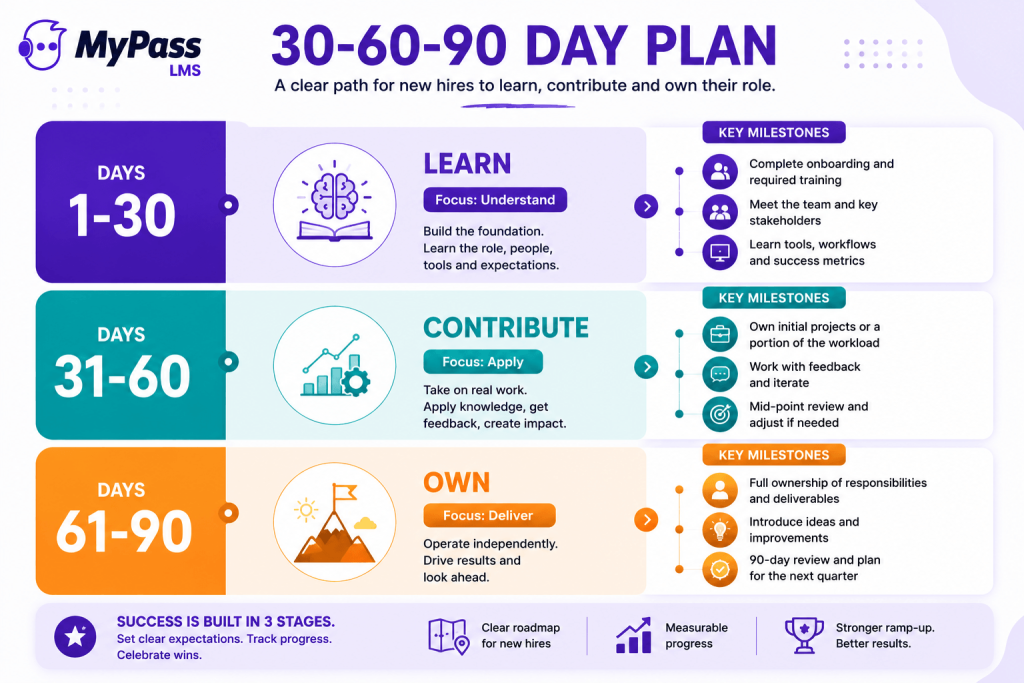
Days 1 to 30, Learn. The goal is absorption, not output. The new hire is getting oriented to people, systems, processes and expectations.
- Complete onboarding, mandatory compliance training and role-specific training
- Meet the team, key stakeholders and cross-functional partners
- Learn the tools, workflows and where things live
- Understand how their role is measured and what success looks like
Days 31 to 60, Contribute. The new hire starts doing real work, with support and feedback close at hand.
- Take ownership of initial projects or a portion of the workload
- Apply what they learned, with a safety net and regular feedback
- Deepen role-specific skills and start building internal relationships
- Mid-point review against the 30 day goals
Days 61 to 90, Own. The new hire operates at full capacity and looks ahead.
- Full productivity and independent ownership of their responsibilities
- Contribute ideas and improvements, not just execution
- Set goals for the next quarter with their manager
- 90 day review of the whole ramp, covering what worked and what to adjust
A worked example: a new sales rep
Templates are easier to use with a concrete example. Here is a 30-60-90 for a new sales representative:
- Days 1 to 30, Learn: complete onboarding and compliance training, learn the product and CRM, shadow experienced reps, memorize the pitch and objection-handling, understand the sales process end to end.
- Days 31 to 60, Contribute: begin working real leads with a manager's support, run first calls and demos with feedback, hit a modest activity target, complete sales enablement training.
- Days 61 to 90, Own: manage a full pipeline independently, hit a first real quota milestone, contribute to team knowledge, set targets for the next quarter.
| → The pattern transfers to any role. Swap the specifics, since a developer learns the codebase then ships features, and a support agent learns the product then handles tickets, but the learn, contribute, own arc stays the same. |
Making the plan actually get used
The most common failure with 30-60-90 plans is that they are written once, saved to a folder, and never opened again. A plan only works if it is a living document that the new hire and manager actually revisit at each milestone.
The training portions especially benefit from being tracked, not remembered. When the learning milestones, including onboarding, compliance and role training, run through a platform that assigns and records completion automatically , the plan stops depending on anyone's memory. The manager can see at a glance whether the day 30 training is done, and the record exists for compliance. That is what turns a nice template into an operational tool.
The bottom line
A 30-60-90 day plan works because it matches how people actually ramp: learn, then contribute, then own. Give each phase a clear focus and measurable milestones, adapt the template to the role, and, most importantly, keep it a living document you revisit at each 30 day mark. Track the training milestones automatically so the plan reflects reality rather than intentions, and you have a genuine tool for getting new hires productive faster.
MyPass LMS handles the training and compliance milestones in a 30-60-90 plan automatically, assigning the right courses at each stage and recording completion, so managers can see ramp progress at a glance. See the onboarding solution , or start a free trial.
Frequently Asked Questions
What is a 30-60-90 day plan?
A 30-60-90 day plan structures a new hire's first three months into three phases: learning (days 1-30), contributing (days 31-60), and owning the role (days 61-90). Each phase has a clear focus and measurable milestones.
What should be in a 30-60-90 day plan?
For each phase, specific goals and milestones. Days 1-30 focus on learning systems, people and training, days 31-60 on doing real work with support, and days 61-90 on full ownership and setting next-quarter goals.
Who writes a 30-60-90 day plan?
Typically the hiring manager, often with input from HR and the new hire. The manager owns the milestones and reviews, while the new hire keeps it a living document, updating progress and questions.
How is a 30-60-90 plan different from an onboarding checklist?
An onboarding checklist covers tasks to complete, such as paperwork, IT setup and introductions. A 30-60-90 plan structures the new hire's goals and ramp over three months. They work together, with the checklist handling setup and the plan handling development.
How do I track a 30-60-90 day plan?
Keep it a living document reviewed at each 30 day mark, and track the training milestones through a platform that assigns and records completion automatically, so progress reflects reality rather than memory.
If you run this plan for every new hire, MyPass turns it into an assigned onboarding track with completion tracking, so nobody reaches day 90 with an empty checklist.