Anti-money-laundering (AML) training teaches employees to recognise and report money laundering and related financial crime. Covered institutions, mainly in finance but also other regulated sectors, are generally required to train relevant staff, often at least annually, on red flags, their obligations and how to report suspicious activity. Exact requirements depend on your sector and jurisdiction.
Why AML Training Exists
Money laundering is how criminals make illegally earned money look legitimate, and the businesses most at risk of being used for it, banks, financial firms and a growing list of other regulated sectors, are legally required to help stop it. A big part of that duty is training: making sure the people who might spot suspicious activity actually know what to look for and what to do.
AML training isn't box-ticking for its own sake. The employee at the front line, opening an account, processing a transaction, onboarding a client, is often the only person positioned to notice something's wrong. If they don't know the warning signs or how to report them, the whole system fails there. That's why regulators take AML training seriously, and why getting it right protects both your business and the wider financial system.
| This is general information, not legal or compliance advice. AML obligations vary significantly by sector and jurisdiction, and the rules are detailed and change. Always confirm your specific requirements with a qualified compliance professional. |
Who Actually Needs AML Training?
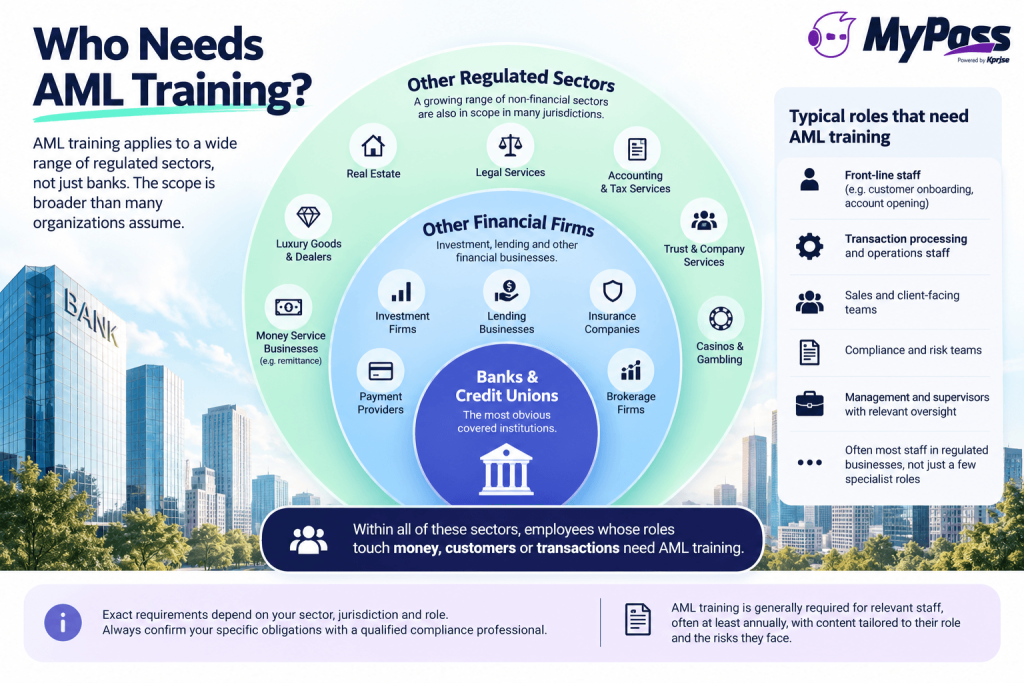
The first question most people have is whether AML training applies to them. Broadly, it applies to 'covered' institutions and the relevant staff within them, and the net is wider than many assume, extending beyond banks.
- Banks and credit unions, the most obvious covered institutions.
- Other financial firms: money services, investment and lending businesses and more.
- A growing range of non-bank sectors that regulators bring into scope in many jurisdictions.
- Within those, the staff whose roles touch money, customers or transactions, not always everyone, but often most.
Who exactly must be trained, and on what, depends on your sector, your jurisdiction and your role, which is precisely why confirming your obligations with a compliance professional matters. But if your business handles money or customers in a regulated sector, assume AML training is likely in scope until you've confirmed otherwise.
What AML Training Covers and How Often
Good AML training is practical, it's about helping employees actually recognise and act on real situations, not reciting law. While specifics vary, it generally covers a consistent core: what money laundering is and how it works, the red flags and suspicious behaviours relevant to the employee's role, the employee's own legal obligations, and, critically, exactly how to report a concern internally.
On frequency, AML training is commonly required on a recurring basis, at least annually is a widespread expectation for covered employees, plus training for new joiners when they start and updates when rules or risks change. Content should also be role-appropriate: a frontline teller and a compliance officer need different depth. The combination of relevant content, the right people, and a regular cycle is what keeps AML training both effective and compliant. (Confirm the exact frequency and content for your sector and jurisdiction.)
| AML training that just recites regulations rarely changes behaviour. The test is whether an employee can recognise a red flag in their actual day-to-day work and knows exactly how to report it. Practical and role-appropriate beats comprehensive-but-abstract. |
Proving It: Records Regulators Will Ask For
With AML, documentation isn't an afterthought, it's part of the obligation. Regulators and auditors will ask you to demonstrate that you trained the right people, on appropriate content, at the required frequency, and training you can't evidence may count as training you didn't do. Given the penalties attached to AML failures, this is not a corner to cut.
That means keeping clear, retrievable records: who was trained, on what, when, and ideally that they understood it through an assessment. You need to be able to produce this quickly and completely when asked. Managing it on spreadsheets across a changing workforce is risky precisely when the stakes are highest, which is why many regulated firms move AML training onto a system that tracks and documents it automatically.
How MyPass LMS Keeps AML Training Audit-Ready
AML training is exactly the kind of recurring, must-prove-it compliance training an LMS is built for, and that's where MyPass LMS fits. You deliver role-appropriate AML training, assign it automatically to the right staff and to new joiners, and reassign it on the required cycle, so the at-least-annual expectation is met without anyone having to remember.
Assessments let you show not just that people took the training but that they understood it, and completion is recorded against each person with dates and results. When a regulator or auditor asks you to demonstrate your AML training, one-click reporting produces the complete record, the right people, the right content, the right frequency, instead of a stressful spreadsheet hunt. That audit-readiness is often the single biggest reason regulated firms put AML training on an LMS.
| Set AML training to auto-assign to covered roles and recur on your required cycle, with an assessment attached. That turns the most scrutinised training you run into something that assigns, tests, tracks and documents itself, which is exactly what an audit wants to see. |
The bottom line
AML training equips the employees best placed to spot financial crime to actually recognise and report it, and for covered institutions it's a legal duty, not a nice-to-have. It generally needs to reach the right staff, cover practical red flags and reporting for their role, happen on a recurring cycle (often at least annually), and, crucially, be documented well enough to prove to a regulator.
Get the content, the people, the frequency and the records right, and AML training protects both your firm and the wider system. See how role-based assignment, assessments and audit-ready reporting work in MyPass LMS features, read about best LMS for finance and banking, or start a free trial. Always confirm your specific AML obligations with a qualified compliance professional.
Frequently asked questions
Who needs AML training?
Broadly, 'covered' institutions and the relevant staff within them. That clearly includes banks and credit unions, and other financial firms such as money services, investment and lending businesses, and in many jurisdictions a growing range of non-bank regulated sectors. Within those organizations, the staff whose roles touch money, customers or transactions generally need it, often most employees, not just a few. Exactly who must be trained depends on your sector, jurisdiction and role, so confirm your obligations with a compliance professional.
What should AML training cover?
Practically useful content rather than recited law: what money laundering is and how it works, the specific red flags and suspicious behaviours relevant to the employee's role, the employee's own legal obligations, and exactly how to report a concern internally. It should be role-appropriate, a frontline employee and a compliance officer need different depth. The test of good AML training is whether an employee can recognise a warning sign in their actual daily work and knows precisely what to do about it.
How often is AML training required?
It varies by sector and jurisdiction, but at least annually is a widespread expectation for covered employees, alongside training for new joiners when they start and updates when rules or risks change. The safest approach is to treat AML training as a recurring obligation on a regular cycle rather than a one-off, and to confirm the exact frequency that applies to your business, since AML rules are detailed and the penalties for gaps are significant.
Why is documentation so important for AML training?
Because with AML, proving the training happened is part of the obligation, and training you can't evidence may count as training you didn't do. Regulators and auditors will ask you to demonstrate that you trained the right people, on appropriate content, at the required frequency, often with evidence they understood it. Given the serious penalties attached to AML failures, keeping clear, retrievable, complete records, ideally produced automatically rather than from spreadsheets, is essential, not optional.