Customer education teaches buyers to succeed with your product rather than just operate it. Research from Forrester found formal programs deliver measurable gains in retention and revenue, and around twenty percent of churn happens in the first thirty days, which is precisely the window education protects. Start with one segment and one business outcome, not a full academy.
The churn happens earlier than you think
Bain research puts roughly twenty percent of customer churn in the first thirty days. That is before most customer success programs have really engaged, and long before a renewal conversation. The customer did not evaluate your product and reject it. They never got far enough to find out whether it worked.
Customer education exists to close that window. And the numbers behind it are unusually good for a discipline that still gets treated as optional.
What the data actually shows
Research commissioned by Intellum and conducted by Forrester found that companies with formalised customer education programs see roughly a 6.2 percent increase in revenue and a 7.4 percent increase in customer retention, with around 90 percent of organizations reporting positive return on the investment.
- Product adoption rises by an average of 38.3 percent for products targeted by training.
- Support costs fall by roughly 15.5 percent, with inbound questions down about 16 percent.
- Customer satisfaction improves by about 26.2 percent among trained customers.
- 86 percent of customers say access to educational onboarding content after purchase makes them more likely to stay loyal.
- Businesses plan to nearly triple customer education spend between 2024 and 2026, which is a reasonable signal that the buyers running these programs are seeing returns.
| The stat that reframes the whole discipline: Recurly's 2026 subscriptions research found 52 percent of consumers cancelled at least one subscription in the past year because they were not using it. Not price. Not a competitor. Non-use. Education is a direct intervention on the actual cause of churn. |
Start with one outcome, not an academy
The most common failure is ambition. A team decides to build a comprehensive customer academy, spends two quarters producing a full curriculum, launches it, and watches almost nobody finish anything.
Better sequencing:
- Pick one segment and one business outcome. For example, reduce thirty-day churn in self-serve accounts, or cut support tickets on the three features that generate the most.
- Find the moment of failure. Look at where customers stall in onboarding or which questions dominate the support queue. That is your first course, and it is usually short.
- Build task-based content, not a product tour. Customers want to do their job, not learn your interface. 'Set up your first automated report' beats 'Introduction to Reporting'.
- Ship it, measure the specific metric you chose, and only then expand.
A single course that measurably reduces first-month churn is worth more than a forty-module academy nobody completes, and it makes the budget case for everything after it.
What to build, in order
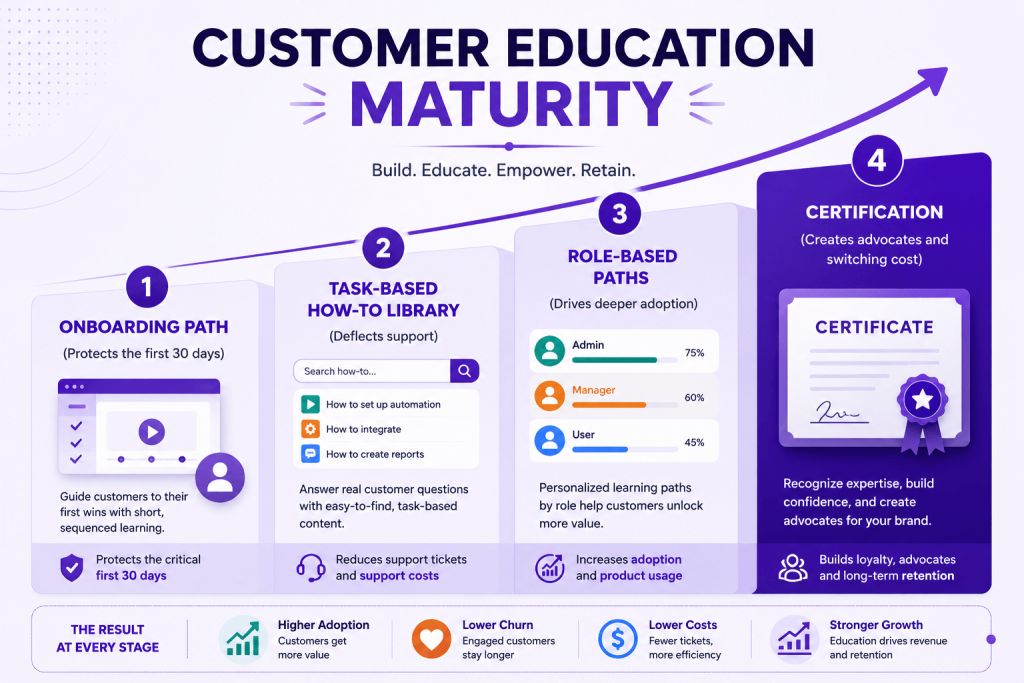
- An onboarding path. Short, sequenced, delivered in the first two weeks. This is the highest-return asset because it targets the thirty-day churn window directly.
- A task-based how-to library. Findable, searchable, mapped to the questions your support team answers most. This is where support deflection comes from.
- Role-based paths. Administrators, end users and executives need different things from the same product. One generic curriculum serves none of them well.
- Certification. The stage most teams skip, and the one that changes the relationship. A customer who holds a credential tied to your product has a professional reason to stay and a public reason to advocate.
That last point deserves emphasis. Certification converts your product knowledge into something that appears on a customer's CV and LinkedIn profile. It creates genuine switching cost that is entirely positive: the customer is not locked in, they are invested.
Measure business outcomes, not content views
Customer education programs get cut when they report the wrong numbers. Course completions and video views are activity metrics. They do not survive a budget review.
- Time to first value, meaning how quickly a new customer reaches their initial success milestone.
- Thirty-day and ninety-day retention for trained versus untrained cohorts.
- Support ticket volume on topics covered by training, before and after.
- Product adoption of the specific features your courses target.
- Net revenue retention and expansion among certified customers versus the rest.
Run trained and untrained cohorts side by side wherever you can. A comparison is far more persuasive than an absolute number, and it is how you convert a nice-to-have into a funded programme.
What you need from the platform
Customer education has requirements a purely internal LMS often does not:
- External learners, at volume and unpredictably. Your customer base is larger than your headcount and grows in ways you do not control, which is why per-seat pricing is a poor fit for this use case specifically.
- Self-service registration, since customers will not wait for an administrator to enrol them.
- Certification and credentials that customers can display.
- The option to sell, because customer education frequently becomes a revenue line once certification is involved.
- Reporting that ties completion back to account-level outcomes rather than only to individual learners.
MyPass LMS includes unlimited registered users on every plan, native ecommerce for paid courses and certifications, and certification workflows, which covers the shape of a customer academy without a separate storefront or a per-learner bill that grows with your customer base.
The bottom line
Customer education is one of the better-evidenced investments in customer success: measurable gains in retention and revenue, a substantial lift in product adoption, and meaningful reductions in support cost. It works because non-use, not price, is what most cancellations come down to. Start with one segment and one outcome, build the onboarding path first, measure against business metrics rather than content views, and add certification once the basics are working.
See the customer education solution, explore the platform features, or start a 15-day free trial.
Frequently asked questions
What is customer education?
Customer education is training delivered to customers so they succeed with a product, covering onboarding, task-based how-to content, role-based learning paths and sometimes certification. Its goal is faster time to value, higher adoption, lower support load and reduced churn.
Does customer education actually reduce churn?
The evidence is strong. Forrester research commissioned by Intellum found formalised programs deliver around a 7.4 percent increase in retention and a 6.2 percent increase in revenue, with roughly 90 percent of organizations reporting positive ROI. Around 20 percent of churn occurs in the first 30 days, the window education targets.
What should I build first in a customer academy?
An onboarding path covering the first two weeks. It targets the highest-risk churn window directly and is short enough to finish. Build the task-based how-to library second, role-based paths third, and certification once the fundamentals are working.
How do you measure customer education ROI?
Track business outcomes rather than content views: time to first value, 30 and 90 day retention for trained versus untrained cohorts, support ticket volume on covered topics, adoption of targeted features, and net revenue retention among certified customers.
Should customer education be free or paid?
Onboarding and basic how-to content should generally be free, since it protects retention and deflects support. Certification and advanced programmes are commonly paid, and often become a genuine revenue line, because a credential carries value the customer is willing to pay for.