Sell Courses Natively: Ecommerce Built Into MyPass LMS
MyPass LMS includes native ecommerce, so courses can be sold and the buyer enrolled automatically in the same system. This removes the gap that appears when a separate store handles payment and someone has to manually grant access afterwards, which is where delays, errors and refund requests usually originate.
On this page 7 sections
MyPass LMS includes native ecommerce, so courses can be sold and the buyer enrolled automatically in the same system. This removes the gap that appears when a separate store handles payment and someone has to manually grant access afterwards, which is where delays, errors and refund requests usually originate.
The gap between paying and learning
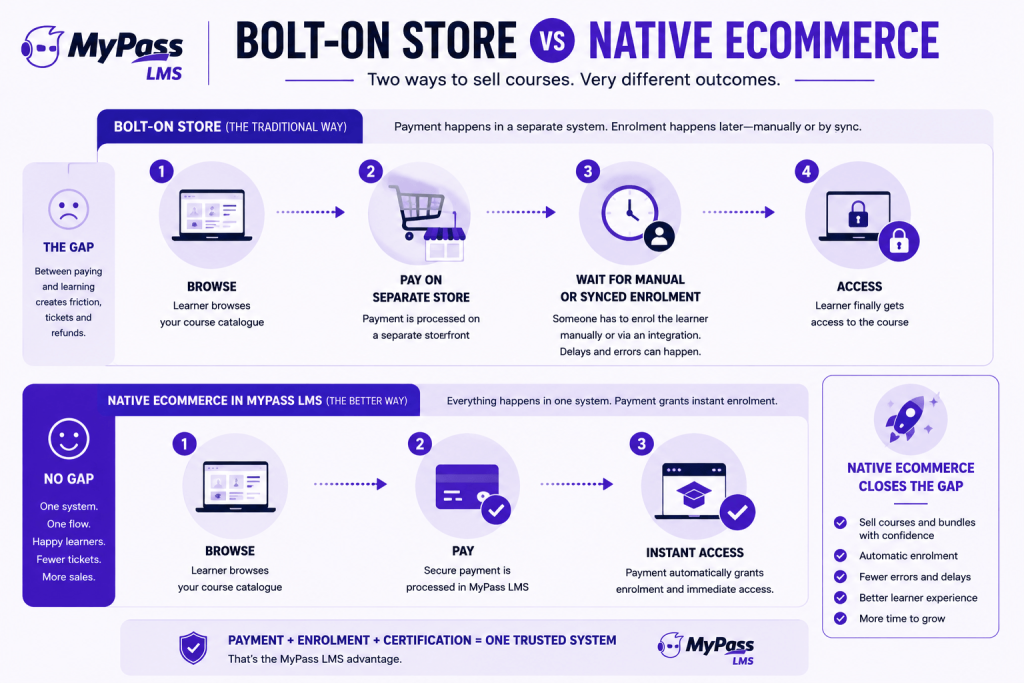
Selling training with a separate storefront looks fine on a diagram. Someone pays on your website, and then they get access to the course. The trouble is in the word then.
In practice that step is often a person checking a payment report and enrolling the buyer by hand, or an integration that works until it does not. Either way there is a window between someone paying and someone learning. For a customer who has just spent money and wants to start immediately, that window is the worst possible first impression, and it generates the support tickets and refund requests that quietly erode margins on course sales.
Native ecommerce closes the gap by making payment and enrolment the same event.
What native ecommerce includes
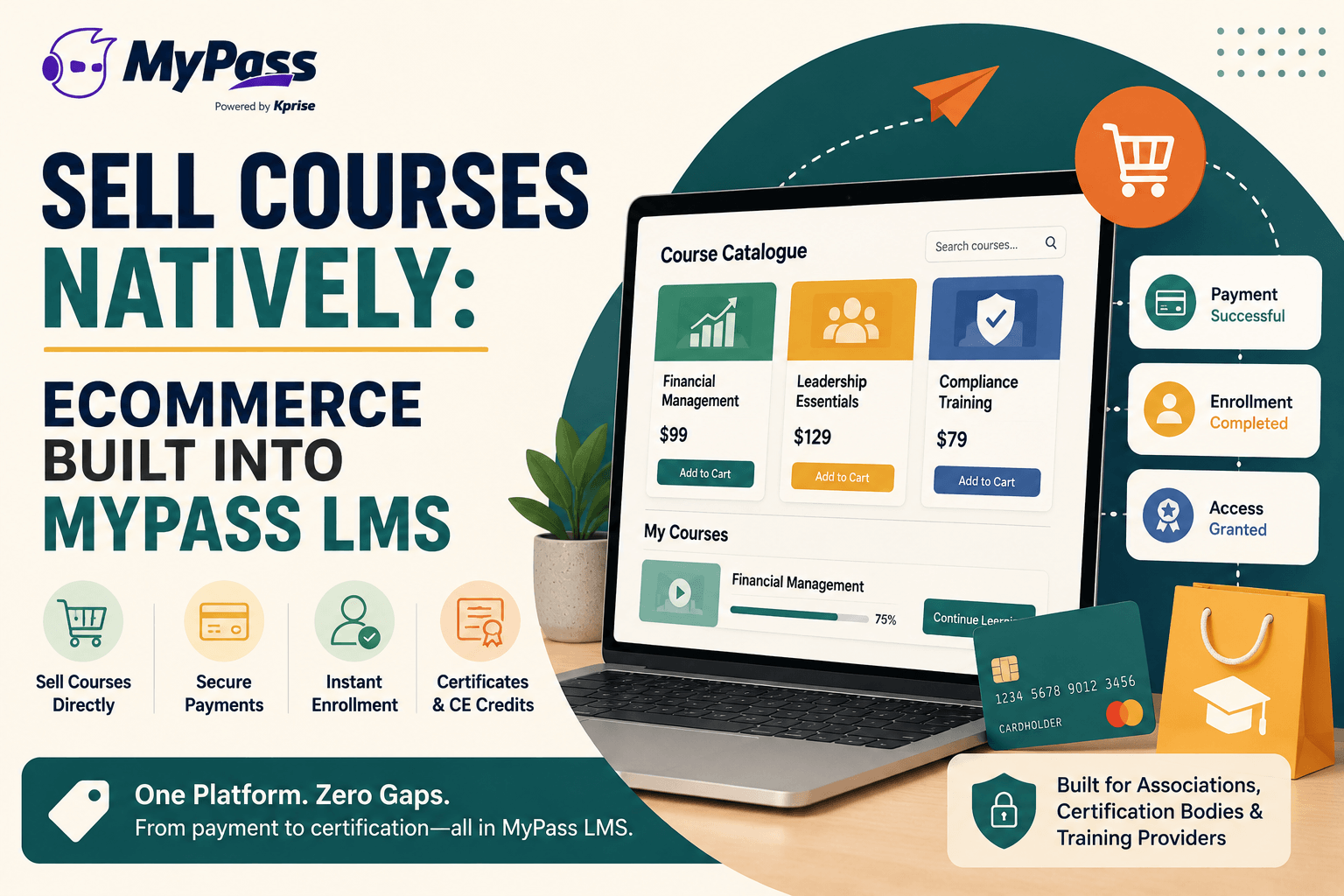
- A course catalogue buyers can browse and purchase directly, without a separate storefront to maintain.
- Payment handling with immediate, automatic enrolment on successful payment.
- Pricing per course or per bundle, so you can sell individual courses, packs or full programmes.
- Certification and CE credits attached to purchased courses, which matters for associations and certification bodies where the credential is what people are actually buying.
- A WordPress plugin for organizations whose public site runs on WordPress and who want the catalogue surfaced there.
- Sales, enrolment and completion data in one place, rather than reconciling a store's reports against an LMS's records.
Who this matters most for
- Associations selling continuing education to members and non-members, often at different prices, where the CE credit is the product.
- Certification bodies selling exam preparation and credentialing programmes, where purchase, assessment and certificate issuance need to be one connected record.
- Training providers and consultancies productising expertise they currently deliver only in person.
- Companies running customer or partner education as a revenue line rather than a cost centre.
Key point
For associations specifically, the pricing nuance matters more than the checkout. Member and non-member pricing, bundled member benefits and CE credit attachment are the things that break generic ecommerce integrations, because a general store does not know who is a member.
Where a dedicated course marketplace still wins
Worth being straight about this. If your primary need is discovery, meaning you want an existing audience of buyers to find your course, a consumer marketplace platform brings traffic that your own site does not. That is a genuine advantage and an LMS does not replicate it.
Native LMS ecommerce wins when you already have the audience, which is the normal situation for associations, certification bodies and companies selling to their own members, customers or partners. In that case you do not need discovery, you need the purchase to work cleanly and the credential to be trustworthy, and keeping payment, enrolment, assessment and certification in one system does that better than any integration between separate tools.
Many organizations sensibly do both: marketplaces for reach, their own platform for the programmes where the credential and the customer relationship matter.
Protecting what you sell
One consideration specific to paid content: the moment training becomes a product, its unauthorised distribution becomes a revenue problem rather than an inconvenience. This is why content protection sits alongside ecommerce rather than being a separate concern.
MyPass LMS includes DRM, protected document distribution, device-level access control and a secure document reader, so material you sell is not trivially forwarded to everyone who did not buy it. For organizations whose course library is a genuine asset, that protection is part of the commercial model rather than an add-on.
The bottom line
Selling courses through a separate storefront leaves a gap between payment and access, and that gap is where refunds, support tickets and bad first impressions come from. Native ecommerce makes purchase and enrolment a single event, keeps sales and completion data together, and lets certification and CE credits attach directly to what people buy. If you already have the audience, which associations, certification bodies and training providers usually do, keeping the whole transaction in one platform is the simpler and more reliable model.
See the platform features, browse the course library, or start a free trial.
Frequently asked questions
Can you sell courses directly from MyPass LMS?
Yes. MyPass LMS includes native ecommerce, so buyers can purchase courses or bundles and be enrolled automatically on successful payment, without a separate storefront or a manual enrolment step afterwards.
Why does native ecommerce matter compared with a separate store?
Because a separate store creates a gap between paying and gaining access, often filled by manual enrolment or a fragile integration. That delay generates support tickets and refund requests. Native ecommerce makes payment and enrolment the same event.
Can I sell courses with certification or CE credits attached?
Yes. Certification and continuing education credits can be attached to purchased courses, which matters particularly for associations and certification bodies where the credential rather than the content is what buyers are paying for.
Does MyPass LMS work with WordPress for selling courses?
Yes. A WordPress plugin is available, so organizations running their public site on WordPress can surface the course catalogue there while purchase, enrolment and tracking remain in MyPass LMS.
How do I stop paid course content being shared?
Content protection matters once training becomes a product. MyPass LMS includes DRM, protected document distribution, device-level access control and a secure document reader, so purchased material is not trivially forwarded to people who did not buy it.
Keep reading
Course design & delivery
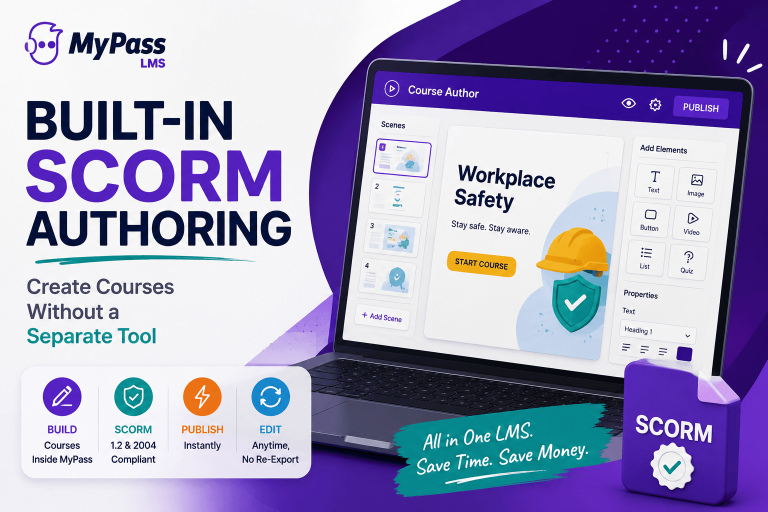
Built-In SCORM Authoring: Create Courses Without a Separate Tool
Course design & delivery
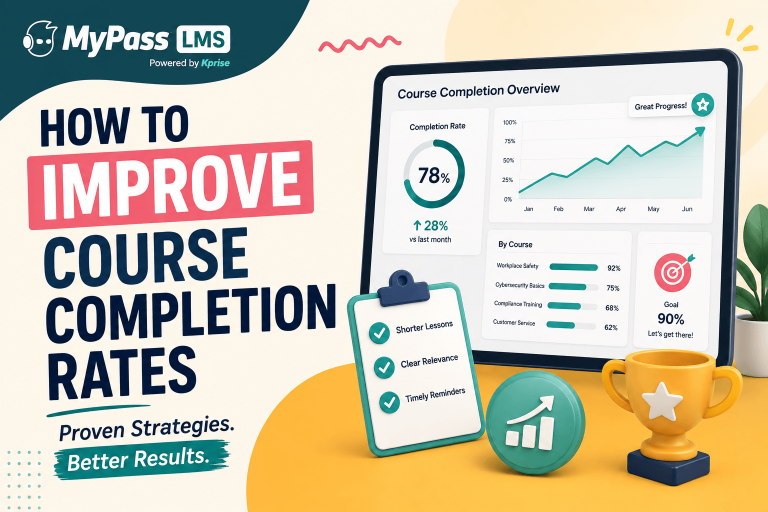
How to Improve Course Completion Rates
Course design & delivery