The single biggest driver of course completion is length. Industry data puts completion at roughly 17 to 25 percent for 30 to 60 minute modules, against 60 to 82 percent for microlearning under five minutes. Before adjusting reminders or incentives, shorten the content, because format beats motivation in almost every dataset.
Completion is a design problem, not a motivation problem
When completion rates are poor, the usual response is to blame learners: they are not engaged, they do not prioritise development, they need better reminders. Occasionally that is true. Far more often the content is simply too long for the space people have.
The numbers are stark. Average completion for long-form eLearning modules of 30 to 60 minutes runs at roughly 17 to 25 percent. For microlearning modules under five minutes, it runs at 60 to 82 percent. That is not a motivation difference. Same people, same organizations, different format.
It also matches what learners say. TalentLMS's 2026 research found time has been the biggest training barrier for employees three years running, and that half of HR managers say high workloads leave little room for training even when it is needed.
For mandatory training, low completion is a compliance problem
Before the fixes, it is worth naming the stakes for regulated training specifically, because this reframes completion from an engagement metric to a risk one.
If 40 percent of your workforce has not completed harassment training, your legal defence in a harassment claim is materially weakened, because that defence rests partly on having taken reasonable preventive steps. If 30 percent have not completed required safety training, you have a documented gap an inspector will find. In those cases the completion report is not a dashboard, it is evidence, and an incomplete one is evidence against you.
| A useful way to prioritise: for mandatory training, treat anything below full completion as an open compliance finding with a deadline, not as a percentage to improve gradually. |
The fixes, in order of impact
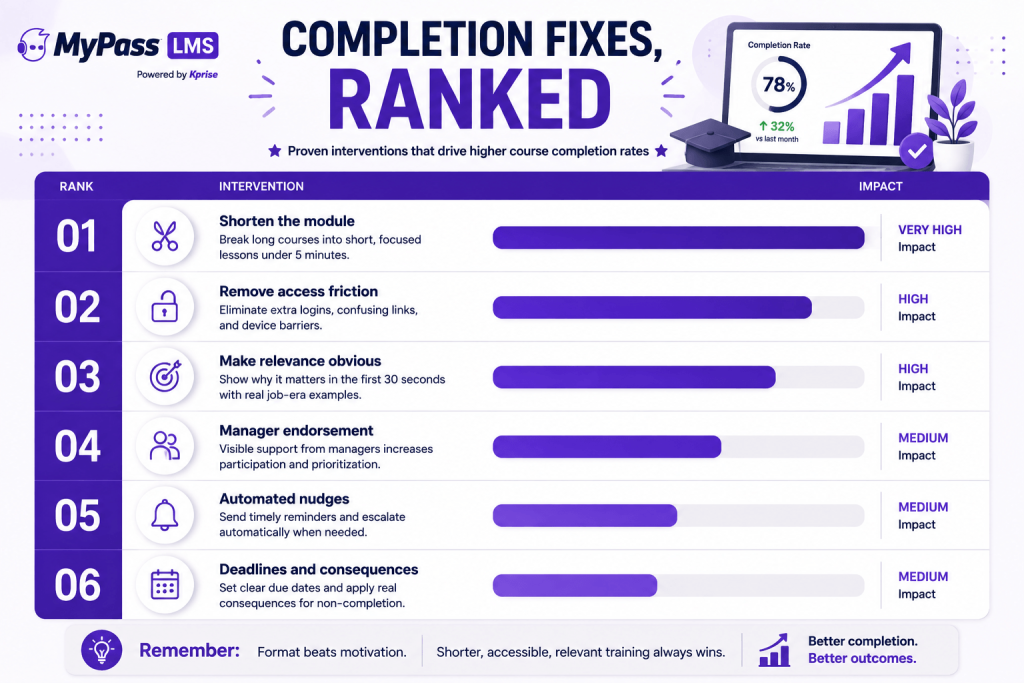
- Shorten it. Split a 45 minute module into six short ones with a clear objective each. Completion is measured per unit, and a learner who finishes four of six has learned considerably more than one who abandoned a long module at minute nine. Microlearning works for exactly this reason, though it suits refreshers and procedures better than complex judgment.
- Remove access friction. Every extra login, unclear link or device incompatibility costs completions. If frontline staff share devices or lack company email, enrolment mechanics matter more than content quality.
- Make relevance obvious in the first thirty seconds. Learners triage. If the opening does not answer why this matters to my job, the tab closes. Lead with the specific situation the training addresses.
- Get manager endorsement. Visible support from a direct manager consistently moves participation more than centrally issued reminders, because it signals that time spent is legitimate rather than stolen from real work.
- Automate nudges, and escalate. Reminders that fire on schedule, then escalate to a manager, outperform any amount of chasing by email. The point is that nobody has to remember to chase.
- Set real deadlines with real consequences, at least for mandatory training. Open-ended assignments finish last, permanently.
What generally does not work
- Better graphics. Production value is not the constraint. A beautifully produced 45 minute module still competes with a full inbox.
- Gamification bolted onto long content. Points and badges can help at the margin, but they do not rescue a format problem. If the module is too long, leaderboards will not fix it.
- Blanket reminder emails to everyone. Untargeted reminders train people to ignore reminders. Target the specific people who have not completed, and escalate.
- Blaming learner motivation. Occasionally accurate, usually the last refuge of an unexamined format.
Measure the right thing
One caution as you improve completion: completion is an activity metric, not an outcome. L&D leaders in 2026 are increasingly clear that course completions and satisfaction scores describe activity rather than impact, and leadership wants to know whether training improved performance.
So chase completion where it is genuinely the goal, meaning mandatory and compliance training where the record is the deliverable. Everywhere else, treat completion as a hygiene metric and measure whether behaviour changed, which is what effectiveness measurement and ROI are for. A hundred percent completion of training that changed nothing is a well-documented waste.
Make the mechanics automatic
Most of the fixes above are operational rather than creative, which means they should not depend on anyone remembering to do them:
- Automatic assignment by role, department or location, so the right people get the right training without list-building.
- Scheduled reminders and manager escalation, firing before deadlines rather than reporting misses afterwards.
- Renewal automation for recurring requirements, so annual training reassigns itself.
- Live completion visibility by team, so managers can see their own gaps rather than waiting for a central report.
That is the difference between a completion problem you fix once and one you fix every quarter forever.
The bottom line
If completion rates are poor, look at length before motivation. The gap between 17 to 25 percent for long modules and 60 to 82 percent for short ones is the largest single lever available, and it costs nothing but editing. Then remove access friction, make relevance obvious immediately, recruit managers, and automate reminders and escalation. For mandatory training, treat incomplete records as an open compliance finding rather than a metric to nudge along.
MyPass LMS automates assignment, reminders, escalation and renewals so completion stops depending on manual chasing. See the platform features, or start a 15-day free trial.
Frequently asked questions
What is a good course completion rate?
It depends heavily on format and whether training is mandatory. Industry data shows roughly 17 to 25 percent completion for 30 to 60 minute eLearning modules and 60 to 82 percent for microlearning under five minutes. For mandatory compliance training, anything short of full completion should be treated as an open gap.
Why are my training completion rates so low?
Length is usually the main cause. Long modules compete with full workloads, and time has been the biggest reported training barrier for employees for three years running. Access friction, unclear relevance and absent manager endorsement are the next most common causes.
How do I improve completion rates for mandatory training?
Shorten modules, automate assignment so the right people are enrolled without manual lists, set firm deadlines, and use scheduled reminders that escalate to managers. For compliance training, treat incomplete records as a documented risk rather than a metric to improve gradually.
Does gamification improve course completion?
It can help at the margin but rarely fixes the underlying issue. Points and badges attached to an overly long module do not solve a format problem. Shortening the content typically produces a far larger improvement than any engagement layer added on top.
Is completion rate a good measure of training success?
Only for mandatory training, where the completion record is itself the deliverable. Elsewhere it measures activity rather than impact. Leadership increasingly asks whether training changed performance, so pair completion with behaviour and business-outcome measures.