Microlearning delivers training in short, focused units, usually two to ten minutes, each targeting a single objective. It suits procedural knowledge, refreshers and just-in-time support, where learners need one specific thing quickly. It suits complex reasoning and nuanced judgment far less well, so it works best as part of a wider programme rather than as a replacement for it.
What microlearning actually means
Microlearning is training broken into short, self-contained units, each built around one clear objective. A two minute video on handling a specific customer objection is microlearning. A ninety minute compliance course chopped into nine ten minute chunks is not, it is just a long course with more clicking.
That distinction matters more than the length. The defining feature is that each unit stands alone and does one job. If a learner has to complete the previous five pieces for the sixth to make sense, you have segmented a course, not designed microlearning.
Why it works, when it works
The reasoning behind microlearning is sound and fairly well established:
- Attention is finite. A short, single-purpose unit is far more likely to be finished than a long one, and an unfinished course teaches nothing.
- Retrieval beats re-reading. Short units end with a check, which forces recall, and recall is what moves knowledge into long-term memory.
- Spacing beats cramming. Small units delivered across weeks let you space and repeat content, which is one of the more reliable findings in learning research.
- It fits the moment of need. Someone stuck mid-task will watch a two minute clip. They will not enrol in an hour-long module.
| → The clearest test of whether microlearning fits: could a learner use this unit on its own, at the moment they need it, without any surrounding context? If yes, it is a good candidate. If no, it belongs inside a longer structured course. |
Where microlearning is the wrong tool
Being honest about the limits is what separates useful advice from a trend piece. Microlearning is a poor fit for:
- Complex reasoning and judgment. Ethical decision-making, difficult conversations and clinical reasoning need discussion, scenarios and time. Two minutes cannot build judgment.
- Content that only makes sense as a whole. Some material genuinely requires a sustained argument, and chopping it up destroys the thread.
- First exposure to a difficult subject. Microlearning excels at reinforcing and refreshing. It is weaker at introducing something entirely new and demanding.
- Anything requiring supervised practice. You cannot certify a practical skill through short videos alone.
Used badly, microlearning becomes a way to appear to be training people while teaching nothing. The organizations that get value from it treat it as one format among several, not as a philosophy.
Practical examples that work
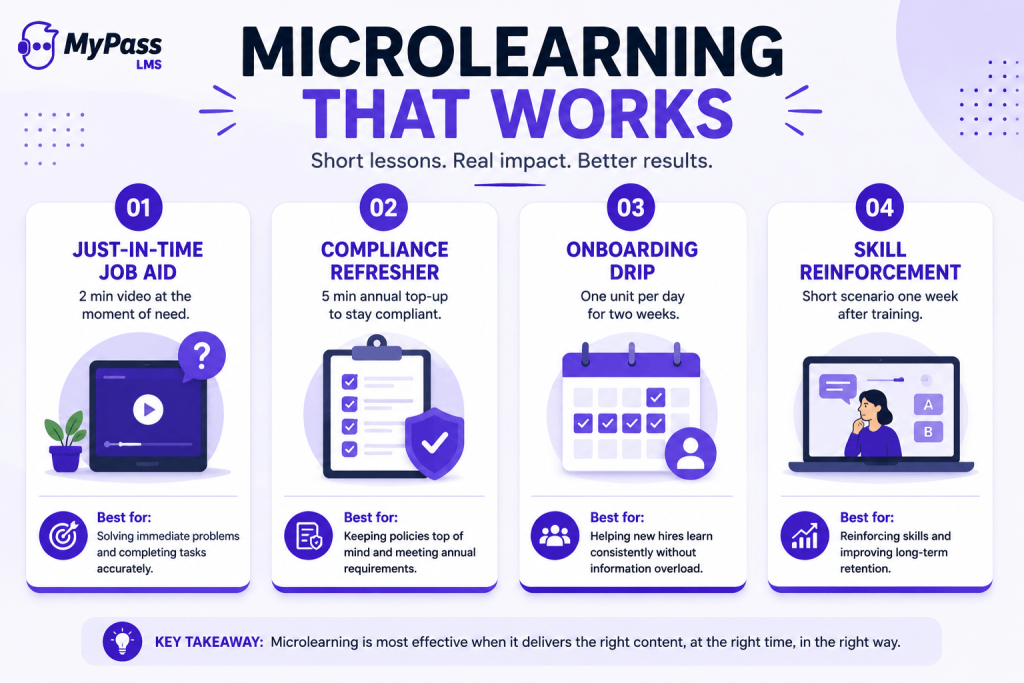
- Just-in-time job aids. A short clip showing exactly how to complete one process step, findable from search inside the platform.
- Compliance refreshers. Rather than repeating a full course annually, a short refresher plus a knowledge check, with the full course reserved for new hires.
- Onboarding drips. One short unit per day for the first two weeks, so a new hire is not drowned on day one. This pairs well with a structured 30-60-90 day plan.
- Reinforcement after live training. A short scenario delivered a week after a workshop, which is when forgetting is steepest.
- Product and process updates. When something changes, a two minute update beats a memo nobody reads.
Four design rules
- One objective per unit. If you cannot state the objective in a single sentence, split it.
- Make it findable. Microlearning used as reference material needs search and clear titles, or it is invisible at the moment of need.
- End with retrieval. A single question that forces recall is worth more than a summary slide.
- Space it deliberately. Schedule reinforcement across weeks rather than releasing everything at once.
The last two are where most programmes fall down. Delivering short content is easy. Scheduling it intelligently and tracking whether it actually landed is the part that needs a platform behind it, so that assignment, spacing and completion tracking happen automatically rather than living in someone's calendar.
The bottom line
Microlearning works when each unit is genuinely self-contained, built around one objective, findable at the moment of need, and spaced deliberately over time. It is excellent for refreshers, job aids, onboarding drips and reinforcement, and poor for complex judgment or first exposure to difficult material. Treat it as one format in a wider programme, and it earns its place. Treat it as a replacement for training design, and it becomes activity without learning.
MyPass LMS handles the scheduling and tracking that microlearning depends on, including automatic assignment, spaced delivery and completion records. See the platform features, or start a free trial.
Frequently Asked Questions
What is microlearning?
Microlearning is training delivered in short, self-contained units, typically two to ten minutes, each built around a single objective. The defining feature is that each unit stands alone and can be used at the moment of need, rather than requiring the units before it.
How long should a microlearning unit be?
Usually two to ten minutes, but length matters less than focus. A unit should cover one objective completely. If it needs longer than about ten minutes, the objective is probably too broad and should be split.
What are good examples of microlearning?
Just-in-time job aids, annual compliance refreshers, onboarding drips of one unit per day, reinforcement scenarios delivered a week after live training, and short product or process update clips.
When should you not use microlearning?
For complex reasoning and judgment such as ethical decisions or clinical reasoning, for content that only makes sense as a sustained whole, for first exposure to difficult new material, and for skills requiring supervised practice.
Is microlearning better than traditional training?
Neither is better in general. Microlearning outperforms long courses for refreshers, job aids and reinforcement. Longer structured formats outperform it for building judgment, teaching complex new material and certifying practical skills. Most effective programmes use both.