Microlearning for Frontline and Shift Workers: Training That Fits
On this page 7 sections
Short answer
Microlearning delivers training in small, focused pieces, a few minutes each, which suits frontline and shift workers who can't step away for long sessions. It works because short lessons fit real gaps in a shift, hold attention better, and, spaced over time, actually stick. For frontline teams it's often the only format that realistically gets completed.
Five Minutes Is What You've Actually Got
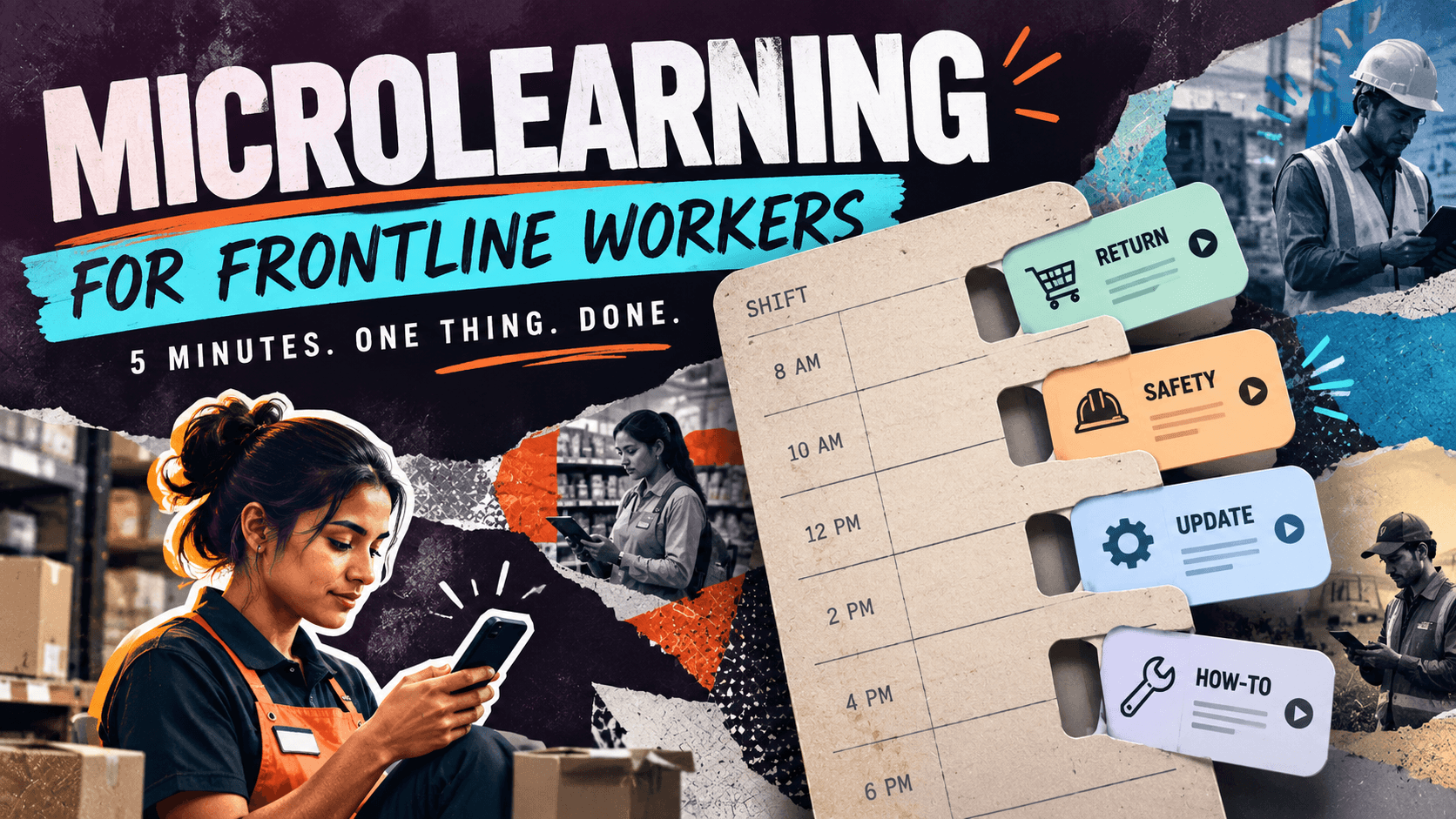
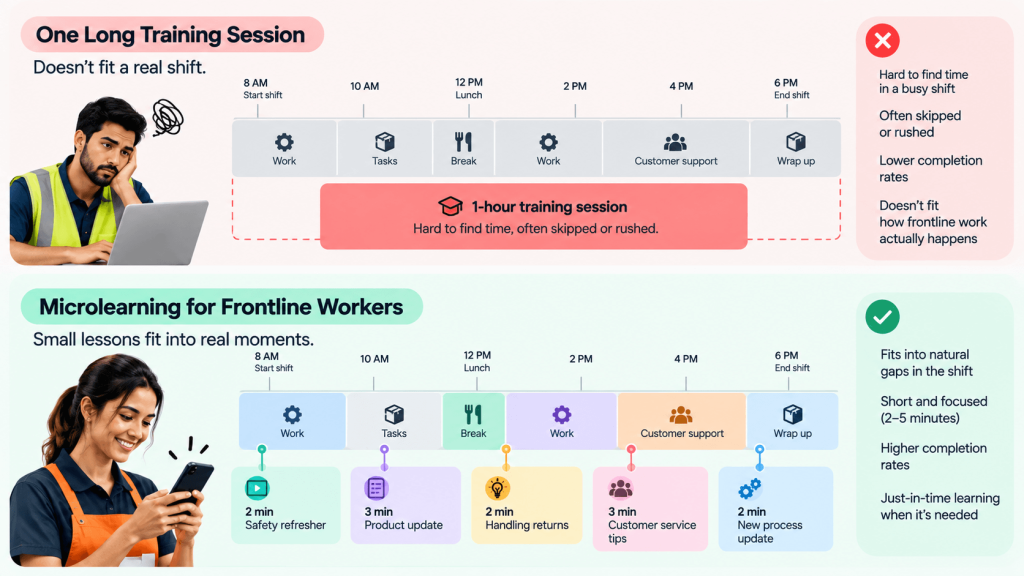
Picture asking a retail associate on a busy Saturday, or a machine operator mid-shift, to sit down for a one-hour training course. It's not going to happen, and if you force it, you'll get a resentful person clicking through to get back to work. Frontline and shift workers don't have long, uninterrupted blocks for training. What they have is five minutes here and there: a lull, a break, the gap between tasks.
Microlearning is training designed to fit exactly those small windows. Instead of one long course, you deliver small, focused pieces, each covering one thing in a few minutes. For frontline teams, this isn't just a nicer format, it's often the only one that realistically gets done. A five-minute lesson fits a real shift; a sixty-minute course doesn't.
Key point
The question isn't whether an hour-long course is better in theory. It's whether a frontline worker will ever actually complete it. Five one-minute lessons they finish beat a one-hour course they don't, every time.
Why Small Actually Works Better
Microlearning isn't just a compromise for busy people, it genuinely helps learning, for reasons rooted in how memory and attention work. It's not only easier to fit in; it tends to stick better too.
- It fits attention: a few minutes on one thing holds focus in a way an hour never does.
- It's less overwhelming: one idea at a time is easier to absorb than a firehose.
- It spaces naturally: short lessons over days beat one long session for retention.
- It's findable: a worker can pull up the exact two-minute refresher they need, when they need it.
- It gets finished: short means completed, and completed training is the only kind that works.
What It Looks Like in Practice
Microlearning for frontline teams is concrete, not abstract. In retail, it might be a two-minute refresher on handling a specific return, or a short visual on a new promotion, delivered to the associate's phone before their shift. In manufacturing, a quick safety reminder on a particular machine, or a one-minute update when a procedure changes. In field work, a short how-to a technician can pull up on-site at the exact moment they need it.
The common thread is one thing, done briefly, delivered to a phone, usable in the flow of real work. It's not watered-down training; it's training sized to reality. A good microlearning approach breaks what workers need to know into these small, specific pieces and delivers them when they're most relevant, rather than dumping everything into one session nobody has time for.
Where It Fits, and Where It Doesn't
Microlearning is powerful, but it's a tool, not a cure-all, and being honest about its limits makes you use it better. It's brilliant for reinforcing knowledge, delivering updates, refreshing procedures, and covering discrete skills, exactly the steady drip of training frontline work needs. It's less suited, on its own, to deep, complex topics that genuinely need sustained attention or hands-on practice.
The best approach usually blends them: microlearning for the ongoing, bite-sized majority, and longer or hands-on sessions for the few things that truly need them. For frontline and shift workers specifically, the balance tips heavily toward microlearning, because the realities of their day leave little room for anything else, but knowing when a topic needs more than five minutes keeps your training honest.
Key point
Use microlearning for the steady stream, refreshers, updates, discrete skills, and reserve longer or hands-on sessions for the few topics that genuinely need them. Matching format to the topic beats forcing everything into one shape.
How MyPass LMS Supports Microlearning
MyPass LMS lets you deliver training as the small, phone-friendly pieces frontline and shift workers can actually fit in. You break content into short modules, deliver them mobile so they reach workers on the floor, and schedule them over time so learning is spaced for retention rather than crammed.
Automated delivery and reminders keep the steady drip going without manual effort, and reporting shows what's completed and where people engage. Because the platform makes short, mobile, self-paced lessons easy to build and assign, microlearning stops being a nice idea and becomes something you actually run. And with flat pricing and unlimited registered users, delivering a steady stream of microlearning to your whole frontline doesn't add per-seat cost.
Key point
Take one thing your frontline needs to know and turn it into a single two-minute mobile lesson. Starting with one small, genuinely useful piece teaches you more about microlearning than planning an elaborate program you never ship.
The bottom line
Frontline and shift workers don't have an hour for training, they have five minutes, so microlearning, small focused pieces delivered to their phones, is often the only format that realistically gets completed. It also genuinely helps learning: short lessons fit attention, reduce overwhelm, space naturally for retention, and actually get finished.
Use it for the steady stream of refreshers and updates frontline work needs, and reserve longer sessions for the few topics that truly require them. See how short, mobile, scheduled lessons work in MyPass LMS features, read about microlearning, or start a free trial.
Frequently asked questions
What is microlearning for frontline workers?
Microlearning delivers training in small, focused pieces, usually a few minutes each, that fit the short windows frontline and shift workers actually have: a break, a lull, the gap between tasks. Instead of one long course, workers get bite-sized lessons on one thing at a time, delivered to their phones. For frontline teams it's often the only format that realistically gets completed, because a five-minute lesson fits a real shift while an hour-long course doesn't.
Why is microlearning good for shift workers?
Because shift workers can't step away for long training sessions, but they can fit a few minutes here and there, which is exactly what microlearning is sized for. Beyond fitting their time, short lessons hold attention better, reduce overwhelm by covering one thing at a time, space naturally over days to aid retention, and actually get finished. For people whose day leaves no room for a long course, microlearning is the difference between training that happens and training that doesn't.
What are examples of microlearning for frontline teams?
In retail, a two-minute refresher on handling a specific return or a short visual on a new promotion before a shift. In manufacturing, a quick safety reminder on a particular machine or a one-minute update when a procedure changes. In field work, a short how-to a technician pulls up on-site exactly when needed. The common thread is one thing, done briefly, delivered to a phone, and usable in the flow of real work rather than in a classroom.
Can microlearning replace all frontline training?
Not entirely, and it's more honest to treat it as the main tool rather than the only one. Microlearning is excellent for reinforcing knowledge, delivering updates, refreshing procedures and covering discrete skills, the steady drip frontline work needs. It's less suited on its own to deep, complex topics that need sustained attention or hands-on practice. The best approach blends them, with the balance tipped heavily toward microlearning for frontline staff because their day leaves little room for anything longer.
Keep reading
Course design & delivery
How to Train Deskless Workers (When They're Never at a Desk)
Course design & delivery
Mobile Learning: Training That Reaches Frontline and Field Teams
Course design & delivery
Best LMS for Retail and Frontline Teams in 2026 (10 Compared)
Course design & delivery