Retail training platforms are judged on constraints most vendors do not design for: high turnover, seasonal hiring spikes, staff without company email addresses, shared devices and very short available time. Prioritise fast enrolment, mobile and shared-device access, short content and pricing that absorbs churn without penalty.
Retail is the hardest environment most LMS platforms meet
A corporate LMS assumes a stable workforce with individual laptops, company email addresses and time at a desk. Retail has none of those things. Turnover is high, a seasonal intake can double headcount for eight weeks, staff often share a back-office terminal or use their own phones, and the available training window is the fifteen minutes before a shift.
So the question is not which platform has the richest feature set. It is which platform still functions when a new starter needs to be trained, verified and on the floor within two days, and when four hundred of them arrive in November.
What retail actually needs
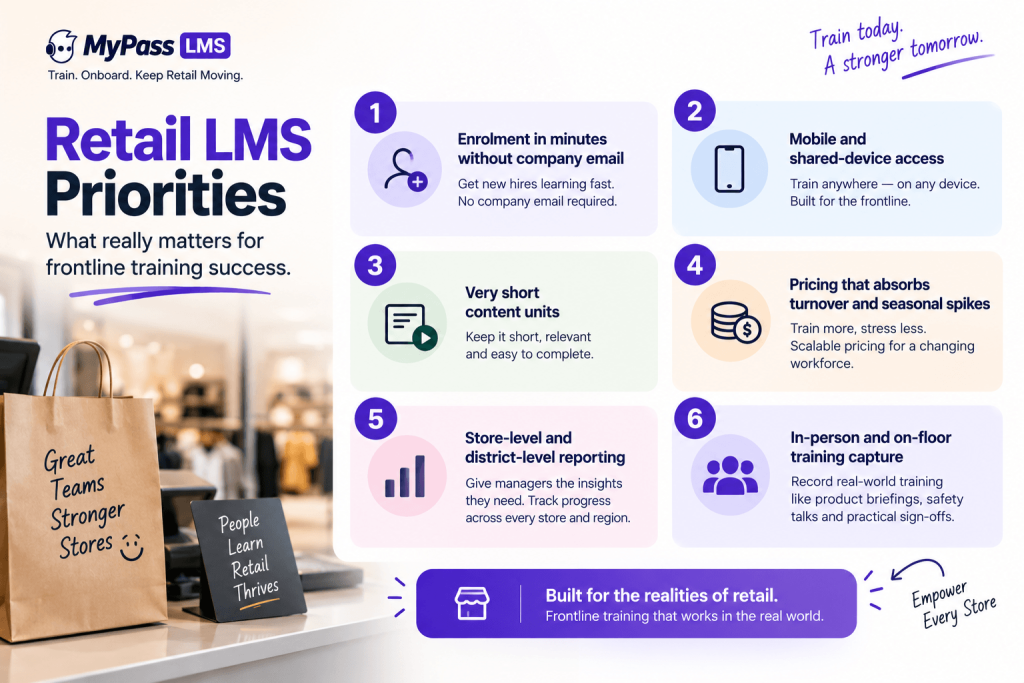
- Enrolment that takes minutes, without assuming a company email address. If your platform requires one per learner, a large share of your workforce cannot be enrolled without workarounds that will not survive a busy season.
- Mobile and shared-device access. Training happens on a phone in a break room or on a shared terminal. A desktop-first experience tested only on desktops will disappoint in exactly the environment that matters.
- Very short units. Retail has no half-hour blocks. Short modules complete dramatically better everywhere, and in retail the difference is decisive rather than marginal.
- Pricing that absorbs turnover. If you pay per seat, high churn and seasonal spikes turn normal retail staffing into an unpredictable software bill, and you start rationing who gets trained.
- Store, region and district reporting. A district manager needs their own stores' completion, not a company-wide percentage.
- Capture of on-floor training. Product briefings, safety talks and practical sign-offs happen in the store, and if they are recorded on paper they effectively did not happen.
| The evaluation test for retail: show me how a seasonal hire with no company email, using a shared back-office terminal, gets enrolled, completes required training and appears in a store-level compliance report, all within 48 hours of starting. Many polished demos quietly assume this away. |
The compliance layer retail underestimates
Retail carries more mandatory training obligations than most people outside HR realise, and several are timing-sensitive in ways that clash directly with seasonal hiring.
- Harassment prevention, where state requirements differ substantially and California requires seasonal and temporary employees to be trained within 30 calendar days of starting.
- Workplace violence prevention, which is the fastest-growing mandate area, with retail among the highest-exposure sectors.
- OSHA safety training tied to the tasks people actually perform, including manual handling and equipment use.
- Alcohol server training in states that mandate it, which is role and location specific.
- Washington's isolated-worker rules, expanded in January 2026, which cover retail among other sectors.
The combination of high turnover and short compliance deadlines is precisely why manual assignment fails in retail. Somebody must be assigned the right training on their start date, in their state, for their role, without anyone remembering to do it.
How the options compare
An honest read. [General 2026 market positioning; confirm capability and pricing with vendors.]
- Frontline-specific platforms. Several mobile-first tools are built for deskless workforces and do the short-content, phone-first experience genuinely well. They are often lighter on formal compliance records, SCORM support and audit reporting, which matters when a regulator asks for evidence.
- TalentLMS. Easy to set up with published pricing, which suits smaller retailers. Active-user brackets mean seasonal spikes can push you into a higher tier for a few months of the year.
- Docebo and enterprise platforms. Strong capability and analytics for large retail groups with procurement teams and administrators, though quote-based pricing and configuration depth are a poor fit for a lean team that needs to move fast.
- Moodle. Free to self-host, but the default experience is not built for shared-device frontline use and you carry hosting and maintenance, which is rarely a good trade for a retail operations team.
- MyPass LMS. Unlimited registered users on every plan, so turnover and seasonal spikes carry no per-seat cost, with automatic role and location based assignment, in-person attendance capture and audit-ready reporting included.
Why unlimited users matters more in retail than anywhere else
Retail turnover means you may enrol substantially more people over a year than you employ at any moment. Under per-seat pricing you face an unattractive choice: pay for accounts belonging to people who left, spend administrative time deprovisioning constantly to control cost, or delay enrolling new starters until you are sure they will stay.
That third option is the one organizations quietly take, and it is the one that creates compliance gaps, because the untrained period is exactly the early-tenure window when incidents are most likely and when several state deadlines are running.
Unlimited registered users removes the tension. Enrol everyone on day one, keep the record when they leave, and pay for infrastructure capacity rather than headcount churn.
Where MyPass LMS fits, and where it does not
MyPass LMS suits retailers that need compliance-grade records alongside frontline delivery: automatic assignment by role, location and state, unlimited users through turnover and seasonal peaks, in-person training capture for on-floor sessions, and reporting that a district manager or an inspector can be shown immediately.
Where it is not the obvious pick: if your requirement is purely short-form mobile engagement content with no formal compliance, certification or SCORM component, a frontline-specific engagement tool may fit that narrower job more neatly. The trade is that those tools generally document less rigorously, which becomes the deciding factor the moment a regulator asks for evidence.
The bottom line
The best LMS for retail is the one that still works under retail conditions: enrolment in minutes without assuming company email, mobile and shared-device access, very short units, store-level reporting, and pricing that absorbs turnover and seasonal spikes without penalty. Layer on the compliance obligations retail actually carries, including tight deadlines for seasonal staff, and automatic assignment by role and location stops being a nice feature and becomes the control that keeps you compliant.
MyPass LMS includes unlimited registered users, role and location based assignment and in-person attendance capture on every plan. See the retail industry page, browse compliance courses, or start a 15-day free trial.
Frequently asked questions
What is the best LMS for retail?
The best retail LMS handles fast enrolment without company email addresses, mobile and shared-device access, very short content, store-level reporting, and pricing that absorbs turnover. Frontline-specific tools suit engagement-led programmes, while platforms such as MyPass LMS suit retailers needing compliance-grade records too.
How do you train retail staff who don't have company email?
Choose a platform that does not require an individual email address per learner and supports shared-device or kiosk access. This is one of the most common ways general-purpose learning platforms fail in retail, so test it specifically during evaluation rather than assuming it works.
What compliance training does retail require?
Commonly harassment prevention with state-specific rules, workplace violence prevention where mandated, OSHA safety training tied to actual tasks, and alcohol server training in states requiring it. Requirements vary by state and role, and several carry tight deadlines for new and seasonal staff.
How quickly must seasonal retail hires be trained?
It depends on the state. California requires seasonal and temporary employees to complete harassment prevention training within 30 calendar days of their start date, which is materially shorter than the six-month window applying to regular hires.
Why does per-seat pricing cause problems in retail?
Because turnover means you enrol far more people across a year than you employ at once, and seasonal spikes add temporary volume. Per-seat pricing pushes teams to delay enrolling new starters, which creates compliance gaps precisely during the early-tenure window when state deadlines are running.