There is no federal harassment training mandate. Eight US jurisdictions require it for private employers, including California, Connecticut, Delaware, Illinois, Maine and New York, with Washington and Virginia applying narrower rules. Chicago, New York City and Washington DC add local requirements. Frequency, duration and covered staff differ in every one.
Why this is hard to get right
Harassment training is one of the few compliance areas where the federal government sets no training requirement at all, while individual states set very specific ones. Title VII prohibits harassment, and the EEOC treats regular interactive training as a promising prevention practice, but it does not require it nationally.
The result is a patchwork. An employer with staff in California, Illinois and Texas faces a two-hour biennial requirement in one state, an annual requirement in another, and no mandate in the third, while still wanting training everywhere for legal-defence reasons. Getting the matrix wrong in either direction is costly: undertrain and you have a compliance gap, overtrain and you have spent budget without reducing risk.
| This article is general information, not legal advice. State requirements change frequently, and both Illinois and New York have amended theirs since first passage. Confirm your specific obligations with employment counsel. |
What changed recently
Three developments worth knowing if your last review was more than a year ago:
- Washington's 2SHB 1524 took effect on 1 January 2026. The state's existing isolated-worker mandate, covering hotels, motels, retail, property services and security guard contractors, now requires all managers and supervisors at covered employers to complete sexual harassment and assault prevention training, on a biennial cycle. A recordkeeping deadline of 31 January 2027 applies to property services contractors submitting annual data.
- The EEOC rescinded its 2024 Enforcement Guidance on Harassment in January 2026. State and local training mandates are unaffected by this, and it does not change any employer's obligations under state law.
- California's biennial cycle means employers who last trained in 2024 are due refreshers during 2026.
The federal BE HEARD Act was reintroduced in February 2026 but is not law, so nothing in it creates an obligation today.
Which jurisdictions actually mandate training
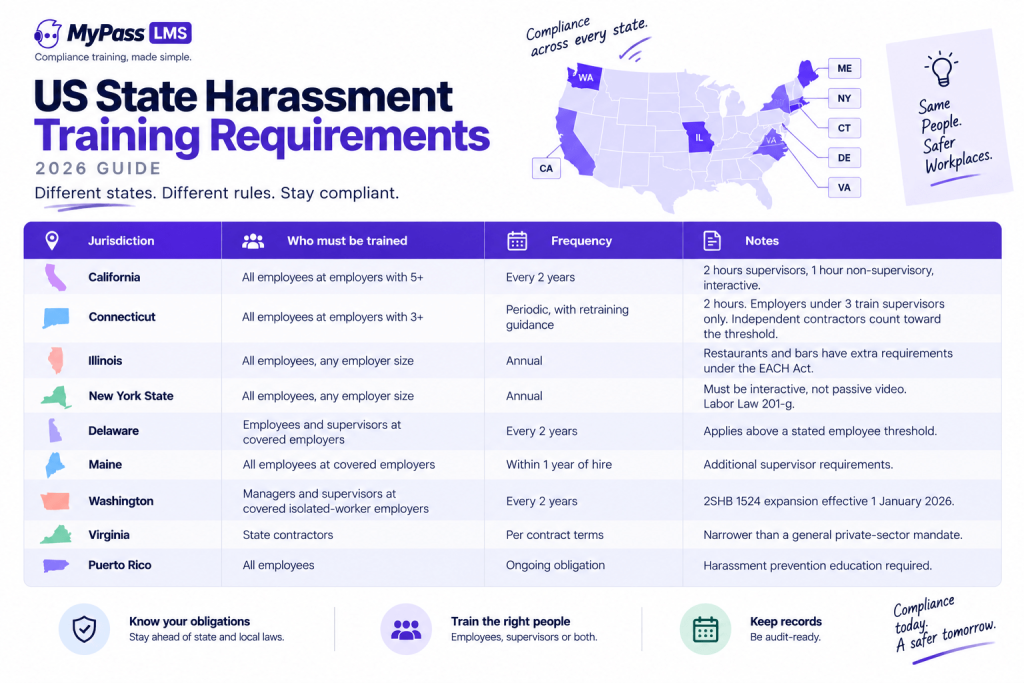
Three cities add requirements on top of state law: Chicago, New York City and Washington DC. Washington DC's rule under the Tipped Wage Workers Fairness Amendment Act specifically covers employers of tipped employees.
Five states formally recommend training without mandating it: Colorado, Massachusetts, Oregon, Rhode Island and Vermont. Oregon additionally requires training every two years for employers with six or more employees under ORS 659A.370, with new employees trained within 180 days of hire.
The timing rules that catch employers out
Most compliance failures are not about whether training happened but when. The deadlines are role-based and tighter than people expect:
- New hires. California requires training within six months of hire. Connecticut requires it within six months. Oregon allows 180 days.
- Newly promoted supervisors. California requires new supervisors to complete training within six months of assuming the role, which means a promotion triggers a fresh deadline regardless of when they last trained as an employee.
- Seasonal and temporary staff. California requires training within 30 calendar days of the start date for seasonal and temporary employees, which is a materially shorter window and the one most commonly missed in retail and hospitality.
- Part-time and temporary workers. Illinois covers all employees performing work in Illinois, including part-time and temporary staff.
| The 30-day seasonal rule is the single most frequently missed requirement, because seasonal intake is exactly when HR capacity is lowest. If you hire seasonally in California, automated assignment on start date is not a convenience, it is the control that keeps you compliant. |
What the training itself must contain
Several states specify content, not just duration. Common requirements include the legal definition of harassment under that state's law, practical examples using realistic workplace scenarios rather than abstractions, the employer's internal reporting process, available legal remedies, and supervisor-specific responsibilities.
Two content points worth noting specifically:
- New York requires training to be interactive. A passive video with no interaction does not satisfy the requirement.
- California emphasises practical application, expecting scenarios drawn from case law and realistic workplace situations, delivered through methods such as role play, case studies and discussion. It also requires coverage of abusive conduct as defined under California law.
This is why generic off-the-shelf courseware often needs a supplement. A bought course can cover the law well and cannot know your reporting route or your named contacts, so pairing it with a short custom module covering your own process is usually the highest-value hour of content you can produce.
Why you should train even where it is not required
In the roughly 35 states with no mandate, training remains strongly advisable, and the reason is legal rather than aspirational.
The Supreme Court's Faragher and Ellerth decisions established an affirmative defence for employers who can show they exercised reasonable care to prevent and correct harassment. Training is a central component of demonstrating that care. So in a state with no mandate, incomplete training is not a compliance violation, but it can materially weaken your position if a claim is brought.
This is also why completion rates matter more here than anywhere else. A programme where 60 percent of staff completed is not 60 percent of a defence. In practice, the gap is what opposing counsel will focus on.
Managing this across multiple states
- Assign by work location, not by headquarters. Requirements follow where the employee works, so a remote employee in New York triggers New York's annual requirement regardless of where your office is.
- Assign by role as well as location, since supervisor requirements differ from employee requirements in duration and content in several states.
- Automate the timing rules. Six months from hire, six months from promotion and 30 days for seasonal staff are impossible to track reliably by hand across multiple states.
- Track the biennial and annual cycles separately, because a single renewal rule will not fit California and Illinois simultaneously.
- Keep dated, tamper-evident records. Audit-ready documentation is the deliverable, since in any dispute the question is what you can evidence.
- Review annually. This area changes every legislative session, and both Illinois and New York have already amended their rules.
The bottom line
There is no federal harassment training requirement, and eight jurisdictions plus three cities impose their own, each with different frequency, duration, covered staff and content rules. Washington's expanded mandate took effect in January 2026, and California employers who trained in 2024 are due refreshers now. Assign by work location and role, automate the timing rules including the 30-day seasonal window, and keep dated records, because even where training is not mandated it forms part of your reasonable-care defence.
MyPass LMS assigns training automatically by role and location, tracks annual and biennial renewal cycles separately, and keeps audit-ready records. See the compliance solution, browse harassment prevention courses, or start a 15-day free trial.
Frequently asked questions
Which states require sexual harassment training?
Eight jurisdictions have broad private-sector mandates: California, Connecticut, Delaware, Illinois, Maine and New York, with Washington applying an industry-specific rule and Virginia covering state contractors. Puerto Rico also requires harassment prevention education. Chicago, New York City and Washington DC add local requirements.
Is harassment training required by federal law?
No. Title VII prohibits harassment but establishes no training requirement for private employers. The EEOC identifies regular interactive training as a promising prevention practice while stating it is not itself a federal legal requirement. State and local mandates are where obligations arise.
How often is harassment training required?
It varies. Illinois and New York require annual training. California, Delaware and Washington operate on a two-year cycle. Oregon requires training every two years for employers with six or more employees. Timing also depends on hire date, promotion date and employment type.
How long must harassment training be?
California requires two hours for supervisors and one hour for non-supervisory employees. Connecticut requires two hours. Other states specify content rather than duration. Always check the specific state rule, since duration requirements are not uniform.
Do seasonal and temporary employees need harassment training?
In several states, yes, and often on a shorter deadline. California requires seasonal and temporary employees to be trained within 30 calendar days of their start date. Illinois covers all employees performing work in the state, including part-time and temporary staff.
Should we train employees in states with no mandate?
Generally yes. The Faragher and Ellerth decisions created an affirmative defence for employers who exercised reasonable care to prevent and correct harassment, and training is central to demonstrating that care. Incomplete training in an unmandated state is not a violation but can weaken your legal position.