| The best LMS for government handles large-scale mandatory training with strict security and accessibility, and tight budget accountability. Look for robust compliance and audit reporting, strong security and data handling, accessibility (so training meets public-sector standards), the ability to train large numbers of staff, and predictable, defensible pricing. |
What Makes This Industry Different
Government and public-sector training has a particular shape. There's a lot of it, much of it mandatory, it has to reach large numbers of employees, and it's held to high standards: security, accessibility, and the kind of documentation that survives scrutiny. Public money also means every spend has to be justified, so an unpredictable or per-seat pricing model is a real problem, not just an annoyance.
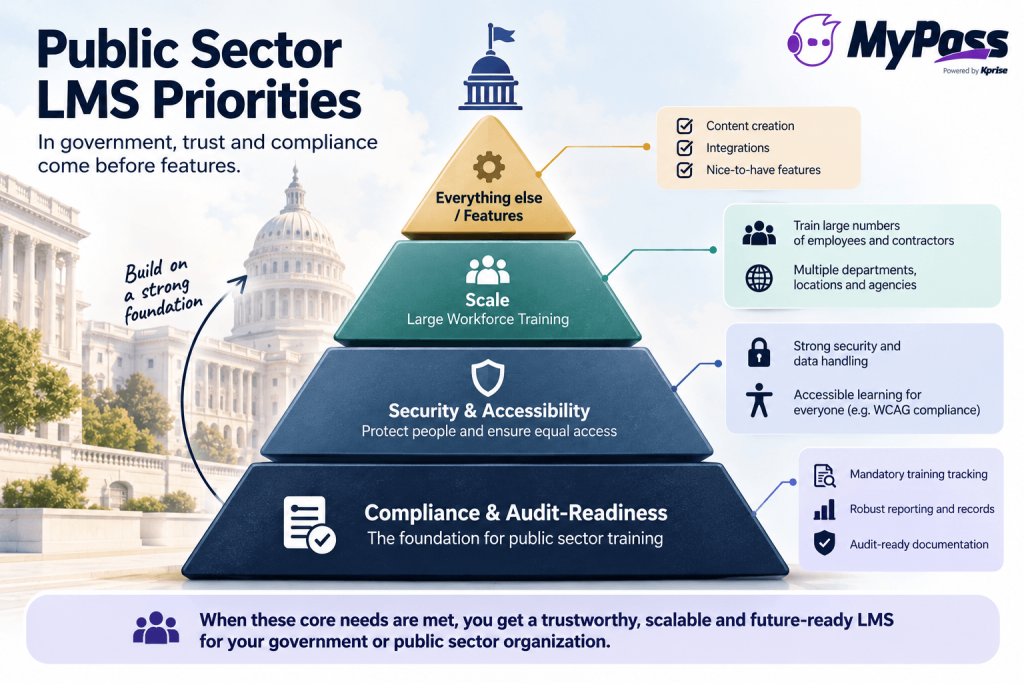
So choosing an LMS for the public sector is less about flashy features and more about trust, compliance and scale. Can it handle mandatory training for a large workforce? Does it meet security and accessibility expectations? Will it produce the records an audit demands? And is the cost predictable enough to defend? Those questions matter far more here than in most sectors.
| In government, 'can it prove it' is as important as 'can it do it.' Mandatory training that isn't documented to an auditor's satisfaction is a finding waiting to happen. Reporting and record-keeping aren't an afterthought in the public sector, they're central. |
What to Look for in an LMS
Generic 'best LMS' lists miss what actually matters for your sector. Here's what to weigh, based on the realities of the work, not a feature checklist.
- Strong compliance and audit reporting, because mandatory training must be provable.
- Security and careful data handling, appropriate to public-sector requirements.
- Accessibility, so training meets the standards the public sector is held to.
- Scale, the ability to train large numbers of employees reliably.
- Predictable, defensible pricing, since public spending has to be justified.
Accessibility Isn't Optional Here
One requirement sits higher in the public sector than almost anywhere else: accessibility. Government training generally has to be usable by everyone, including employees who rely on screen readers, captions or keyboard navigation, and in many places that's a legal obligation, not a nice-to-have. An LMS and its content that aren't accessible can put a public-sector body out of compliance from day one.
That means accessibility should be a hard requirement in your evaluation, not a box you hope gets ticked later. Both the platform itself and the training content delivered through it need to meet the relevant standards. It's far cheaper to choose an accessible platform and build accessible content from the start than to retrofit it under audit pressure. (Specific accessibility and security obligations vary; confirm yours with a qualified professional.)
Where MyPass LMS Fits
MyPass LMS lines up with public-sector priorities. Compliance and audit-readiness are central: training is assigned, tracked and recorded, and one-click reporting produces the documentation an audit requires. It supports delivering accessible, structured content so your training can meet the standards the public sector is held to.
It handles scale, training large numbers of employees with bulk enrolment and role-based assignment, and crucially for a public budget, pricing is flat with unlimited registered users, so the cost is predictable and easy to justify rather than climbing with every seat. That combination of provable compliance, accessibility, scale and defensible pricing is exactly what public-sector training needs.
| Make compliance reporting and accessibility your two non-negotiables when you evaluate. In the public sector, a platform that can't prove training happened, or can't be used by everyone, is a problem no feature list makes up for. |
The bottom line
Public-sector training is defined by mandatory training at scale, strict security and accessibility, and the need to justify every spend, so the best LMS for government is the one that's provably compliant, accessible, scalable and predictably priced. Trust and documentation matter more than features here, and the right platform treats them as central, not optional.
See how audit-ready reporting, accessible delivery and flat predictable pricing come together in MyPass LMS features, read about accessible e-learning, or start a free trial. This article is general guidance, not legal advice.
Frequently asked questions
What should government and public-sector organizations look for in an LMS?
Prioritise strong compliance and audit reporting (mandatory training must be provable), security and careful data handling, accessibility so training meets public-sector standards, the ability to train large numbers of employees reliably, and predictable, defensible pricing since public money must be justified. In the public sector, trust, compliance and documentation matter more than flashy features, so evaluate against those first and treat accessibility and audit-readiness as non-negotiables, not nice-to-haves.
Why does accessibility matter so much for public-sector training?
Because government training generally has to be usable by everyone, including employees who rely on screen readers, captions or keyboard navigation, and in many places that's a legal obligation. An LMS or training content that isn't accessible can put a public body out of compliance immediately. Both the platform and the content need to meet the relevant standards, and it's far cheaper to choose an accessible platform and build accessible content from the start than to retrofit under audit pressure.
How does an LMS help the public sector with compliance?
It assigns mandatory training to the right employees, tracks completion with dates and results, reassigns recurring training on the correct cycle, and produces complete records on demand, which is exactly what an audit of a public body requires. Given how much public-sector training is mandatory and how closely it's scrutinised, this automated assignment, tracking and documentation is often the core reason to adopt an LMS, because proving training happened matters as much as delivering it.
Why is predictable pricing important for government LMS buyers?
Because public spending has to be justified and budgeted carefully, and a pricing model that climbs unpredictably, such as per-seat fees that rise every time you add staff, is hard to defend and plan around. Flat pricing with a known cost regardless of headcount is far easier to budget and justify to the people who scrutinise public spend. For large public-sector workforces especially, predictable pricing can be a deciding factor, not just a preference.