
Best LMS for Insurance in 2027: What to Look For and Why
On this page 13 sections
- What Makes an Insurance LMS Different?
- What Training Do Insurance Producers Have to Complete?
- What Do Market Conduct Examiners Actually Check?
- Who Needs to Be in the System?
- What Features Should an Insurance LMS Have?
- What an LMS Won't Do for You
- How Do You Evaluate an Insurance LMS in a Demo?
- Where MyPass LMS Fits
- Common Mistakes When Choosing an Insurance LMS
- Where This Comes From
- The bottom line
- Frequently asked questions
- Sources
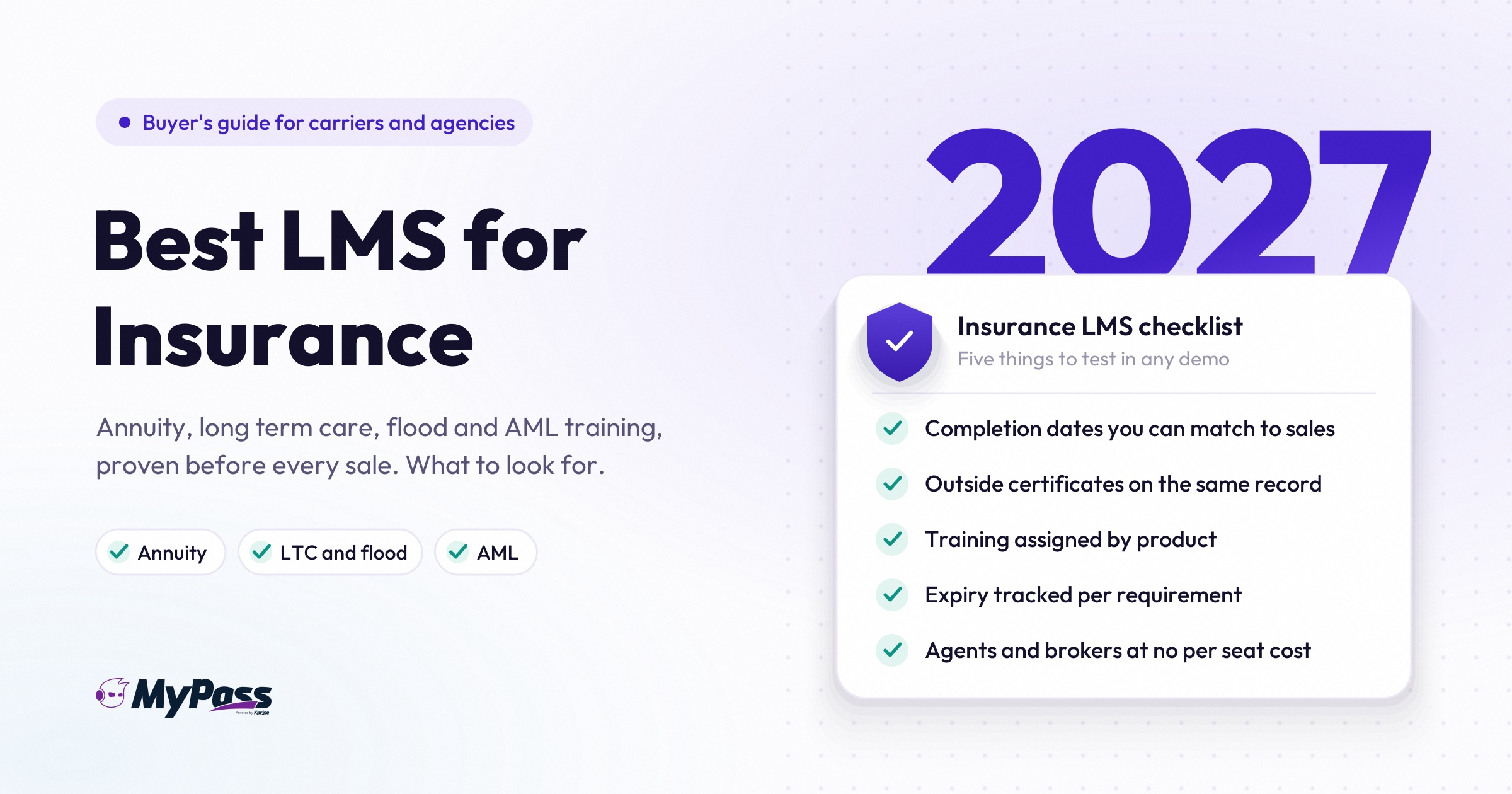
The best LMS for insurance tracks training per producer and per product, timestamps every completion so it can be matched to sales, and covers agents and brokers who aren't employees. It should hold annuity, long term care, flood and AML training evidence, flag gaps before a producer sells, and export a clean record for examiners.
What Makes an Insurance LMS Different?
An insurance LMS has to prove that a specific person was trained on a specific product before a specific sale, for people who mostly don't work for you. A general corporate LMS is built to show that employees finished assigned courses. That difference drives almost every buying decision in this guide.
Here is where the two part ways in practice.
- Most of your learners aren't employees. Appointed producers, independent agents, brokers and agency staff sit outside your payroll, and often outside your HR and identity systems.
- Training attaches to products, not job titles. Selling annuities, long term care and flood each carry their own training rule. Completing one tells you nothing about the others.
- The order of events is the evidence. It isn't enough that a producer was trained. Examiners check that training happened before the sale, which means completion dates have to line up against business records.
- Some training is yours to provide and some isn't. Carriers provide product specific training. The general annuity course comes from state approved providers, and you verify it rather than deliver it.
- States split on product rules, not on general CE. General continuing education usually follows the producer's home state. Long term care and flood rules are where states differ, and they can apply to non-residents too.
If you're comparing against neighboring sectors, best LMS for finance and banking covers the regulated financial footing. What insurance adds on top is the distributed producer problem.
What Training Do Insurance Producers Have to Complete?
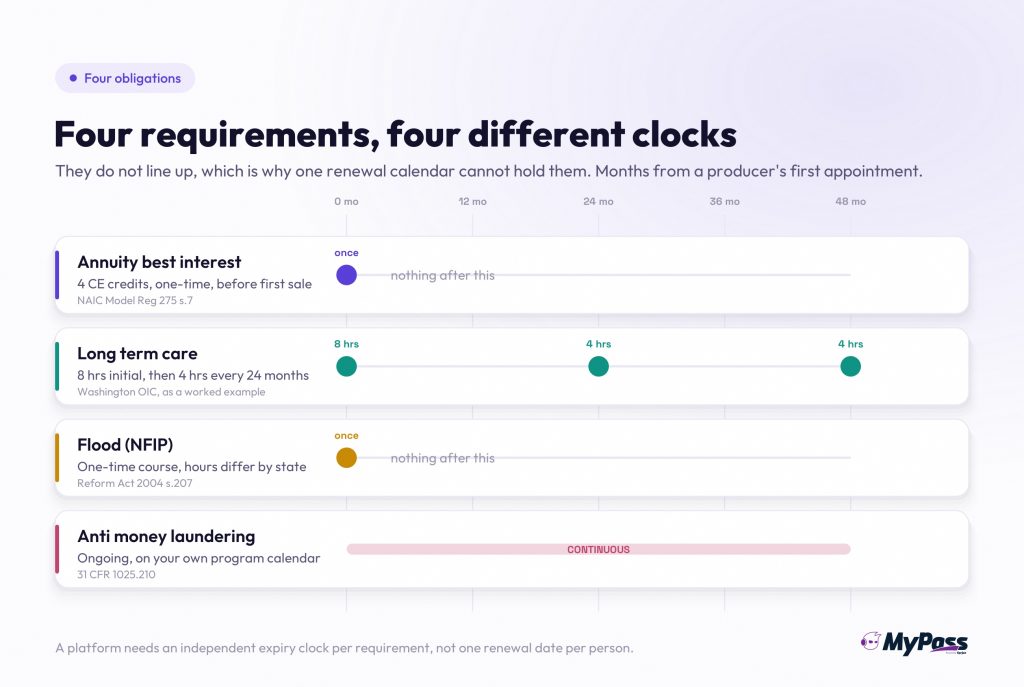
Insurance producers face six overlapping training obligations: general licensing CE, a one-time annuity course, insurer product training, long term care training, flood training, and AML training for covered products. They run on different schedules and sit with different owners, which is why one renewal date per person never works.
| Requirement | Who it applies to | How often | Whose job it's |
| General licensing CE | All licensed producers | 24 credits every 2 years, 3 in ethics, under the uniform standard. States vary | The producer, with their home state |
| Annuity best interest course | Producers selling annuities | Once, at least 4 CE credits, before soliciting | Producer completes it. Carrier must verify it |
| Insurer product training | Producers selling your annuities | Before recommending your product | The carrier provides it |
| Long term care | Producers selling LTC | 8 hours initial, then 4 hours every 24 months in Washington. Other states differ | Producer completes it. Carrier checks it |
| Flood | Agents selling NFIP policies | One-time. Hours vary by state | Producer completes it |
| Anti money laundering | Employees, agents and brokers involved with covered products | Ongoing | The carrier's AML program |
The reciprocity detail that saves you work
Under the NAIC's uniform standard, a non-resident producer who completes their home state's CE is generally treated as meeting your state's CE as well, provided the home state returns the favor. In plain terms, general CE is mostly one clock per producer, not one per state.
The exception matters. The same NAIC guidance says states may impose product specific requirements, including long term care and flood, on non-residents. So the multi state complexity lives in product training. That's where your tracking effort should go.
Which products bring AML training into scope
The AML rule applies to covered products, defined in 31 CFR 1025.100 as:
- Permanent life insurance, other than group policies.
- Annuity contracts, other than group annuities.
- Any other insurance product with cash value or investment features.
If your book is purely term life or property and casualty, this obligation is unlikely to apply to those lines. If you write individual annuities or permanent life, it does, and it reaches your distribution as well as your staff.
Key point
This guide summarizes regulations and NAIC guidance. It isn't legal advice. State rules vary and change, so confirm the current position for each state you write business in.
What Do Market Conduct Examiners Actually Check?
Examiners don't stop at asking whether training exists. According to the NAIC's examination handbook, they cross-reference your new business and replacement logs against producer training files to confirm training happened before each annuity sale, compare your files with state CE records, and review whether your training materials fully explain your products.
That's the most useful single fact in this guide, and the one most platform comparisons miss. Here is what the handbook lists for review.
- Producer training files and producer CE files, held by you.
- State insurance department CE records, which examiners compare against your files.
- New business and replacement logs, cross-referenced with training files to confirm training came first.
- Your training materials, checked for whether they fully explain all material features of your annuity products.
- Your procedures for telling producers what training they need and for verifying it.
- Complaint logs and producer investigation files, where a sale is alleged to be unsuitable.
Key point
The completion date is the evidence. A record that says a producer completed annuity training, without a reliable date you can line up against the policy application, is the weakest possible answer to the question examiners are actually asking.
How you're allowed to verify training
The handbook allows insurers to rely on certificates of completion, reports from commissioner sponsored databases or vendors, or reports from a reasonably reliable commercial database vendor. Two practical consequences follow:
- Your platform has to hold training it didn't deliver. Most annuity courses come from outside providers, so certificates arrive from elsewhere and still need to sit on the producer's record.
- Testing isn't a requirement of the model regulation. Building elaborate quizzes for the general annuity course is optional. Making sure your product training explains material features isn't.
Who Needs to Be in the System?
More people than your licensed sellers. Under 31 CFR 1025.100, an insurance agent includes anyone who sells, markets, distributes or services your covered products, and the AML program must integrate agents and brokers. That usually means agency service staff and brokers belong in the system alongside appointed producers and employees.
- Employees in service, operations and compliance who handle covered products.
- Captive and appointed producers who sell your products.
- Brokers acting for customers on your covered products.
- Agency staff who service policies, even if they don't sell. The definition includes servicing.
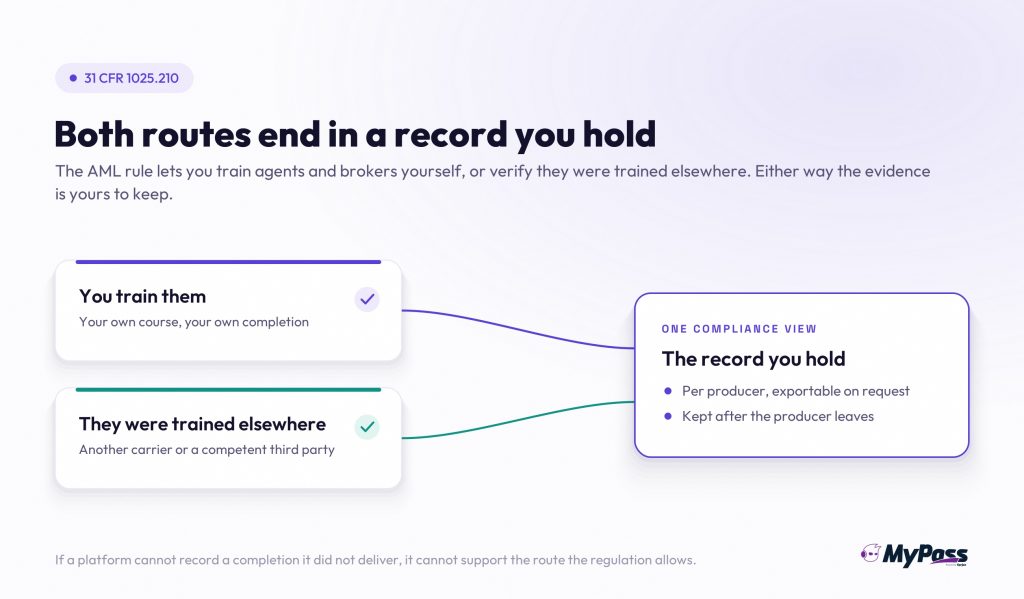
For AML training specifically, 31 CFR 1025.210 lets you either train agents and brokers yourself or verify that they were trained by another insurance company or a competent third party. Either route ends in the same place: a record you hold, for a person outside your payroll.
The general version of this problem, training people beyond your own walls, is covered in extended enterprise training.
What Features Should an Insurance LMS Have?
An insurance LMS needs dated completions you can match to sales, room for certificates from outside providers, training assigned by product rather than role, expiry tracking per requirement, per producer evidence exports, and pricing that doesn't penalise you for adding non-employees. Each feature below maps to an obligation or an examination step.
| Feature | Why insurance needs it |
| Reliable completion dates and times | Examiners line training dates up against new business logs |
| Certificates from outside providers on the same record | Annuity courses usually come from approved third parties |
| Assignment by product, not just by role | Annuity, LTC and flood rules attach to what someone sells |
| Expiry and renewal per requirement | LTC refreshers recur. Annuity and flood are one-time |
| Advance warning before a lapse | A lapsed refresher should be caught before the next sale, not after |
| Per producer evidence export | Verification and examinations ask about named people |
| Records kept after a producer leaves | Examination and complaint reviews can look back |
| Agency level views | An agency principal manages their own people, not your whole roster |
| No per seat charge for registered users | Distribution often outnumbers staff many times over |
Key point
Per seat pricing isn't a minor commercial detail in this sector. If every appointed producer costs you a license, there's a quiet incentive to track fewer people than the regulation covers. That's the gap a spreadsheet beside the LMS usually fills, badly.
What an LMS Won't Do for You
An LMS holds training evidence and shows who is ready. It doesn't license producers, manage appointments or approve CE courses. Licensing status lives with the state, appointments sit in your contracting process, and the general annuity course comes from approved providers. Expect your LMS to connect to those, not replace them.
- It isn't a licensing system. Whether a producer holds an active license and the right line of authority is a separate check.
- It isn't an appointment system. Whether a producer is appointed with you is decided in contracting.
- It isn't a CE provider. State approved CE comes from approved providers. Your platform records it.
- It doesn't make the sell decision on its own. It should feed a ready or not ready status into whatever controls the sale.
Being clear about this boundary in a demo saves a lot of disappointment later. Vendors that blur it are usually describing integrations you would have to build.
How Do You Evaluate an Insurance LMS in a Demo?
Bring real cases instead of a feature list. Ask the vendor to model a messy producer live, attach an outside certificate, show a completion date next to a sale date, show what happens when a refresher lapses, and produce one producer's evidence pack. These five tests separate platforms that handle insurance from those that merely claim to.
1. Model one messy producer live. Licensed in three states, annuity trained, long term care refresher overdue, never trained on flood. Watch how long it takes and whether the status is obvious at a glance.
2. Attach a certificate from an outside provider. Then find it in the same view as training you delivered. If it lives somewhere else, your examiners will have to look in two places.
3. Show a completion date beside a sale date. Ask how you would prove training came before a specific application. If the answer involves exporting two spreadsheets and matching them by hand, note it.
4. Let a refresher lapse. The useful answer is a warning weeks ahead and a visible change of status. A report you have to remember to run isn't a control.
5. Produce one producer's evidence pack. Not a dashboard. The document you would hand to an examiner or a carrier verification request.
Ask one more question at the end: what happens to a producer's training record when they leave? If it disappears with the user account, the platform can't support the look-back that examinations and complaint reviews require. We cover retention periods in how long to keep training records.
Where MyPass LMS Fits
We build MyPass LMS, so read this section as a vendor describing its own product. Everything above this point is sourced to regulation or NAIC guidance and applies whichever platform you choose.
- Unlimited registered users on every plan. MyPass LMS plans are sized by simultaneous logins, not by registered users, so adding appointed producers, brokers and agency staff doesn't add license cost.
- Certificate builder with expiry and renewal tracking. A recurring requirement like a long term care refresher can carry its own expiry, separate from one-time items.
- Learning paths with sequencing, so product training can be set to follow the general course in the order your procedures require.
- One-click audit reports, so a verification request or examination request starts from a report rather than a hunt. More on that in one-click audit reports.
- Bulk onboarding and SSO provisioning for bringing large producer rosters in without one-by-one setup.
- Open core with a self-hosted Community Edition, for teams that want training records on their own infrastructure.
What MyPass LMS isn't: a licensing system, an appointment system or a CE provider. It holds and evidences training. In a demo, ask us to show how outside certificates and your sales dates come together for your setup, using one of your real producers.
Common Mistakes When Choosing an Insurance LMS
- Choosing on course library size. The general annuity course has to come from an approved provider anyway. A big generic library does little for the obligations in this guide.
- Tracking producers in a spreadsheet beside the LMS. This is usually where per seat pricing leads, and it splits your evidence across two places examiners will both want to see.
- Treating the state annuity course as the whole requirement. Your product specific training is separate, and examiners check that it explains material features.
- Spreading effort evenly across states. General CE mostly follows the home state. Put your tracking effort into product training, where states actually differ.
- Recording completion without a reliable date. The question examiners ask is whether training came before the sale. Undated or bulk-uploaded records can't answer it.
- Letting records leave with the producer. Termination doesn't end the look-back period.
For the broader compliance platform question, without the distributed producer layer, see best LMS for compliance training.
Where This Comes From
The annuity requirement is from Section 7 of NAIC Model Regulation 275. The examination detail, including verification before sale, the cross-referencing of new business and replacement logs, the comparison with state CE records, the permitted verification methods and the point that testing isn't required, is from Chapter 23 of the NAIC Market Regulation Handbook, Standards 10 to 12.
The general CE structure and non-resident reciprocity are from the NAIC's Uniform Licensing Standards material, including Model 218 Section 16(B), which also confirms that product specific requirements such as long term care and flood may be imposed on non-residents.
AML material is from 31 CFR 1025.210 and the definitions in 31 CFR 1025.100. Long term care hours are from the Washington State Office of the Insurance Commissioner, used as a worked example. Flood traces to Section 207 of the Bunning-Bereuter-Blumenauer Flood Insurance Reform Act of 2004, with state hour counts from FEMA's agent site.
We give no count of states that have adopted the 2020 best interest revision. The trackers we checked contradicted their own numbers, so we haven't repeated them.
MyPass LMS capabilities described here are limited to documented features. We haven't feature tested competing platforms, so this guide doesn't rank them.
This guide isn't legal advice. Read on 11 November 2026.
The bottom line
If you're choosing a platform for 2027, the best LMS for insurance isn't the one with the most courses. It's the one that can show, for a named producer who may not work for you, that the right training on the right product happened before the sale.
Test that directly in a demo. One messy producer, one outside certificate and one sale date will tell you more than any feature comparison.
Get the evidence right and the rest of insurance training becomes routine. Get it wrong and every examination turns into a manual reconciliation exercise.
Frequently asked questions
What is the best LMS for insurance companies in 2027?
One that tracks training per producer and per product, keeps reliable completion dates, holds certificates from outside providers, covers non-employee agents and brokers without per seat cost, and exports a clean evidence pack per producer.
Do insurance agents need annuity training before selling?
Yes, where the state has adopted NAIC Model Regulation 275. Producers complete a one-time course of at least four CE credits before soliciting annuities, and the insurer must verify it and provide its own product training.
Does general insurance CE need tracking in every state?
Usually not. Under NAIC reciprocity, meeting home state CE generally satisfies non-resident states. Product rules such as long term care and flood can still apply to non-residents, so track those per state.
Can an LMS replace insurance licensing software?
No. An LMS holds training evidence. License status, lines of authority and appointments are managed separately. A good LMS feeds training status into that process rather than replacing it.
Sources
- Annuity training: Section 7 of NAIC Model Regulation 275. The examination detail, including insurer verification before sale, the cross-referencing of new business and replacement logs against training files, the comparison with state CE records, the permitted verification methods and the statement that testing is not required, is from Chapter 23 of the NAIC Market Regulation Handbook, Conducting the Life and Annuity Examination, Standards 10 to 12.
- General CE structure of 24 credits per two year compliance period including three ethics credits, fifty minutes to the credit, and non-resident reciprocity under Model 218 Section 16(B), are from the NAIC's Uniform Licensing Standards material in its producer licensing handbook, chapter 14. The same source states that product specific requirements for long term care, flood and crop may be imposed on non-residents.
- AML: 31 CFR 1025.210 for the four program elements, the ongoing training wording and the option to verify training received elsewhere. 31 CFR 1025.100 for the definitions of covered product, insurance agent and insurance broker.
- Long term care hours are from the Washington State Office of the Insurance Commissioner, used as a worked example rather than a national figure.
- Flood: Section 207 of the Bunning-Bereuter-Blumenauer Flood Insurance Reform Act of 2004, FEMA's topical outline at 70 Fed. Reg. 52117, and state hour counts from FEMA's agent site.
- We give no count of states that have adopted the 2020 best interest revision. The trackers we checked contradicted themselves, so the number is not reliable enough to print.
- MyPass LMS capabilities are limited to those documented in the Kprise product brief. We have not feature tested competing platforms and do not rank them.
- Not legal advice. State rules vary and change.
- Read on 11 November 2026.
Keep reading
Choosing an LMS
Best LMS for Government and Public Sector Organizations
Choosing an LMS
Best LMS for Logistics and Transportation: A Buyer's Guide

Choosing an LMS
Best LMS for Hospitality: Hotels, Restaurants and Beyond

Choosing an LMS