Extended Enterprise Training: Training Beyond Your Walls
On this page 7 sections
Short answer
Extended enterprise training delivers learning to people outside your payroll, such as partners, resellers, customers, franchisees and suppliers, who still affect your business. It drives revenue and brand consistency by making sure everyone who represents or uses your product knows it well. It needs an LMS with multi-tenant, branded portals.
What Extended Enterprise Training Is
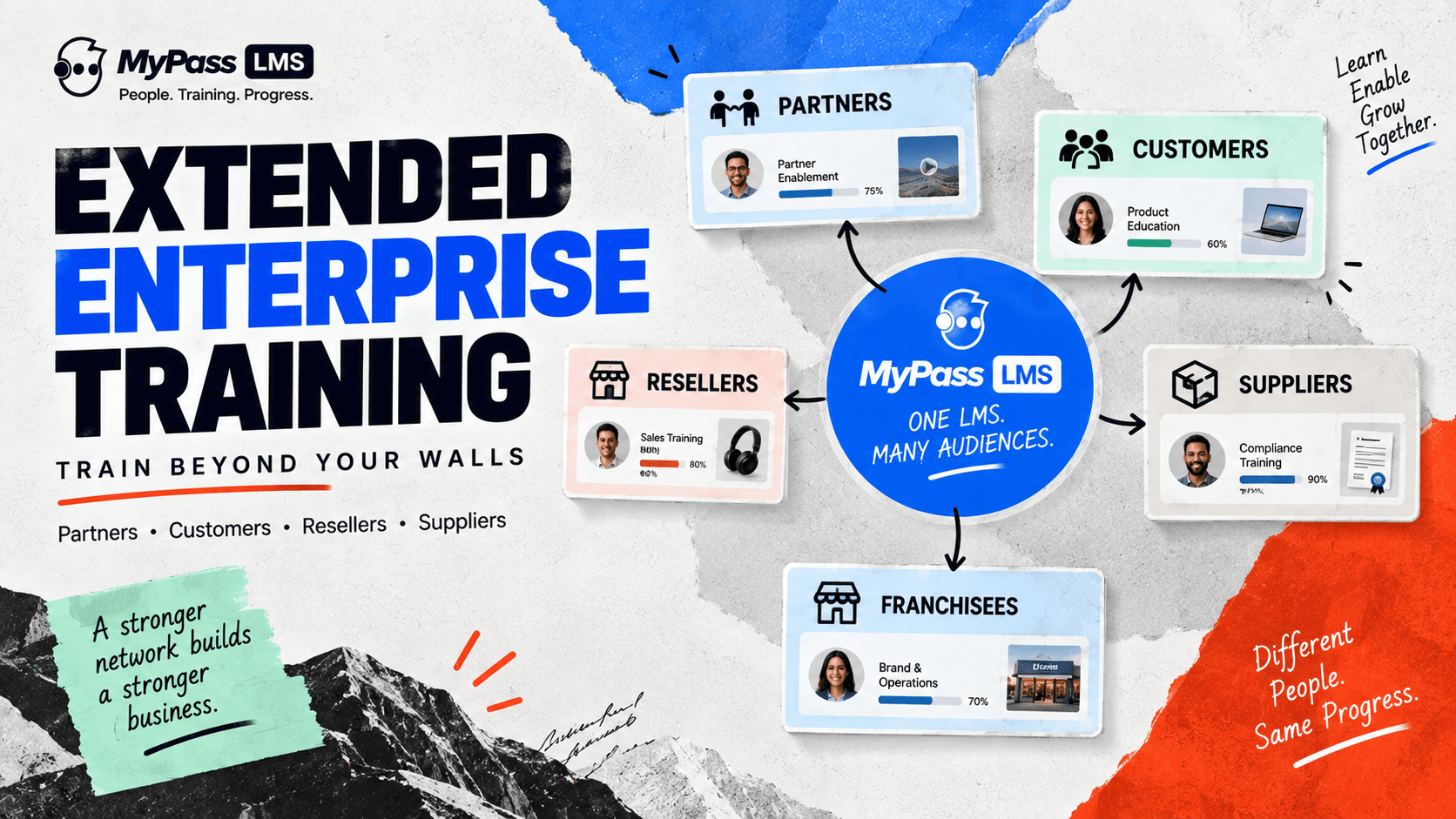
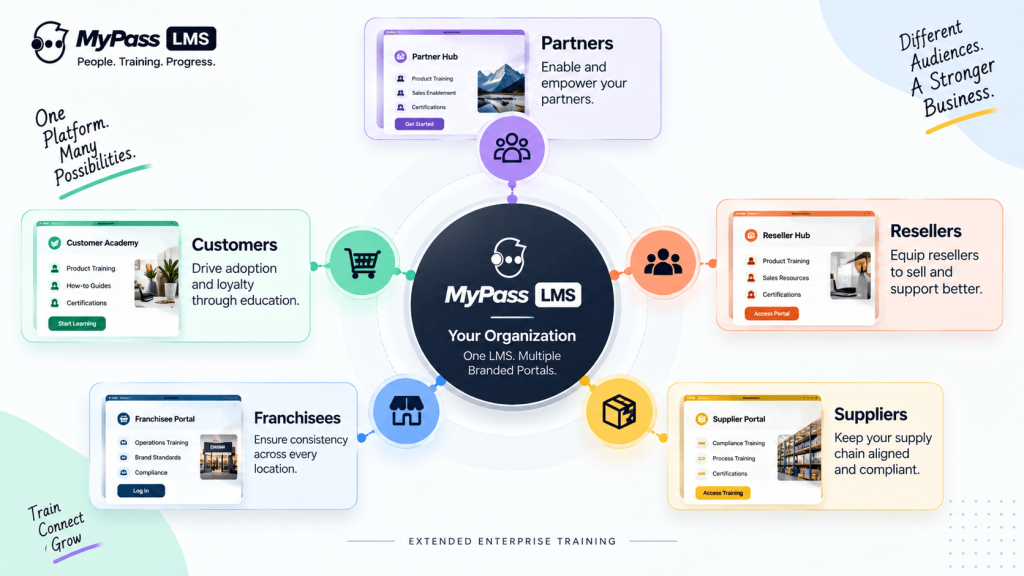
Extended enterprise training is training designed for people outside your organization's own employees who still play a role in its success. That includes channel partners and resellers, distributors and franchisees, suppliers, and customers. The common thread is that what these external audiences know and can do affects your business, even though they are not on your payroll.
It is a different job from internal training. Your employees learn through your HR-connected LMS, but a reseller, a customer and a supplier each need their own content, their own branding, and access that does not depend on your internal systems. A reseller learns how to position and sell your product; a customer learns how to use it; the same platform has to keep those journeys separate and relevant.
Key point
The defining feature of extended enterprise training is audience separation: multiple external groups, each with their own content, branding and access, running from one platform without bleeding into each other.
Why It Drives Business Growth
Unlike internal training, which is mostly about capability and compliance, extended enterprise training connects directly to revenue and retention. It has become a strategic growth lever, not a nice-to-have.
- Customer education reduces churn: customers who understand your product use it more and renew more.
- Partner enablement scales sales: trained partners and resellers sell and support better, acting as brand extensions.
- Brand consistency: everyone representing you delivers a consistent experience, protecting your reputation.
- New revenue: training itself can be sold, turning customer education into a revenue stream via certification and paid courses.
- Compliance across the chain: suppliers and franchisees stay aligned with your quality and process standards.
Key point
The clearest ROI case is customer education. A customer who is trained to get value from your product is far less likely to churn, which makes extended enterprise training a retention investment, not just a training cost.
What the LMS Needs to Support It
Extended enterprise training has specific platform requirements that internal-only tools often lack. Before running it, check the LMS can handle these.
- Multi-tenant or multi-portal: separate, branded environments for each audience from one back end.
- Custom branding: each portal can carry the right look, domain and messaging for its audience.
- Flexible access: enrolment that does not depend on your internal HR system, since these learners are external.
- Ecommerce: the ability to sell courses and certifications, if training is also a revenue stream.
- Per-audience reporting: analytics segmented by partner, customer group or region.
- Scalable pricing: a model that does not punish you for training thousands of external learners.
The Pricing Trap
There is a specific commercial catch with extended enterprise training. External audiences are often large and occasional: thousands of customers or partners who log in now and then. On a per-user pricing model, billing for every one of those accounts makes extended enterprise training prohibitively expensive, exactly the opposite of what a growth initiative should be.
This is where the pricing model matters more than almost any feature. A platform that charges per registered user turns a large external audience into a large bill. A platform with flat pricing and unlimited registered users lets you train your entire ecosystem without the cost scaling with headcount.
Key point
Before committing to an extended enterprise program, model the cost at your real external audience size. Per-user pricing that looks fine for staff can become punishing when you add thousands of customers and partners.
Extended Enterprise Training in MyPass LMS
MyPass LMS is well suited to extended enterprise training because it combines the capabilities these programs need. Branded portals let each external audience get its own experience, native ecommerce lets you sell courses and certifications, and per-partner reporting shows how each group is doing.
Two things matter most for external audiences. First, unlimited registered users with flat pricing means training thousands of customers, partners or resellers does not trigger a per-seat cost spike. Second, the same platform handles content protection through MyPass DRM, so paid or proprietary training delivered outside your walls stays protected.
- Branded portals for partners, customers and other audiences.
- Native ecommerce to sell courses and certifications.
- Unlimited registered users on flat pricing, so scale does not inflate cost.
- Per-audience reporting and DRM-protected content.
The bottom line
Extended enterprise training extends learning to the partners, customers, resellers and suppliers who shape your business from outside your payroll. Done well, it reduces churn, scales your sales channel, protects your brand and can even generate revenue. The requirements are specific: branded portals, flexible access, ecommerce and, above all, pricing that does not punish scale.
If you are training audiences beyond your employees, the platform choice is decisive. See how branded portals, ecommerce and unlimited registered users work in MyPass LMS features, or start a free trial.
Frequently asked questions
What is extended enterprise training?
Extended enterprise training is learning delivered to people outside your organization's employees who still affect its success: channel partners, resellers, distributors, franchisees, suppliers and customers. Each audience usually needs its own content, branding and access. It differs from internal training, which runs through your HR-connected systems for staff only.
Why is extended enterprise training important?
Because external audiences drive revenue and retention. Trained customers understand and keep using your product, reducing churn. Trained partners and resellers sell and support better. Consistent training protects your brand across everyone who represents it, and training can itself become a revenue stream. It has become a strategic growth lever rather than an optional extra.
What does an LMS need for extended enterprise training?
It needs multi-tenant or multi-portal support with per-audience branding, access that does not depend on your internal HR system, ecommerce if you sell training, per-audience reporting, and pricing that scales affordably. The last point is critical: external audiences are often large and occasional, so per-user pricing can make these programs prohibitively expensive.
How is extended enterprise training different from employee training?
Employee training serves internal staff through HR-connected systems and focuses on capability and compliance. Extended enterprise training serves external audiences, partners, customers, resellers and suppliers, each needing separate branded portals, independent access and often ecommerce. It connects more directly to revenue, retention and brand consistency than internal training does.