
Adult Learning Principles, and What Each One Should Change
Adult learning principles describe how working adults approach learning: they need to know why, they want control, they bring experience, they learn when there is an immediate need, they want problems rather than topics, and they respond to internal motivation. Each one forces a specific design decision.

On this page 11 sections
Adult learning principles describe how working adults approach learning: they need to know why, they want control, they bring experience, they learn when there is an immediate need, they want problems rather than topics, and they respond to internal motivation. Each one forces a specific design decision.
The Short Version
Most articles on this subject list the principles and stop. The list is the easy part. What matters is what each one obliges you to change.
- They are design constraints, not descriptions. Each principle rules out something you were probably going to do.
- The biggest one is why. Adults want to know why before they will spend attention, and most corporate training never answers it.
- Experience cuts both ways. It is your best resource and your biggest obstacle, because people defend what they already believe.
- Timing beats content. The same module lands or fails depending on whether the person needs it this week.
- They are assumptions, not laws. Useful ones, well argued, but the research base is thinner than the confidence with which they are quoted.
The Six Principles, and What Each One Forces
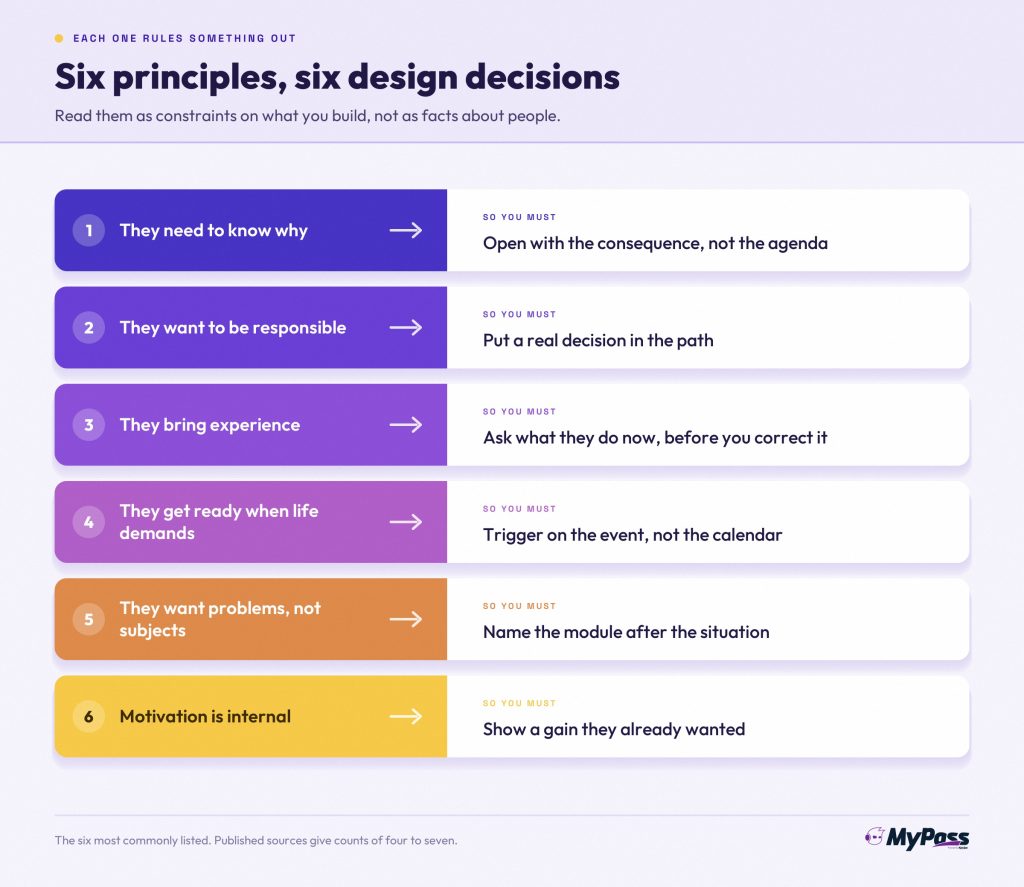
These are the six most commonly listed. Read each one as a constraint on your design rather than as a fact about people.
1. They need to know why
Adults want a reason before they invest attention. Not a learning objective, which is a statement about the course. A reason, which is a statement about them.
What it forces. Open with the consequence, not the agenda. Why this, why now, what goes wrong without it. If you cannot answer that in two sentences, the module is not ready, and no amount of production value will rescue it.
2. They want to be responsible for their own learning
Adults see themselves as capable of running their own lives, and react badly to being handled. The most common complaint about workplace training is not that it is hard. It is that it is patronising.
What it forces. Give real choices. Order, pace, depth, examples. A path with no decisions in it is a lecture with navigation buttons.
3. They bring experience, and it is in the way
This is the principle people quote most and handle worst. Experience is the richest resource in the room. It is also why adults resist: new information that contradicts what someone already does is heard as criticism.
What it forces. Build in a place for what they already know before you tell them anything. Ask how they currently do it. Then show where that holds and where it breaks. Correcting a belief is a different design problem from filling a gap, and most training is built as if every learner were empty.
4. They get ready when something in life demands it
Adults become willing to learn when a real need shows up. A promotion, a new system, a failure. Readiness is situational, and it is mostly outside your control.
What it forces. Stop fighting the calendar and start following it. Attach training to the moment that creates the need rather than to the annual cycle. Our guide to on-the-job training covers how to deliver at the point the need appears.
5. They want problems, not subjects
Children are taught subjects. Adults want to solve something. Orientation is to the task, not the topic.
What it forces. Organise around the situations people face, not the structure of the content. A module called Data Protection Principles is a subject. A module called What To Do When A Customer Asks You To Delete Their Data is a problem, and it is the same content.
6. The strongest motivators are internal
External pressure works, badly and briefly. The durable drivers are competence, standing, autonomy and a sense of getting better at something that matters.
What it forces. Make the gain visible and personal. Completion certificates satisfy the organisation. Being visibly better at a thing you care about satisfies the person.
Andragogy and Pedagogy, Without the Jargon
The word for all of this is andragogy, usually set against pedagogy. The distinction is simpler than the vocabulary suggests.
| Pedagogy | Andragogy | |
| Who decides | The instructor decides what is needed | The learner shares the decision |
| Role of experience | Something to be built up | Something to be drawn on |
| Why they learn | Because they are told to | Because something in life requires it |
| How it is organised | By subject | By problem |
| What drives it | Mostly external | Mostly internal |
One warning, because this is where the idea is most often misused. Andragogy is not a claim that adults are better learners, and it is not a licence to remove all structure. Plenty of adults, faced with something genuinely unfamiliar, want to be taught directly and in order. Treat the two columns as a dial rather than a switch, and set it by how familiar the subject is rather than by the age of the people in the room.
Where the Idea Came From
Worth knowing, because the history explains some of the argument around it.
1. 1833. Alexander Kapp, a German educator, coins the term andragogy.
2. 1921 and 1926. The term resurfaces in Germany, and Eduard Lindeman publishes Andragogik: The Method of Teaching Adults in Workers' Education.
3. 1966. Malcolm Knowles meets Dusan Savicevic in Boston, who introduces him to the term and how it is used in Europe.
4. 1968. Knowles publishes Andragogy, Not Pedagogy, bringing the idea into American adult education.
5. 1975 to 1984. Knowles develops it across Self-Directed Learning, The Adult Learner and Andragogy in Action.
Key point
A detail worth reporting honestly: published sources do not agree on how many assumptions Knowles set out. You will find lists of four, five, six and seven, all presented confidently. We have used the six most commonly given. If a page states a number without noting the disagreement, it has not checked.
What the Critics Say
The principles are useful. They are not settled science, and a senior practitioner should know the arguments against them before quoting them at a stakeholder.
- Kidd, 1978. Argued that principles of learning should apply across lifelong development, and that there is no real basis for a separate theory of adult learning at all.
- Hanson, 1996. Argued that the differences attributed to adulthood actually track context, culture and power in the learning setting, not age or life stage.
- Merriam, 2001. Pointed out that instructors cannot assume adults always want self-direction, because many prefer more structure, not less.
- Rachal, 2002. Observed that Knowles did not apply the self-concept principle in his own teaching to the degree he described. In one of his courses, learner choice meant picking from a list of eighteen objectives he had written.
- Jarvis. Argued that andragogy reflects an ideology about how adults ought to be treated more than a scientific contribution to understanding how they learn.
There is also no international consensus on whether andragogy is a theory or simply a set of principles, and little research establishes that its claims are specific to adults rather than true of learners generally.
So why use it
Because as a set of design constraints it is good, whatever its status as a theory. Every one of the six rules out a real and common mistake. A module that explains why, offers choice, engages existing practice, arrives when it is needed, is built around a problem and shows a personal gain is a better module than one that does none of those things. That holds whether or not adults are categorically different from children.
The honest position is that these are well-argued assumptions that happen to produce good design. Use them for that. Do not cite them as evidence.
One Module, Redesigned
Abstract principles are easy to nod along to, so here is one real module taken through all six. The module: annual data protection training for a customer service team.
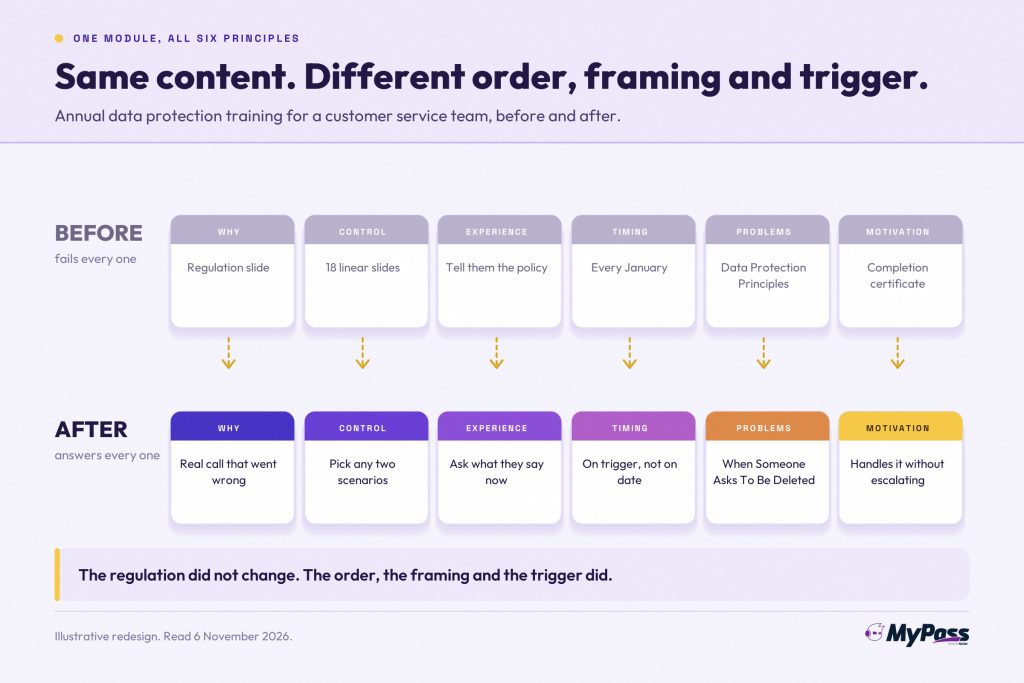
1. Why. Before: a slide on the regulation and the penalties. After: a real call recording where an agent gets a deletion request wrong, and what happened next. The reason is now a consequence, not a statute.
2. Control. Before: eighteen linear slides. After: four scenarios, pick any two, skip what you can already do.
3. Experience. Before: tell them the policy. After: ask what they currently say when a customer asks to be deleted, then show which of those answers is fine and which creates a problem.
4. Readiness. Before: every January, everyone. After: at onboarding, and triggered again whenever the request volume on someone's queue crosses a threshold.
5. Problem not subject. Before: Data Protection Principles. After: When Someone Asks You To Delete Their Data.
6. Motivation. Before: a completion certificate. After: the agent can handle the call without escalating, which is the thing they actually wanted.
Nothing in the content changed. The regulation is the same regulation. What changed is the order, the framing and the trigger, and that is almost always where the gain is.
If your compliance programme has the before column, our piece on why employees ignore compliance training covers the rest of the diagnosis. For turning the after column into something you can actually run, learning paths is where the structure lives, and the ADDIE model is the wider process this sits inside.
One practical note on choice. Letting people skip what they already know only works if you can tell who already knows it, which means assessment before content rather than after. Writing the objectives first is what makes that possible, because you cannot pre-test against a vague aim.
A Review Checklist You Can Run on Any Module
Turn the six into questions and you have a review that takes about ten minutes and catches most of what goes wrong. Run it on something already built before you run it on something new, because the first pass is more convincing when it finds real problems.
1. Can a learner say why this exists, in one sentence, before slide three. If the only answer is that it is mandatory, you have a compliance record rather than a piece of training.
2. Is there a single real decision in it. Not a quiz question. A choice about what they do next. If the path is identical for everyone, nothing has been designed, only sequenced.
3. Does anything ask what they already do. If the module assumes an empty learner, it will bounce off anyone experienced, which is usually the people whose habits you most wanted to change.
4. What triggers it. If the answer is the date, ask what event could trigger it instead. Onboarding, a role change, a threshold being crossed, an incident.
5. Is the title a problem or a subject. Read it aloud. If it sounds like a chapter heading, it is a subject.
6. What does the learner get that they would want anyway. If the only answer is a certificate, the motivation is entirely external and completion will show it.
Six questions. Most modules fail three or four, and the failures are usually cheap to fix, because they are about framing and sequence rather than content.
Where These Come From
The history is taken from the documented record of the term: Kapp in 1833, its reuse in Germany in the 1920s including Lindeman's 1926 article, Knowles meeting Savicevic in Boston in 1966, and his 1968 article Andragogy, Not Pedagogy, followed by the 1975 and 1984 books.
The six principles are the six most commonly listed in published summaries. We have flagged, rather than hidden, that sources give counts of four, five, six and seven.
Each criticism is attributed to its author and year in the text: Kidd 1978, Hanson 1996, Merriam 2001, Rachal 2002, and Jarvis. The observation that there is no consensus on whether andragogy is a theory, and that little research establishes its claims as specific to adults, comes from the same documented record.
The redesigned module is our own illustration. Read on 6 November 2026.
The bottom line
Adult learning principles are a better set of design constraints than they are a theory, and that is the most useful way to hold them.
If you take one thing from the list, take the first one. Adults want to know why, and the overwhelming majority of workplace training answers a different question, which is what the organisation needs them to have completed.
Fix that one and the rest tends to follow, because a module that can state clearly why it exists has usually been thought about properly.
Frequently asked questions
What are the adult learning principles?
The six most commonly listed are: adults need to know why, want responsibility for their own learning, bring relevant experience, become ready when life demands it, prefer problems to subjects, and respond most to internal motivation.
What is andragogy?
Andragogy is the term for teaching adults, as distinct from pedagogy. Alexander Kapp coined it in 1833, and Malcolm Knowles brought it into American adult education from 1968.
What is the difference between andragogy and pedagogy?
Pedagogy puts the instructor in charge and organises by subject. Andragogy shares the decisions with the learner, draws on their experience and organises by problem. Treat it as a dial, not a switch.
Are adult learning principles backed by research?
They are well-argued assumptions rather than settled findings. Kidd, Hanson, Merriam, Rachal and Jarvis have all published criticism, and little research shows the claims are specific to adults.
Sources
- Alexander Kapp, German educator, coined the term andragogy in 1833. Rosenstock reused it in 1921, and Eduard Lindeman published Andragogik: The Method of Teaching Adults in Workers' Education in 1926.
- Malcolm Knowles met Dusan Savicevic in Boston in 1966, who introduced him to the term and its European use. Knowles published his first article on it, Andragogy, Not Pedagogy, in 1968.
- Knowles, Self-Directed Learning, 1975. Knowles, The Adult Learner: A Neglected Species, and Andragogy in Action, both 1984.
- Sources disagree on how many assumptions Knowles set out. Published lists give four, five, six and seven. We have used the six most commonly listed and said so rather than picking a number and presenting it as settled.
- Criticism, each attributed: Kidd, 1978, that principles of learning should apply across lifelong development and there is no real basis for a separate adult learning theory. Hanson, 1996, that differences in learning relate to context, culture and power rather than to age or life stage. Merriam, 2001, that instructors cannot assume adults always want self-directed learning, since some prefer more structure. Rachal, 2002, that Knowles did not apply the self-concept principle in his own teaching to the extent he described. Jarvis, that andragogy reflects ideology more than a scientific contribution.
- There is no international consensus on whether andragogy is a theory or a set of principles, and little research establishes that its claims are specific to adults.
- Read on 6 November 2026.