A learning path is an ordered sequence of courses that takes a learner from a defined starting point to a defined outcome, with prerequisites controlling progression. Paths convert a course catalogue into a programme, which matters because catalogues put the burden of deciding what to learn on the learner, and most learners will not carry it.
A catalogue is not a programme
Plenty of organizations buy a learning platform, load fifty courses into it, and are disappointed by what happens next. The courses are good. Uptake is poor. The usual conclusion is that learners are not motivated.
The more likely explanation is that a catalogue asks the learner to do the hard part. Faced with fifty options, a new starter has to work out what applies to them, in what order, and to what standard. That is a curriculum design decision, and it has been silently delegated to the person least equipped to make it.
A learning path makes that decision on their behalf. Same content, ordered, with a clear destination.
What a learning path actually does
- Defines a destination. Not 'complete these courses' but 'be able to do this job unsupervised', which changes how the sequence is chosen.
- Orders the content so foundational material comes before the material that depends on it.
- Enforces prerequisites where order genuinely matters, so someone cannot take an advanced assessment before the groundwork.
- Shows progress, which is motivationally useful in a way that a catalogue of unrelated items is not.
- Ends in something: a certificate, a certification, or a documented competency.
The last point matters more than it looks. A path with a visible endpoint completes at a noticeably higher rate than an open-ended collection, because the learner can see how much is left.
Where sequencing helps and where it annoys
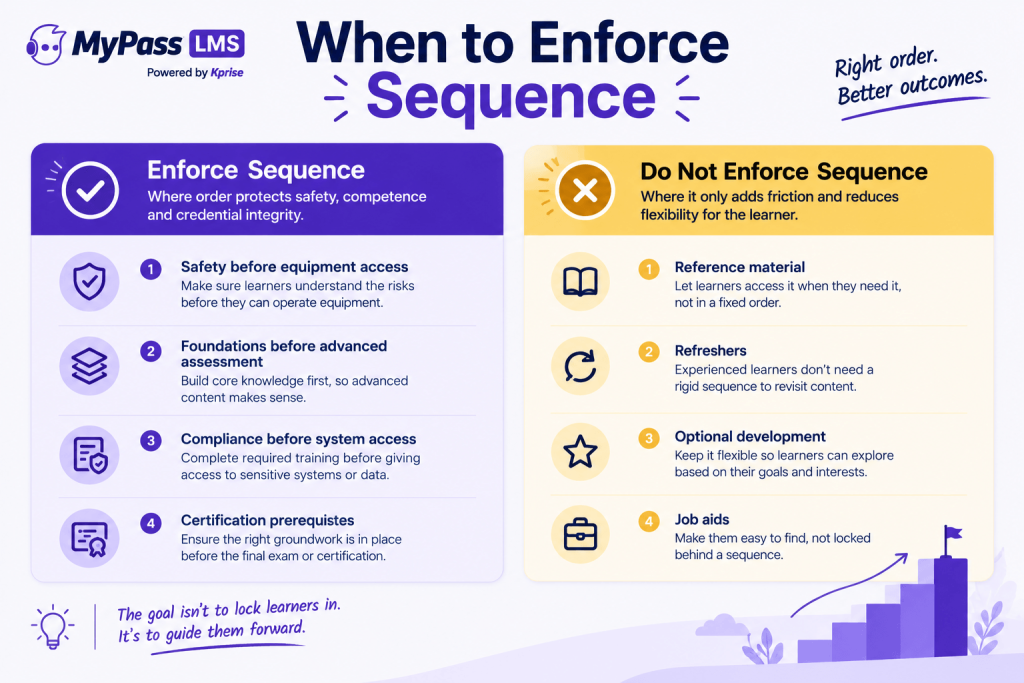
Enforced sequencing is a genuine tool and an easy one to overuse. Apply it where order affects safety, competence or credential integrity:
- Safety training before someone is permitted to operate equipment.
- Foundational modules before an assessment that assumes them.
- Compliance training before access to a system holding sensitive data.
- Prerequisite courses before a certification exam, where the credential depends on demonstrated groundwork.
And leave it off where it only adds friction:
- Reference and job-aid material, which by definition is consulted at the moment of need in no fixed order.
- Refreshers for experienced staff who already hold the knowledge.
- Optional development content, where forcing a route reduces uptake.
| A locked sequence tells a learner you do not trust them to know what they need. Use it where the consequences justify that, and not where the only consequence is your tidiness. |
Designing a path that works
- Start from the outcome. Write the destination as a capability, then work backwards to what someone needs in order to reach it.
- Order by dependency, not by topic tidiness. What must be true before the next piece makes sense?
- Keep individual units short. A path of eight short modules completes far better than one of three long ones, because completion is driven by unit length more than by total volume.
- Mix formats. Paths can include online modules, in-person sessions, assessments and practical sign-offs, which matters when the outcome is a real capability rather than knowledge alone.
- Put an assessment near the end, not only at the very end, so someone struggling is identified before they finish.
- Give it an endpoint worth reaching, whether a certificate, a certification or a documented competency.
How learning paths work in MyPass LMS
In MyPass LMS, learning paths combine with the platform's assignment and tracking so a path is not just a curated list:
- Paths can be assigned automatically by role, department or location, so a new starter enters the right path without anyone building a list.
- Sequential progression and prerequisites are enforced where you enable them, and left open where you do not.
- Paths can include instructor-led sessions alongside online modules, so blended programmes stay in one structure rather than splitting across systems.
- Certification and continuing education credits attach to path completion, which matters for structured certification programmes.
- Progress and completion feed the same reporting and audit records as everything else, so a partially complete path is visible before it becomes a problem.
That combination is what makes paths operational rather than decorative. A path nobody is assigned to, and whose progress nobody can see, is a curriculum document with extra steps.
The bottom line
A learning path turns a catalogue into a programme by making the sequencing decision for the learner rather than delegating it to them. Design backwards from a capability, order by dependency, keep the units short, mix formats where the outcome demands it, and finish with something worth reaching. Enforce sequence where safety, competence or credential integrity depend on it, and leave it open everywhere else, because unnecessary locks cost you goodwill for nothing.
See the platform features, read how certification programmes are built, or start a 15-day free trial.
Frequently asked questions
What is a learning path?
An ordered sequence of courses and activities taking a learner from a defined starting point to a defined outcome, usually with prerequisites controlling progression. It converts a course catalogue into a structured programme with a clear destination.
What is the difference between a learning path and a course?
A course teaches one subject. A learning path sequences multiple courses, and often assessments or in-person sessions, toward a capability or credential. The path makes the decision about what to learn and in what order, which a catalogue leaves to the learner.
When should you enforce sequence in a learning path?
Where order affects safety, competence or credential integrity: safety training before equipment access, foundations before an assessment that assumes them, compliance before system access, or prerequisites before a certification exam. Avoid enforcing it for reference material, refreshers and optional development.
How long should a learning path be?
Total length should follow the outcome, but individual units should be short. A path of eight short modules generally completes better than one of three long ones, since completion is driven more by unit length than by total volume.
Can a learning path include in-person training?
Yes, and it should where the outcome requires practical capability. Paths can combine online modules, instructor-led sessions, assessments and practical sign-offs, keeping a blended programme in one structure rather than splitting it across systems.