| Self-paced learning lets people learn on their own schedule and scales cheaply, which suits standardised knowledge. Instructor-led learning adds a live instructor for interaction and feedback, which suits complex or high-stakes topics. Neither is universally better; the right choice depends on the content, the audience and your budget. Many programs blend both. |
The Core Trade-off
Self-paced and instructor-led learning sit at two ends of a spectrum, often described as asynchronous versus synchronous. Self-paced (asynchronous) learning is content learners work through on their own schedule: courses, videos and modules available any time. Instructor-led (synchronous) learning happens live, with an instructor and learners together at the same time, in a room or online.
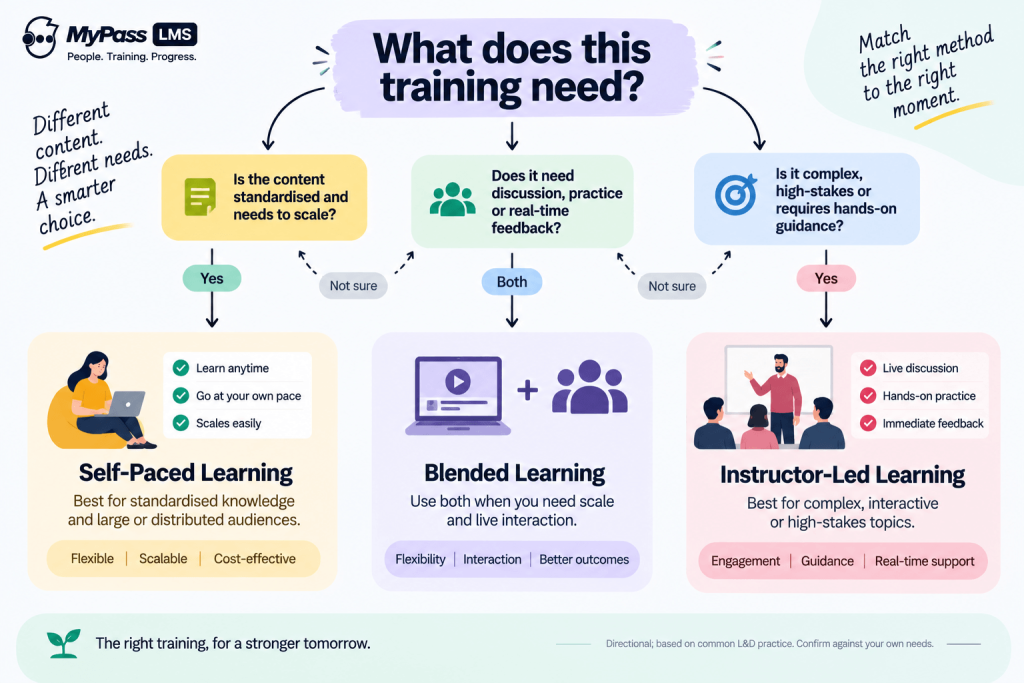
The trade-off is straightforward. Self-paced learning wins on flexibility, scale and cost. Instructor-led learning wins on interaction, real-time feedback and handling complexity. Choosing well means matching the mode to what the training actually needs, rather than defaulting to whichever your organization is used to.
| There is no universally better mode. The question is never 'which is better' in the abstract, but 'which fits this content, this audience and this budget'. The same organization should use both, for different things. |
Head to Head
Laying the two side by side makes the decision concrete. Each column is a strength for some situations and a weakness for others.
| Self-paced | Instructor-led | |
| Schedule | Any time, learner's pace | Fixed time, everyone together |
| Cost to scale | Low once built | High, repeats per session |
| Interaction | Limited | High, live discussion |
| Feedback | Automated or delayed | Immediate, tailored |
| Best for | Standardised knowledge at scale | Complex, interactive, high-stakes topics |
| Main risk | Disengagement, low completion | Cost and scheduling |
When to Choose Self-Paced
Self-paced learning is the right default for a large share of training, because most workplace knowledge is standardised and needs to reach many people affordably.
- Standardised knowledge: policies, product facts, compliance basics that are the same for everyone.
- Large or distributed audiences: where gathering everyone live is impractical or costly.
- Flexible schedules: shift workers, global teams, or anyone who cannot attend fixed sessions.
- Content that must repeat: onboarding and refreshers that run continuously, cheaply, once built.
| Self-paced learning's weakness is engagement. Without a live instructor, completion can drop. Counter it with short microlearning units, clear structure, assessments and, where useful, gamification. |
When to Choose Instructor-Led
Instructor-led learning earns its higher cost when the training genuinely needs a live human, and using it for simple knowledge that could be a self-paced module wastes money.
- Complex or nuanced topics: where learners need to ask questions and get tailored answers.
- Interactive skills: leadership, negotiation, difficult conversations, anything needing live practice.
- High-stakes training: where confirming understanding in real time matters.
- Team building and alignment: where the shared live experience is part of the value.
The classic mistake is using expensive instructor-led time to deliver information a video could cover. Save live sessions for discussion, practice and the things only a human in the room can do.
Why Blended Usually Wins
For many programs, the best answer is not either-or but both. Blended learning combines self-paced content with instructor-led sessions, using each for what it does best: self-paced for the knowledge, live time for practice and application. The flipped classroom is the clearest example, learners study online first, so the live session is spent applying rather than lecturing.
Running blended well means holding both modes in one place, so a learner moves through self-paced prework, a live session and follow-up without switching systems, and so completion across both is tracked together.
| A good rule for blended design: move all the 'telling' into self-paced content, and reserve every minute of live instructor time for 'doing', practice, discussion, questions and feedback. |
Delivering Both in MyPass LMS
MyPass LMS runs self-paced and instructor-led learning in the same platform, which is what makes blended delivery practical rather than a juggling act. Self-paced courses, SCORM content and assessments sit alongside instructor-led session management, and learning paths let a single program combine online prework, a live session and a follow-up assessment in the right order.
Because both modes share one learner record, completion of a self-paced module and attendance at a live session, captured with QR code check-in, appear in the same reporting. That gives you the flexibility to choose the right mode for each piece of training, and to blend them, without running two disconnected systems.
- Deliver self-paced courses and manage instructor-led sessions together.
- Combine both in one learning path for blended programs.
- Track self-paced completion and live attendance in one record.
- Choose the right mode per topic without switching platforms.
The bottom line
Self-paced and instructor-led learning are tools for different jobs. Self-paced scales cheaply and flexibly for standardised knowledge; instructor-led adds live interaction and feedback for complex, high-stakes or interactive topics. Neither is universally better, and the strongest programs blend them, moving knowledge into self-paced content and reserving live time for practice.
The practical enabler is a platform that runs both together. See how self-paced courses, instructor-led sessions and blended learning combine in MyPass LMS features, or start a free trial.
Frequently asked questions
What is the difference between self-paced and instructor-led learning?
Self-paced (asynchronous) learning is content learners work through on their own schedule, such as courses and videos available any time. Instructor-led (synchronous) learning happens live with an instructor and learners together at the same time. Self-paced wins on flexibility, scale and cost; instructor-led wins on interaction, real-time feedback and handling complex topics.
Which is better, self-paced or instructor-led training?
Neither is universally better; it depends on the content, audience and budget. Self-paced is best for standardised knowledge that must reach many people affordably. Instructor-led is best for complex, interactive or high-stakes topics that need live discussion and feedback. Many programs get the best result by blending both, using each mode for what it does well.
When should you use self-paced learning?
Use self-paced learning for standardised knowledge that is the same for everyone, large or distributed audiences, learners with flexible or shift schedules, and content that repeats continuously such as onboarding and refreshers. Its main weakness is engagement, so support it with short units, clear structure, assessments and sometimes gamification to keep completion high.
What is blended learning and why is it effective?
Blended learning combines self-paced content with instructor-led sessions, using each for its strength: self-paced for knowledge delivery and live time for practice and discussion. The flipped classroom, where learners study online first so live sessions focus on application, is a common example. It is effective because it captures the flexibility and scale of self-paced learning and the interaction of instructor-led learning.