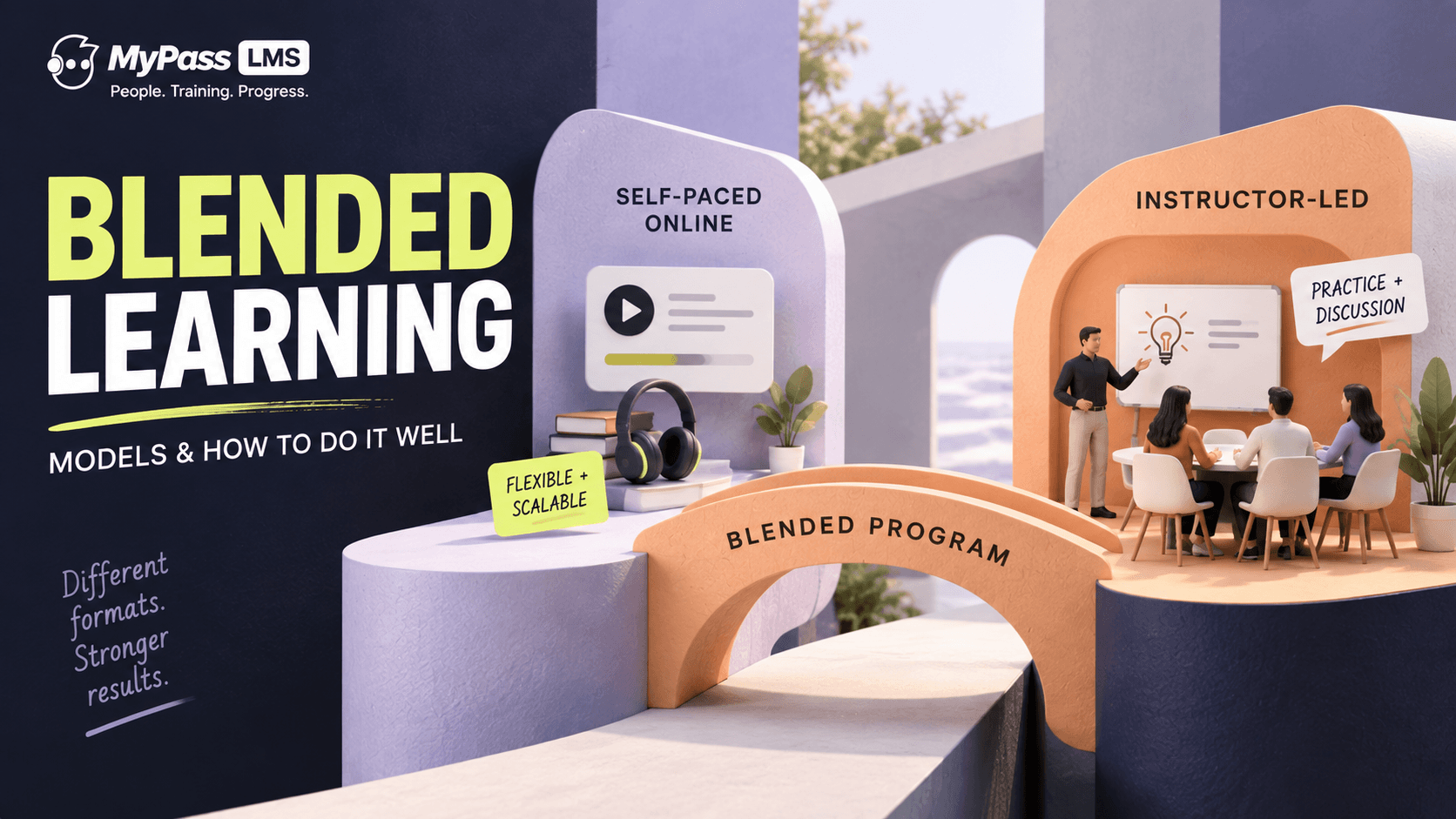
Blended Learning: Models and How to Do It Well
On this page 7 sections
Short answer
Blended learning combines self-paced online content with instructor-led sessions into one designed program, so each part does what it is best at. The main models are the flipped classroom, rotation, flex and enriched virtual. It differs from hybrid learning, which is about where people attend, not how the learning is designed.
What Blended Learning Is, and Is Not
Blended learning is a design approach that intentionally combines self-paced online content with instructor-led training into a single, coherent program. The point is not to bolt a video onto a workshop, but to let each mode do what it does best: online content for consistent knowledge delivery, live sessions for practice, discussion and application.
It is often confused with hybrid learning, but they are different things. Blended learning is about how the learning is designed, mixing modes on purpose. Hybrid learning is about where people are, with some attending in person and others joining remotely at the same time. You can run a blended program that is not hybrid, and a hybrid session that is not blended.
Key point
Simple rule: blended is a design choice about mixing self-paced and live learning. Hybrid is a logistics choice about in-person versus remote attendance. Do not use them interchangeably.
The Main Blended Learning Models
There is no single way to blend. A handful of established models cover most corporate needs, and the right one depends on your objectives, your audience and how much learner autonomy makes sense.
- Flipped classroom: learners study online content first, so live sessions are spent on discussion, practice and application rather than lecturing.
- Rotation: learners move on a fixed schedule between modes, such as online modules, instructor-led sessions and group work.
- Flex: online content is the core, with instructors providing coaching and support on demand. Best when schedules differ.
- Enriched virtual: mostly online, with occasional scheduled in-person sessions for connection, calibration or hands-on tasks.
| Model | Centre of gravity | Best for |
| Flipped classroom | Live session is practice, not lecture | Topics needing discussion and application |
| Rotation | Fixed schedule across modes | Cohorts that benefit from varied formats |
| Flex | Self-paced online with on-demand support | Audiences with different schedules |
| Enriched virtual | Mostly online, occasional in-person | Distributed teams needing some face time |
Why Blended Learning Works
Blended learning is popular because it captures the strengths of both modes while covering their weaknesses. Fully classroom-based training is consistent and social but expensive and hard to schedule. Fully self-paced online training is flexible and cheap but easy to disengage from. Blending them balances the two.
- Flexibility: learners handle self-paced content on their own time, reducing scheduling pressure.
- Better use of live time: when knowledge delivery moves online, in-person sessions focus on practice and questions.
- Consistency: everyone gets the same core content online, so live sessions start from a shared baseline.
- Scalability: the online portion reaches distributed audiences without repeating every session in person.
- Retention: mixing formats and adding practice tends to help knowledge stick better than a single mode.

What You Need to Run It Well
Blended learning falls apart when the pieces live in different systems and nobody can see the whole learner journey. Running it well means one place to hold the online content, schedule and track the live sessions, and see progress across both.
- A platform that houses self-paced content and manages instructor-led sessions together.
- Structured learning paths that sequence the online and live components in the right order.
- Attendance tracking for the in-person or virtual sessions, tied to the same record as online completion.
- Analytics that show progress across both modes, not two disconnected reports.
- Regular checkpoints, so the self-paced portion does not quietly become passive, ignored eLearning.
Key point
The most common blended-learning failure is fragmentation: online in one tool, sessions in another, attendance on paper. If the modes are not in one system, the 'blend' is really just two disconnected programs.
Blended Learning in MyPass LMS
MyPass LMS is built to run both halves of a blended program in one place. Self-paced courses, SCORM content and assessments sit alongside instructor-led training session management, so a single learning path can move a learner through online prework, a live session, and a follow-up assessment without leaving the platform.
Because delivery, attendance and reporting share one record, you can see the whole journey: who completed the online module, who attended the session (including via QR code attendance tracking), and how they performed afterward. That is the visibility blended learning needs and rarely gets.
- Deliver self-paced content and manage instructor-led sessions in one platform.
- Sequence online and live steps with learning paths.
- Track live attendance, including QR code check-in, against the same learner record.
- Report progress across both modes together, not in separate silos.
The bottom line
Blended learning works because it lets self-paced content and live instruction each do what they are best at, inside one designed program. Pick the model that fits your audience and goals, flipped, rotation, flex or enriched virtual, and hold the whole thing in one system so the blend does not fracture into disconnected parts.
The practical requirement is a platform that runs online and instructor-led learning together. See how self-paced courses, sessions and learning paths combine in MyPass LMS features, or start a free trial to design your first blended program.
Frequently asked questions
What is blended learning?
Blended learning is a design approach that intentionally combines self-paced online content with instructor-led training into one coherent program. Online content handles consistent knowledge delivery, while live sessions focus on practice, discussion and application. The goal is to use each mode for what it does best rather than mixing them at random.
What are the main blended learning models?
The main models are the flipped classroom, where learners study online first so live time is spent on practice; rotation, where learners move on a fixed schedule between modes; flex, which is self-paced online with on-demand instructor support; and enriched virtual, which is mostly online with occasional in-person sessions. The right model depends on your goals and audience.
What is the difference between blended and hybrid learning?
Blended learning is about how learning is designed, deliberately mixing self-paced and instructor-led modes. Hybrid learning is about where people attend, with some in person and others remote at the same time. A program can be blended without being hybrid, and a session can be hybrid without being blended. The terms are not interchangeable.
Is blended learning effective for corporate training?
Yes, when it is designed around business outcomes rather than convenience. Blending improves flexibility, makes better use of live session time, keeps core content consistent, scales to distributed teams, and tends to aid retention. It is especially effective for onboarding, compliance, manager development and software rollouts.
Keep reading
Course design & delivery
What Is eLearning? A Clear, No-Jargon Guide
Course design & delivery
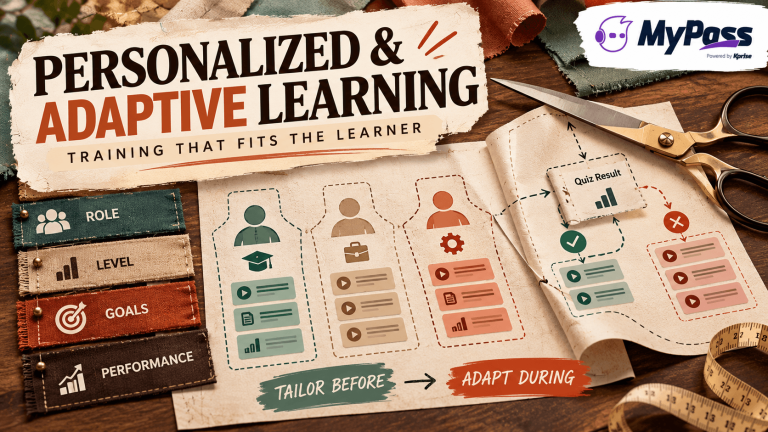
Personalized and Adaptive Learning: Training That Fits the Learner
Course design & delivery
Microlearning for Frontline and Shift Workers: Training That Fits
Course design & delivery