| Personalized learning tailors training to each learner, their role, level and goals, so they're not stuck with one-size-fits-all content. Adaptive learning goes further: it adjusts in real time based on how someone performs, skipping what they know and focusing on what they don't. Both make training more relevant, engaging and efficient, and they're increasingly practical thanks to AI. |
The Problem With One-Size-Fits-All Training
Think about the last generic course you were made to take. Half of it you already knew, some of it didn't apply to your job, and the bit you actually needed went by too fast. That's one-size-fits-all training, and it's the default almost everywhere, not because it works well, but because tailoring training to each person used to be impossible to do at scale.
Personalized and adaptive learning exist to fix exactly this. Instead of pushing identical content at everyone, they match the training to the learner, what they already know, what their role needs, where their gaps are. The result is training that respects people's time and teaches them what they actually need, which is both more effective and a lot less resented. The two terms are related but not the same, and the difference is worth understanding.
| One-size-fits-all training wastes the expert's time on things they know and loses the beginner on things they don't. Personalized and adaptive learning fix this by matching the training to the person, not the average. |
Personalized vs Adaptive: The Difference
People use these terms interchangeably, but they're distinct, and knowing which you mean matters.
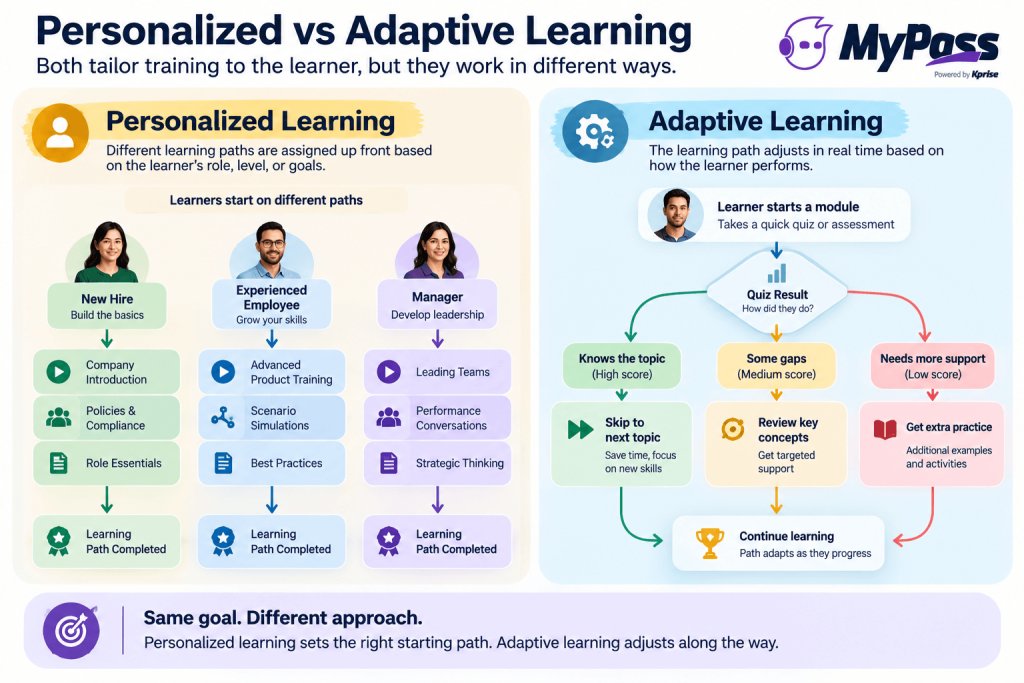
- Personalized learning: training is tailored to the learner up front, by role, level, goals or interests. You decide who gets what.
- Adaptive learning: training adjusts in real time based on performance. It responds as the learner goes, harder if they're flying, more support if they're struggling.
- The simple way to remember it: personalized is tailored before, adaptive adjusts during.
- They work together: you can personalize what someone starts with, then let it adapt as they learn.
Why It's Worth the Effort
Tailoring training takes more thought than blasting everyone with the same course, so it's fair to ask what you get for it. The payoff shows up in a few places that matter. Engagement rises, because people pay attention to training that's clearly relevant to them and tune out training that isn't. Retention improves, because people learn better when content is pitched at their actual level, not too easy, not over their heads. And it's efficient: people don't waste time on what they already know, so training takes less time overall.
There's also a respect dimension that's easy to undervalue. Making everyone sit through content they don't need signals that you don't value their time; giving them training that fits signals that you do. In a world where people resent most mandatory training, that difference affects whether they engage at all. Personalized and adaptive learning aren't just more effective, they make training something people are willing to actually do.
How to Start Without Overcomplicating It
Personalized and adaptive learning can sound high-tech and daunting, but you don't have to start with complex AI-driven adaptivity. Most of the benefit comes from basic personalization you can do straightforwardly, and you can add sophistication later.
- Start with role-based assignment: give people the training their job actually needs, not everything.
- Let people skip what they know: a quick assessment can excuse someone from content they've mastered.
- Build learning paths by level: beginner, intermediate and advanced routes through the same topic.
- Add adaptivity gradually: once the basics work, let content respond to how people perform.
| You don't need fancy AI to start personalizing. Just assigning training by role, so people only get what's relevant to them, is personalization, and it's often the single biggest improvement over one-size-fits-all. |
How MyPass LMS Supports Personalized Learning
MyPass LMS makes the practical forms of personalized learning straightforward, so you get the benefits without needing a research project. Role-based assignment means people receive the training relevant to their job rather than a generic catalogue, and learning paths let you build structured routes tailored to different roles or levels, so a beginner and an experienced employee follow appropriately different journeys.
Assessments let people demonstrate what they already know and move on, rather than sitting through it, and reporting shows where individuals have gaps so you can direct training where it's actually needed. On top of that, AI features help tailor and generate content efficiently. The result is training that fits the learner without creating a mountain of manual work, and because pricing is flat with unlimited registered users, personalizing across your whole workforce doesn't add per-seat cost.
| The fastest win is to stop assigning the same thing to everyone. Assign by role so people only see what's relevant, and let a quick assessment excuse those who already know it. That alone transforms how training feels. |
The bottom line
Personalized learning tailors training to the learner up front (by role, level and goals); adaptive learning adjusts in real time based on performance. Both replace wasteful one-size-fits-all training with something relevant, better-pitched and more efficient, which lifts engagement and retention and respects people's time. And they're increasingly practical, you can start simply and add sophistication later.
Begin with role-based assignment and letting people skip what they know, then build from there. See how role-based paths and assessments support personalized learning in MyPass LMS features, read about designing learning paths, or start a free trial.
Frequently asked questions
What is the difference between personalized and adaptive learning?
Personalized learning is tailored to the learner up front, by their role, level, goals or interests, so you decide who gets what before they start. Adaptive learning adjusts in real time based on how the learner performs, getting harder if they're doing well or offering more support if they're struggling. The simple way to remember it: personalized is tailored before, adaptive adjusts during. They work together, you can personalize someone's starting point and then let the content adapt as they learn.
What is personalized learning in corporate training?
Personalized learning in corporate training means matching the training to the individual rather than pushing identical content at everyone. Instead of one generic course for all, people get training suited to their role, their level and their gaps, so an expert isn't stuck relearning basics and a beginner isn't lost. It raises engagement and retention and respects people's time. In practice it often starts simply, with role-based assignment and letting people skip what they already know.
What are examples of adaptive learning?
Adaptive learning responds to performance in real time. Examples: a course that gives a learner harder questions when they answer correctly and easier ones (or extra explanation) when they struggle; a path that skips a module once a learner proves they already know the material; training that spends more time on a learner's weak areas and less on their strong ones. The common thread is the training re-routing itself based on how the individual is actually doing, rather than following a fixed sequence.
How do you start with personalized learning?
Start simply, you don't need complex AI. Begin with role-based assignment so people get the training their job actually needs rather than everything. Let people skip content they already know by using a quick assessment. Build learning paths by level, beginner, intermediate, advanced, through the same topic. Then, once the basics work, add adaptivity so content responds to how people perform. Most of the benefit comes from that first step: stopping the practice of assigning the same thing to everyone.