| eLearning (electronic learning) is learning delivered through digital technology, usually online, instead of only in a physical classroom. It covers self-paced online courses, live virtual training and blended approaches. Its big benefits are scale, consistency, flexibility and lower cost; its limits are around hands-on skills and engagement. Most workplace eLearning is delivered through a learning management system (LMS). |
eLearning, in One Sentence
eLearning is just learning delivered through digital technology, usually online, rather than only in a physical classroom. That's the whole idea. Instead of everyone gathering in a room with a trainer, people learn through a screen: an online course, a video, a virtual session, an interactive module. The 'e' is simply for 'electronic'. If you've ever taken an online course or clicked through a workplace training module, you've done eLearning.
It's become the default way organizations train people, and for good reason, but it's worth understanding properly rather than treating it as a buzzword. This guide covers what eLearning actually is, the main types, the real benefits and honest drawbacks, and how it's delivered, so whether you're researching it for your organization or just want to understand the term, you'll have the full picture.
| eLearning isn't a specific thing, it's a category: any learning delivered through digital technology instead of only a physical classroom. A quick safety video and a year-long online course are both eLearning. |
The Main Types of eLearning
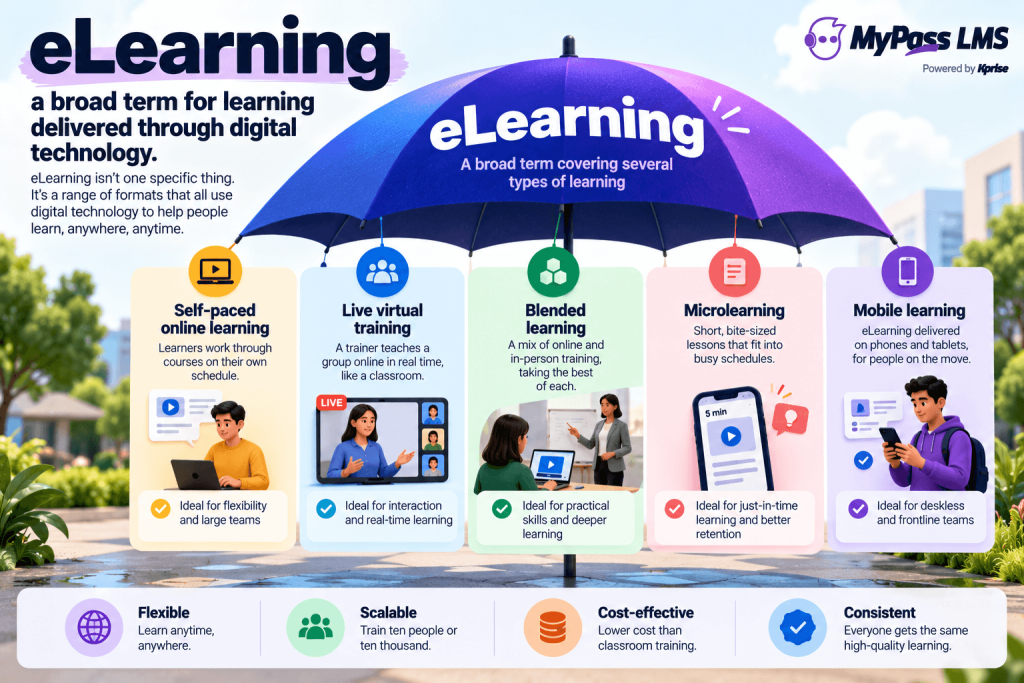
eLearning isn't one format, it's several, and knowing them helps you picture what it actually involves. Most eLearning falls into these types.
- Self-paced online courses: learners work through content on their own schedule, the most common form.
- Live virtual training (synchronous): a trainer teaches a group online in real time, like a classroom over video.
- Blended learning: a deliberate mix of online and in-person, taking the best of each.
- Microlearning: short, bite-sized digital lessons that fit into busy schedules.
- Mobile learning: eLearning delivered on phones and tablets, for people on the move.
The Real Benefits
eLearning became the default for solid reasons, it solves real problems that classroom-only training can't. The biggest wins show up in a few places. It scales: you can train ten people or ten thousand with the same course, which classroom training can't match. It's consistent: everyone gets the same correct version, rather than depending on which trainer they got. It's flexible: people learn when and where it suits them, around their actual work. And it's usually cheaper over time: no venues, travel or repeated trainer time once the content exists.
There's also a tracking benefit that's easy to undervalue, with eLearning, you can actually see who completed what, how they did, and where they struggled, which is nearly impossible with purely in-person training. For most organizations, especially those with distributed, deskless or growing teams, these benefits are exactly why self-paced and mobile learning have become central to how they train.
The Honest Drawbacks
It would be dishonest to pretend eLearning is perfect for everything, it isn't, and knowing its limits helps you use it well. Some things are genuinely harder to teach through a screen. Hands-on physical skills often need real practice that eLearning alone can't provide. Engagement can be a challenge, it's easier to tune out of a screen than a room, so poorly designed eLearning gets clicked through and forgotten. And some topics, especially nuanced, discussion-heavy or interpersonal ones, benefit from live human interaction.
None of these is a reason to avoid eLearning, they're reasons to use it thoughtfully. The strongest approach for many organizations is blended learning eLearning for the knowledge and scale, with in-person or live sessions for the hands-on practice and discussion that need it. Used for what it's good at, and paired with other methods where needed, eLearning is powerful; treated as a cure-all, it disappoints.
| eLearning is brilliant for scaling knowledge consistently, but it won't teach a hands-on skill by itself, and badly designed eLearning gets clicked through and forgotten. Use it for what it's good at, and blend in other methods where it isn't. |
How eLearning Is Delivered
You might wonder how all this actually happens, where the courses live, how people access them, how completion is tracked. The answer, almost always, is a learning management system (LMS). An LMS is the software that hosts eLearning courses, delivers them to learners, and tracks who's done what. If eLearning is the content, the LMS is the place it lives and the system that runs it.
That's where MyPass LMS fits: it's a platform for delivering all types of eLearning, self-paced courses, blended programs, microlearning, mobile, in one place, with the tracking and reporting that make eLearning measurable. You can even build the courses in it, including with an AI course builder, and deliver them at scale without per-seat costs thanks to flat, unlimited-user pricing. If you're moving into eLearning, an LMS is usually the practical starting point, and you can see how it works on the features page or by exploring the course library.
| If you're new to eLearning, the practical first step is usually an LMS to host and track it, then start with one genuinely useful course (often onboarding or compliance) and build from there. |
The bottom line
eLearning is learning delivered through digital technology, usually online, rather than only in a classroom, spanning self-paced courses, live virtual training, blended, micro and mobile learning. Its benefits are real (scale, consistency, flexibility, cost, tracking) and so are its limits (hands-on skills, engagement, nuanced topics). Used thoughtfully, and blended with other methods where needed, it's a powerful way to train.
Most eLearning is delivered through an LMS. See how MyPass LMS delivers and tracks eLearning on the features page, read what an LMS is, or explore pricing.
Frequently asked questions
What is eLearning?
eLearning (electronic learning) is learning delivered through digital technology, usually online, instead of only in a physical classroom. It covers self-paced online courses, live virtual training, blended learning, microlearning and mobile learning. The 'e' simply means electronic. It's become the default way organizations train people because it scales, stays consistent, is flexible and is usually cheaper over time than classroom-only training. Most workplace eLearning is delivered and tracked through a learning management system (LMS).
What are the benefits of eLearning?
The main benefits are scale (train ten or ten thousand people with the same course), consistency (everyone gets the same correct version rather than depending on the trainer), flexibility (people learn when and where it suits them), and lower cost over time (no venues, travel or repeated trainer time once content exists). There's also a tracking benefit: with eLearning you can see who completed what, how they did and where they struggled, which is nearly impossible with purely in-person training. These are why distributed and growing teams rely on it.
What are the types of eLearning?
The main types are self-paced online courses (learners work through content on their own schedule, the most common form), live virtual training or synchronous learning (a trainer teaches online in real time), blended learning (a deliberate mix of online and in-person), microlearning (short, bite-sized digital lessons), and mobile learning (eLearning delivered on phones and tablets). Most organizations use a mix of these, matched to what they're teaching and who they're teaching, all typically delivered through a single learning management system.
What are the disadvantages of eLearning?
eLearning has real limits. Hands-on physical skills often need real practice that eLearning alone can't provide. Engagement can be harder, it's easier to tune out of a screen than a room, so poorly designed eLearning gets clicked through and forgotten. And nuanced, discussion-heavy or interpersonal topics benefit from live human interaction. These aren't reasons to avoid eLearning, but reasons to use it thoughtfully, often blending it with in-person or live sessions for the parts that need them, rather than treating it as a cure-all for every kind of training.