| A train-the-trainer program turns your own subject-matter experts into capable trainers so training scales without hiring. You build one by choosing people who can teach as well as they know the material, training them in both content and facilitation, giving them standardized materials, letting them practice with feedback, and measuring outcomes so quality holds as delivery spreads. |
The Problem Train-the-Trainer Solves
There is a common ceiling in growing organizations: training depends on one or two people, and those people cannot be everywhere. New locations, new hires and new products all need training, but the handful of people who can deliver it are already stretched. Hiring more trainers is slow and expensive, and it does not solve the underlying fragility of relying on a few individuals.
The train-the-trainer model breaks that ceiling. Instead of one expert training everyone, you train a wider group of internal people to deliver training themselves. Done well, it multiplies your training capacity using people you already have, and it makes the whole system more resilient, because knowledge is no longer trapped in one person's head.
| Train-the-trainer is a scaling model, not just a course. The goal is to move from 'one person trains everyone' to 'many people can train,' so capacity grows with the organization instead of bottlenecking on a few individuals. |
Who Makes a Good Internal Trainer
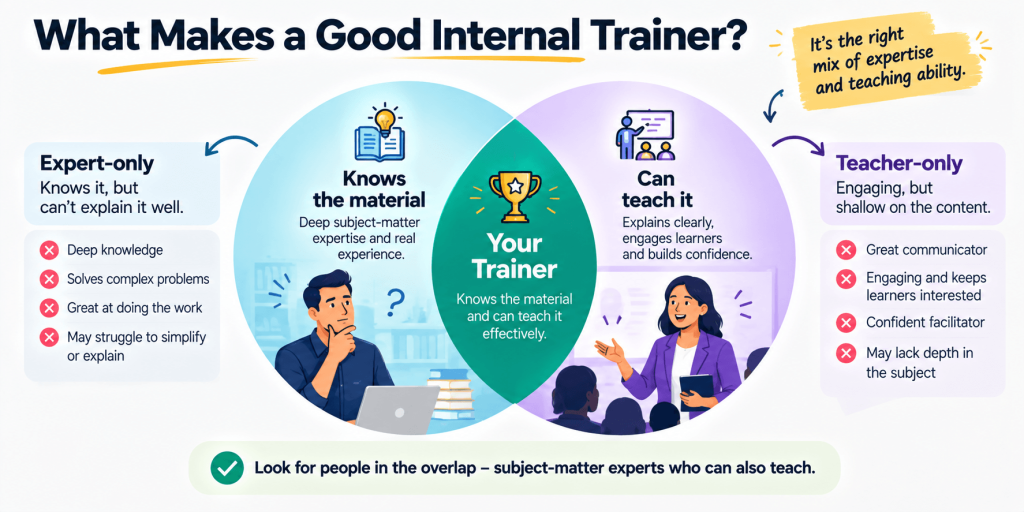
The most common mistake is assuming your best performer will be your best trainer. Doing something expertly and teaching it are different skills, and the two do not always live in the same person. A great internal trainer needs a blend of qualities.
- Real command of the material, so they can answer questions and handle edge cases.
- The ability to explain clearly, breaking complex things into simple steps.
- Patience and empathy, because learners ask 'obvious' questions and need a safe space to.
- Credibility with the audience, so people take the training seriously.
- Willingness to teach, not everyone wants to, and reluctant trainers rarely excel.
Train Them in Content and Delivery Both
Once you have the right people, they need two kinds of preparation, and skipping either one undermines the program. The first is content mastery: even experts benefit from reviewing exactly what the course covers, so every trainer teaches the same correct version. The second, and the one most often neglected, is facilitation skill.
Facilitation is how you actually teach: explaining clearly, asking questions that check understanding, managing a room or a virtual session, handling the person who dominates or the one who has checked out, and knowing when to move on. These are learnable skills, and a train-the-trainer program that only hands over slides, without teaching people how to deliver them, produces inconsistent, often poor sessions.
| The fastest way to ruin a train-the-trainer program is to give people content and assume they can teach. Facilitation, explaining, questioning, reading a room, is a distinct skill that has to be trained deliberately. |
Standardize the Materials
Distributing training across more people creates a risk: everyone starts teaching their own version, and quality drifts. The protection against this is standardized materials. Rather than each trainer building their own slides and improvising, you give every trainer the same structured course, a facilitator guide that tells them how to run it, and consistent assessments.
This does two things. It keeps quality even, so a learner in one location gets the same training as one in another, and it lowers the bar to becoming a trainer, because people are delivering a proven course rather than inventing one. Standardized materials are what let you scale trainers without scaling inconsistency.
How MyPass LMS Supports Train-the-Trainer
MyPass LMS gives a train-the-trainer program the standardized backbone it needs. You build the course once, including with a built-in course builder, so every trainer delivers the same content, and you can host the facilitator guidance and trainer onboarding in the same platform, so new trainers are themselves trained consistently.
For any self-paced portion, learners complete it in the platform while trainers focus their time on the live, high-value facilitation. Reporting shows learner outcomes, and because you can see results by group, you can spot where a particular trainer or location needs support, and keep quality even as you scale. Flat pricing with unlimited registered users means adding trainers and learners does not add per-seat cost.
| Start small: pick one course and two or three potential trainers, train them properly on both content and delivery, have them practice with feedback, then measure their learners' results before expanding. A proven small program is a far better foundation than a rushed large one. |
The bottom line
Train-the-trainer breaks the ceiling that comes from relying on one or two people to train everyone. You build it by choosing people who can teach as well as they know the material, preparing them in both content and facilitation, giving them standardized materials so quality stays even, letting them practice with feedback, and measuring outcomes so you can support trainers as delivery spreads.
The result is training capacity that grows with your organization. See how a built-in course builder and group reporting support consistent delivery in MyPass LMS features, read how to create an employee training program, or start a free trial.
Frequently asked questions
What is the train-the-trainer model?
Train-the-trainer is a model where you train a group of internal people, usually subject-matter experts, to deliver training themselves, rather than relying on one or two central trainers. It multiplies your training capacity using people you already have and makes the organization more resilient, because knowledge is no longer trapped with a few individuals. Done well, it combines content mastery, facilitation skills and standardized materials to keep quality high as delivery spreads.
How do you build a train-the-trainer program?
Choose people who can teach as well as they know the subject, train them in both the content and facilitation skills (explaining, questioning, managing a session), give them standardized materials and a facilitator guide so every trainer delivers a consistent version, let them practice a session with coaching before they train for real, and measure learner outcomes per trainer so you can support quality as the program scales. Start small and prove it before expanding.
Who should be an internal trainer?
Someone with a blend of real command of the material, the ability to explain it clearly, patience and empathy with learners, credibility with the audience, and genuine willingness to teach. The common mistake is picking your top performer automatically: doing something expertly and teaching it are different skills. The best trainers sit in the overlap between knowing the subject and being able to help others learn it.
Why do train-the-trainer programs fail?
Usually because they hand people content and assume they can teach, skipping facilitation training entirely, or because they let each trainer improvise their own version, so quality drifts across the organization. Programs also fail when trainers are chosen only for expertise, not teaching ability, or get no practice and feedback before delivering. The fixes are training delivery skills deliberately, standardizing materials, and supporting trainers with feedback and measurement.