How to Train Deskless Workers (When They're Never at a Desk)
On this page 7 sections
Short answer
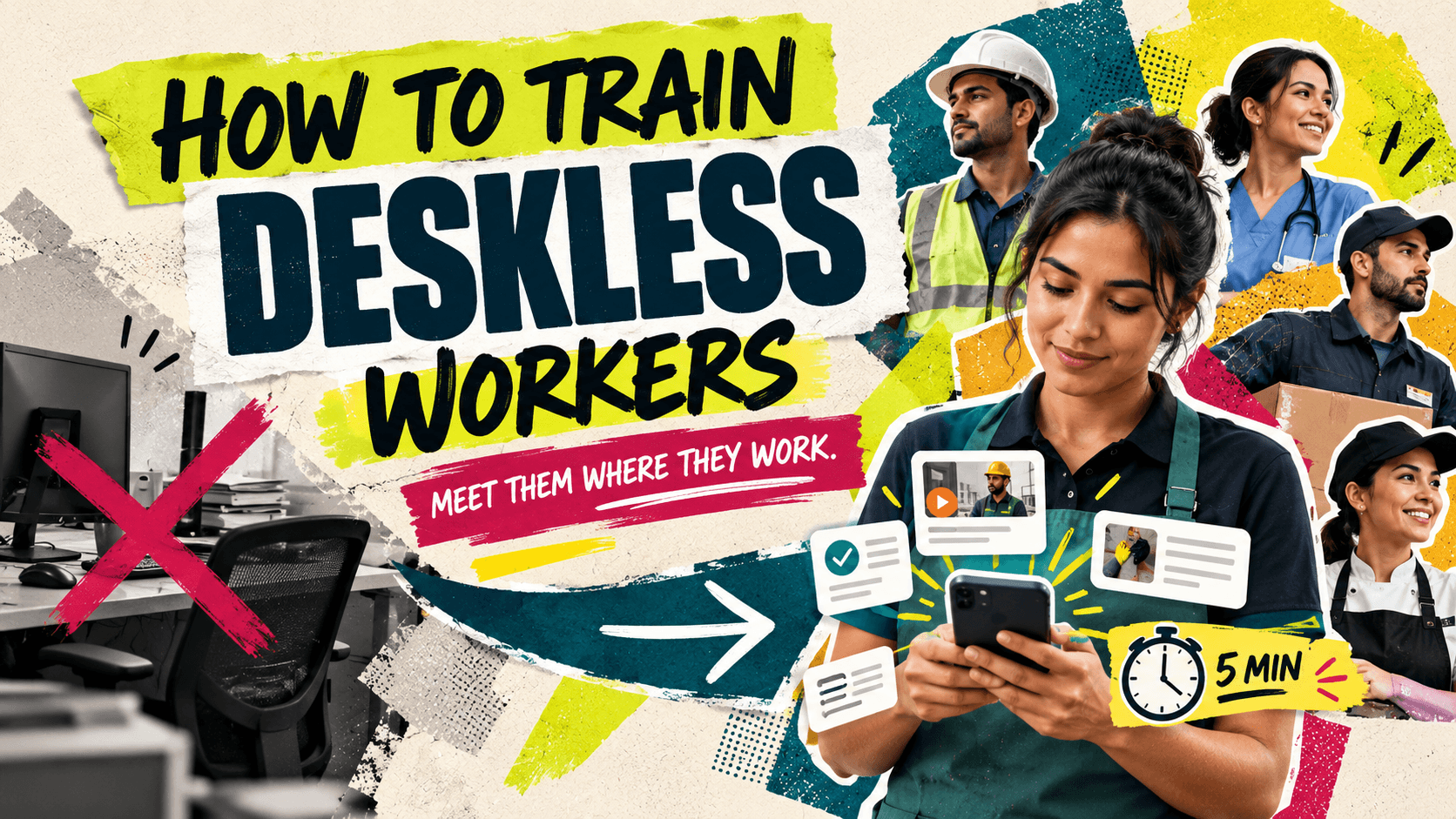
To train deskless workers, meet them where they are: deliver training to their phones in short, practical, visual pieces they can complete around their shifts, self-paced, with simple tracking so you know they're trained before they're on the floor. The core shift is away from desk-and-computer assumptions toward mobile, bite-sized, schedule-friendly training.
The Workers Your Training Tools Forgot
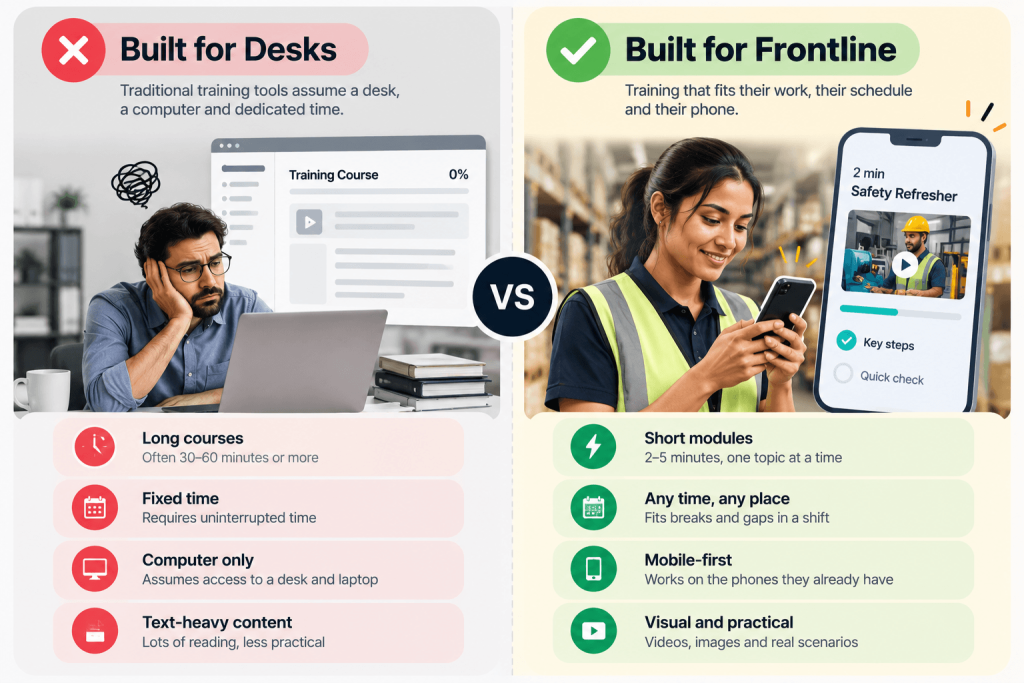
Most training software quietly assumes something that isn't true for a huge share of the workforce: that people sit at a desk, in front of a computer, with time to take a course. But think about who actually keeps most organizations running, retail staff, warehouse crews, drivers, nurses, field technicians, restaurant teams, manufacturing workers. They're on their feet, on the move, and rarely near a computer. They're the deskless workforce, and they're the majority in many industries.
These are often the people whose training matters most, they're the ones serving customers, operating machinery, following safety procedures, and they're the ones traditional training reaches worst. If your approach to training assumes a desk, you're leaving out exactly the people you most need trained. The good news: training deskless workers well isn't complicated, it just requires meeting them where they actually are.
Key point
If your training only really works at a desk, you've built it for the minority. In retail, hospitality, manufacturing, logistics and healthcare, most of the workforce never sits at a computer, and they're often the people whose training matters most.
Meet Them on Their Phone
The single biggest shift in training deskless workers is delivery. They don't have a computer, but almost all of them have a phone, and they carry it everywhere. So the phone, not the desktop, is where frontline training has to live. A platform that only works properly on a computer is a non-starter for people who never sit at one.
Mobile delivery changes everything about reach. A retail worker can do a module on their break, a driver between runs, a nurse between rounds. They don't have to be pulled off the floor to a back-office computer that's always in use anyway. If you take one thing from this article, make it this: frontline training has to be mobile-first, because the phone is the only screen most of these workers actually have access to during their day.
Short, Practical, and On Their Schedule
Reaching the phone is necessary but not enough, what you deliver to it matters just as much. Frontline work is busy, physical and interruption-heavy, so the training has to fit that reality rather than fight it.
- Keep it short: small pieces that fit a break or a gap between tasks, not hour-long courses.
- Make it practical: focus on what they actually do, not theory they'll never use.
- Make it visual: show the task with video or images, because frontline work is physical.
- Let it be self-paced: people learn when they can, around a shift, not at a fixed clashing time.
- Keep tracking light: confirm completion without piling admin on already-stretched managers.
Don't Make Managers the Bottleneck
There's a trap in frontline training: if getting someone trained depends on a manager running a session or chasing paperwork, it won't happen consistently, because frontline managers are the busiest people in the building. Every hour a shift lead spends on training admin is an hour they're not running the floor, so training that leans on them quietly gets skipped.
The fix is to make training as self-service as possible. Workers complete it themselves on their phones, the system tracks who's done it and reminds those who haven't, and the manager's only job is to glance at a report, not to deliver or chase. Taking the admin burden off frontline managers is often the difference between a training program that runs and one that stalls after the first busy week.
Key point
Frontline managers are already stretched thin. If training adds to their workload, it won't survive a busy period. Make it self-serve and self-tracking so a manager's only job is to check a report, not run the training.
How MyPass LMS Reaches the Frontline
MyPass LMS is built to reach exactly the workers desk-based tools miss. It's mobile-first, so frontline staff complete training on their own phones, wherever they are, and you can deliver short, visual, practical content that fits a break rather than requiring a classroom.
Self-paced delivery means people learn around their shifts, and automated tracking and reminders take the chasing off managers, they just see who's trained. Bulk enrolment handles onboarding a whole shift or site at once, and because pricing is flat with unlimited registered users, putting your entire frontline, often your largest group of workers, on the platform doesn't add per-seat cost. For a deskless-heavy workforce, that last point matters a lot.
Key point
Start with the one piece of training your frontline most needs and can't easily get, often a safety or core-task refresher, and deliver it mobile, short and self-paced. Proving it reaches people on their phones is the fastest way to see the difference.
The bottom line
Deskless and frontline workers are the majority in many industries and often the people whose training matters most, yet traditional training reaches them worst because it assumes a desk and a computer. Train them by meeting them where they are: mobile delivery to their phones, short and practical and visual content, self-paced around their shifts, and light tracking that doesn't burden managers.
Flip every desk-based assumption and frontline training suddenly works. See how mobile, self-paced delivery reaches the frontline in MyPass LMS features, read about mobile learning for field teams, or start a free trial.
Frequently asked questions
How do you train deskless workers?
Meet them where they are. Deliver training to their phones (the one screen they have during the day), keep it short so it fits a break or a gap between tasks, make it practical and visual since the work is physical, let it be self-paced so it fits around shifts, and keep tracking light so it doesn't burden managers. The core shift is flipping every desk-and-computer assumption, because deskless workers are never at a desk, that's the whole point.
What is the deskless workforce?
The deskless workforce is everyone who doesn't do their job at a desk in front of a computer, retail staff, warehouse and manufacturing workers, drivers, nurses, field technicians, hospitality teams and more. They make up the majority of workers in many industries, and they're often the people whose training matters most because they serve customers, operate equipment and follow safety procedures. Yet traditional training reaches them worst, because most training tools assume a desk that these workers don't have.
Why doesn't traditional training work for frontline workers?
Because most training assumes something untrue for frontline staff: that they sit at a computer with time to take a course. Frontline workers are on their feet, on the move and rarely near a computer, so desktop-based, long, fixed-time, text-heavy training simply doesn't reach them. It also often leans on already-stretched frontline managers to deliver or chase it. Training that works for the frontline flips all of this: mobile, short, visual, self-paced, and self-tracking.
What's the best way to deliver training to frontline staff?
On their phones, in short, practical, visual pieces they can complete self-paced around their shifts. Almost every frontline worker carries a phone all day, so it's the one reliable way to reach them, far more so than a back-office computer that's always in use. Keep modules short enough for a break, show tasks with video rather than describing them in text, and make the whole thing self-serve so workers complete and the system tracks it, without a manager having to run sessions.
Keep reading
Course design & delivery
Microlearning for Frontline and Shift Workers: Training That Fits
Course design & delivery