| To onboard seasonal workers fast, get accounts and training assigned before day one, teach only what they need to start safely and usefully, make the core training self-paced and mobile so you're not repeating sessions, pair each person with a go-to contact, and save the whole package so you can reuse it next peak instead of rebuilding it. |
The Seasonal Onboarding Squeeze
Seasonal hiring is a genuine bind. You bring on a wave of people all at once, often right before your busiest stretch, and you need them productive almost immediately, but they may only be around for a few weeks or months. The onboarding you use for permanent staff is too slow and too heavy, yet skipping onboarding entirely means unsafe, unproductive workers exactly when you can least afford them.
The answer isn't to do less onboarding, it's to do onboarding differently. Seasonal onboarding has to be fast, focused and repeatable, and once you set it up that way, each peak season gets easier instead of being a fresh scramble.
| Don't shrink your permanent onboarding and call it seasonal onboarding. They're different jobs. Seasonal onboarding is about getting someone safe and useful in hours, not turning them into a long-term expert. |
Teach the Vital Few, Not the Nice-to-Know
The biggest mistake with seasonal staff is trying to teach them everything a permanent employee learns, just faster. It doesn't work, and it wastes the little time you have. Instead, ruthlessly separate what someone genuinely needs to start their job safely and usefully from what's merely nice to know.
For most seasonal roles the essentials are a short list: the safety basics that keep them and others from harm, the core tasks they'll actually do, and where to go when they're stuck. That's it for day one. Everything else, deeper product knowledge, edge cases, the company history, can come later if it comes at all. Front-loading only the vital few gets people working sooner and respects that their time with you is short.
Make It Self-Serve, Not a Repeated Lecture
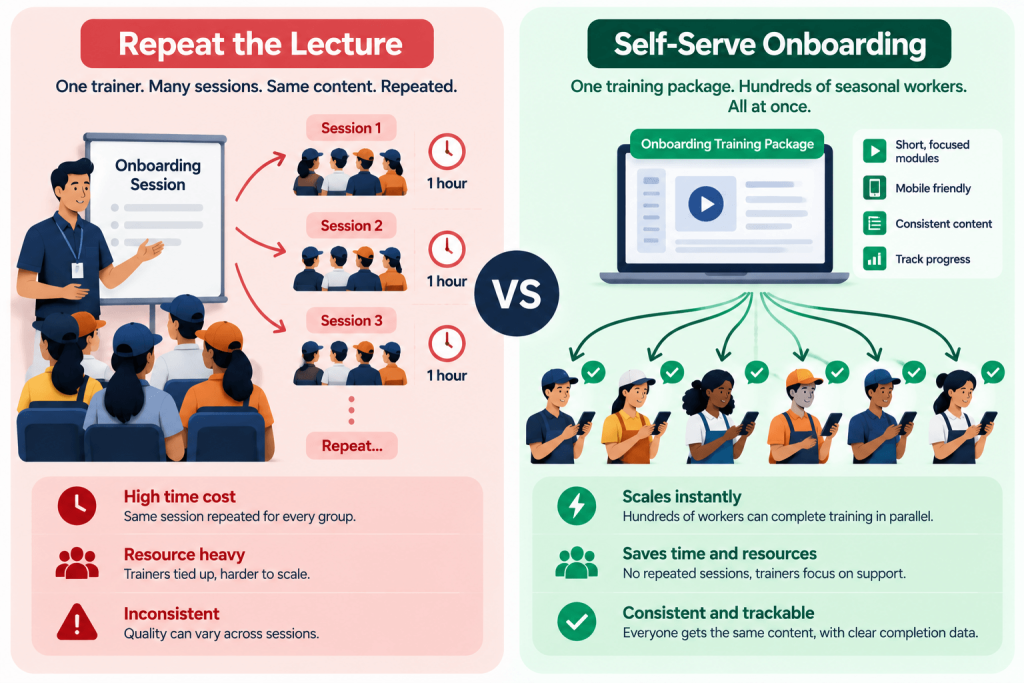
If onboarding means you personally walking each new hire through the same material, a wave of seasonal staff will bury you. The fix is to make the core training self-paced and, ideally, mobile, so people can complete it on their own phone, at their own speed, without a scheduled session or a trainer in the room.
- Self-paced: they start whenever they're ready, and you're not running the same session ten times.
- Mobile: frontline and seasonal workers often don't sit at a desk, so training has to reach their phone.
- Consistent: everyone gets the same correct version, not a rushed one that skips bits.
- Trackable: you can see who's actually done it before they're on the floor.
Don't Skip the Human Bit
Self-serve training handles the what; it doesn't handle the "who do I ask when something weird happens?" And with seasonal staff, weird things happen constantly, because they're new and everything is unfamiliar. A worker who can't get an answer either guesses (risky) or stands around (unproductive), and both are expensive during peak.
So pair each new seasonal hire with a go-to person, an experienced colleague or a shift lead, whose job is simply to be askable. It costs almost nothing and it's the difference between a new worker who gets unstuck in thirty seconds and one who wastes an afternoon. Fast onboarding plus a human safety net is what actually gets people productive, not training alone.
| The go-to person doesn't need to train anyone. They just need to be the obvious answer to "who do I ask?" That single point of contact removes most of the friction a new seasonal worker hits. |
How MyPass LMS Makes Seasonal Onboarding Repeatable
The real win with seasonal onboarding is doing the work once and reusing it every peak. In MyPass LMS you build the essential onboarding as a self-paced course, assign it in bulk to a whole intake of seasonal hires at once, and let them complete it on their phones before or on day one, no repeated sessions.
You can see who's finished before they start work, so nobody's on the floor untrained, and because the course is saved, next season you assign the same package to the new intake instead of rebuilding it. Bulk enrolment handles the volume, and flat pricing with unlimited registered users means a big seasonal wave doesn't spike your costs, you're not paying per temporary seat.
| Build it once, properly, this season, then it's an asset. The second peak, and every one after, becomes 'assign the package and check the report' instead of starting from scratch under pressure. |
The bottom line
Seasonal onboarding fails when you treat it like a rushed version of permanent onboarding. Do it differently: prepare before day one, teach only the vital few things people need to start safely and usefully, make the core training self-paced and mobile so it scales with the volume, pair each person with a go-to contact, and save the whole thing to reuse next peak.
Get it right once and every future season gets easier. See how bulk enrolment and self-paced mobile courses handle a seasonal wave in MyPass LMS features, or read about bulk user onboarding. Peak season coming up? Start a free trial.
Frequently asked questions
How do you onboard seasonal workers quickly?
Prepare before they arrive (accounts, access and training assigned ahead of day one), teach only the essentials they need to start safely and usefully rather than everything a permanent hire learns, make the core training self-paced and mobile so it scales without repeated sessions, pair each person with a go-to contact for questions, and save the whole package so you can reuse it next season. The goal is safe and useful in hours, not expert in weeks.
What should seasonal employee onboarding include?
Just the vital few things for the role: the safety basics that protect them and others, the core tasks they'll actually perform, and where to go when they're stuck. Skip the deep product knowledge, edge cases and company history that permanent staff need over time, those can wait or be dropped entirely for short tenures. Front-loading only the essentials gets seasonal workers productive faster and respects that their time with you is limited.
How is onboarding seasonal workers different from permanent staff?
Permanent onboarding builds long-term knowledge and connection over weeks; seasonal onboarding needs to make someone safe and useful in hours, because they arrive in a wave, often right before peak, and may only stay weeks. Trying to run a compressed version of permanent onboarding wastes the little time you have. Seasonal onboarding should be fast, focused on essentials, self-serve so it scales, and reusable so each peak gets easier.
Can seasonal onboarding be done on mobile?
Yes, and for many seasonal roles it should be. Frontline, retail, warehouse and event staff often don't sit at a desk, so training that only works on a computer won't reach them. Self-paced mobile onboarding lets a whole intake complete the essentials on their own phones, at their own speed, before or on day one, without a trainer running the same session repeatedly. It's also trackable, so you can confirm everyone's done it before they start.