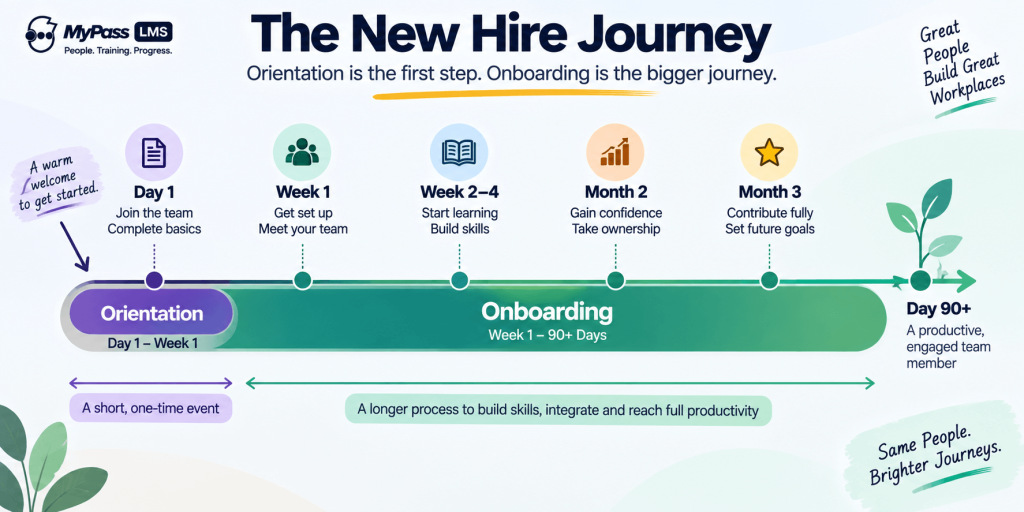
| Orientation is a short, one-time event that welcomes a new hire and covers the basics: paperwork, policies, tools and introductions. Onboarding is the longer process, often 90 days or more, that turns a new hire into a productive, integrated team member. Orientation is part of onboarding, not a replacement for it. |
The Core Difference
Orientation and onboarding get used interchangeably, but they describe different things and confusing them leads to new hires who feel welcomed on day one and lost by week three. Orientation is an event: the first-day or first-week welcome that handles paperwork, introduces policies and tools, and shows people around. Onboarding is a process: the weeks or months of training, integration and support that take a new hire from arrival to full productivity.
The simplest way to hold the distinction: orientation is a moment, onboarding is a journey. Orientation is one of the first steps of onboarding, not the whole thing. An organization that runs a great orientation and then leaves people to fend for themselves has done onboarding badly, regardless of how good day one felt.
| If your 'onboarding' ends after the first week, it is really just orientation. Real onboarding continues through the first 90 days and often beyond, because that is how long it takes someone to become fully productive. |
Side by Side
Laying the two next to each other makes the difference concrete and shows why you need both.
| Orientation | Onboarding | |
| Type | One-time event | Ongoing process |
| Duration | A day or a week | Often 90 days or more |
| Focus | Welcome, paperwork, policies, tools | Training, integration, productivity |
| Goal | Get the basics set up | Turn a hire into a contributor |
| Owner | Usually HR | HR, the manager and the team |
Why Both Matter
Getting either one wrong is costly, and they fail in different ways. A weak orientation makes a chaotic first impression, forms not ready, no laptop, nobody expecting the new hire. A weak onboarding process is quieter but more damaging: the person is welcomed, then abandoned, and a large share of preventable early turnover happens in exactly this gap.
- Orientation done well: a smooth, organised start that signals the organization is competent and glad they came.
- Onboarding done well: structured training and support that gets the hire productive faster and makes them want to stay.
- Orientation without onboarding: a warm welcome followed by confusion and early exits.
- Onboarding without orientation: useful development undermined by a shaky, disorganised first day.
| The 90-day mark matters. A large share of new hires who leave do so within their first three months, and the cause is usually a poor onboarding process, not a poor orientation. Fix the process, not just the welcome. |
How to Do Both Well
A strong new-hire experience treats orientation as the first structured step of a longer onboarding journey, with both planned rather than improvised.
- Prepare orientation before day one: accounts, equipment and paperwork ready so the first day runs smoothly.
- Structure onboarding across 30, 60 and 90 days, with clear goals at each stage.
- Assign role-based training so each hire learns what their specific job needs, not a generic tour.
- Automate the repeatable parts, enrolment, reminders, policy sign-offs, so nothing is forgotten.
- Track progress so managers can see who is on track and who needs support.
This is where a learning platform turns onboarding from a manual, easily-dropped process into a reliable one.
How MyPass LMS Supports Onboarding
MyPass LMS runs the onboarding process as a structured, trackable program rather than a scramble. Orientation content, policy sign-offs and role-based training sit in learning paths, assignment and reminders are automated so nothing slips, and progress is visible across the first 90 days.
Because it handles bulk enrolment and role-based assignment, a new intake, one hire or fifty, gets the right onboarding automatically, and flat pricing with unlimited registered users means onboarding seasonal or high-volume intakes does not inflate cost. The result is an onboarding process that actually continues past day one instead of quietly stopping there.
| Tip: build one onboarding learning path per role, opening with the orientation basics everyone needs, then branching into role-specific training. That way orientation and onboarding live in one place and no new hire falls through the gap between them. |
The bottom line
Orientation and onboarding are not interchangeable. Orientation is the one-time welcome event; onboarding is the months-long process that makes a new hire productive and keeps them. Orientation is the first step of onboarding, not a substitute for it, and confusing the two is how organizations lose people in the first 90 days.
Do both well by treating orientation as the start of a structured onboarding journey. See how learning paths, bulk enrolment and progress tracking support onboarding in MyPass LMS features, read our employee onboarding checklist, or start a free trial.
Frequently asked questions
What is the difference between onboarding and orientation?
Orientation is a one-time event, usually the first day or week, that welcomes a new hire and covers basics like paperwork, policies, tools and introductions. Onboarding is the longer process, often 90 days or more, that trains and integrates the hire until they are fully productive. Orientation is one step within onboarding, not a replacement for it.
Is orientation part of onboarding?
Yes. Orientation is typically the first structured step of the broader onboarding process. It handles the immediate welcome and setup, while onboarding continues for weeks or months with training, integration and support. Treating orientation as the whole of onboarding is a common mistake that leaves new hires welcomed but then unsupported.
How long should onboarding last?
Onboarding commonly lasts at least 90 days and often longer, because that is roughly how long it takes a new hire to reach full productivity. Structuring it across 30, 60 and 90-day stages with clear goals works well. Orientation, by contrast, lasts only a day or a week. Ending 'onboarding' after the first week means you have really only done orientation.
Why does the difference between onboarding and orientation matter?
Because they fail differently and both are costly. A weak orientation makes a chaotic first impression; a weak onboarding process quietly abandons new hires after the welcome, and much preventable early turnover happens in that gap. Understanding the difference ensures you plan both: a smooth start and a structured process that follows it.