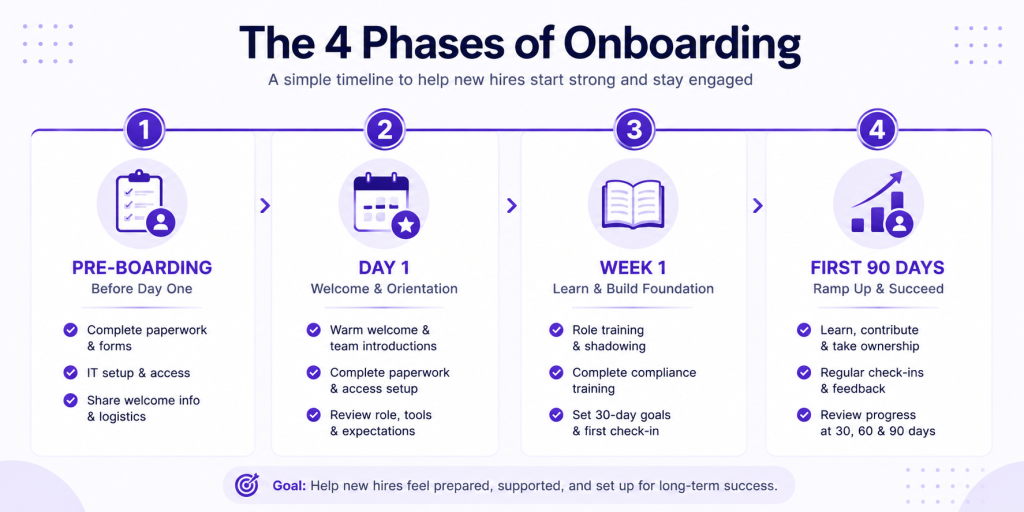
A complete employee onboarding checklist spans four phases: pre-boarding before day one, the first day, the first week, and the first 90 days. Pre-boarding covers paperwork, IT setup and access, day one covers welcome and orientation, week one covers role training and compliance training, and the first 90 days covers ramp-up and check-ins. Standardizing this in a repeatable checklist is what makes onboarding consistent instead of ad hoc.
Why onboarding is the cheapest retention lever you have
Research from Gallup has found that only around 12 percent of employees strongly agree their organization onboards new hires well. That is not a minor gap. Poor onboarding is directly tied to early turnover, and replacing someone costs far more than onboarding them properly in the first place. Structured onboarding, by contrast, has been shown to meaningfully lift new hire retention and productivity.
In other words, onboarding is one of the highest return processes you can fix, and it is mostly a matter of consistency. A checklist turns onboarding from something that depends on how busy the hiring manager happens to be that week into a repeatable process where nothing slips. Here is the full checklist, phase by phase, ready to copy and adapt.
Phase 1: pre-boarding, before day one
The best onboarding starts before the new hire walks in. Pre-boarding prevents the awkward, unproductive first day where nothing is ready.
- Send the offer paperwork, contracts and any required forms, including tax and payroll setup
- Provision IT: laptop, accounts, email, software access and building or system access
- Share a welcome message, first day logistics, schedule and dress code
- Assign a buddy or mentor and notify the team a new person is starting
- Prepare their workspace, whether physical or a remote equipment shipment
Phases 2 and 3: the first day and first week
Day one sets the tone. Week one builds competence. Keep day one welcoming rather than overwhelming, and front-load week one with the training that helps a new hire contribute.
First day:
- Warm welcome, workspace orientation and team introductions
- Complete any remaining paperwork and confirm system access works
- Walk through the org chart, tools and where to get help
- Set expectations for the first week, so no one ends day one unsure what happens next
First week:
- Role specific training and shadowing
- Assign mandatory compliance training covering harassment prevention, cybersecurity, data privacy and any industry requirements
- Set initial 30 day goals and clarify how success is measured
- First manager check-in to answer questions and catch problems early
| → Front-load compliance training in week one and track it automatically. New hire compliance is exactly where documentation gaps appear, and those gaps tend to surface at the worst possible moment, in an audit. |
Phase 4: the first 90 days, and how to make it repeatable
Onboarding does not end when the paperwork is done. The first 90 days are where a new hire either becomes productive and engaged or quietly checks out. Structure it with a 30-60-90 day plan:
- Days 1 to 30: learn systems, people, processes, and complete foundational training
- Days 31 to 60: contribute by taking on real work with support, deepening role skills
- Days 61 to 90: own the role fully, with clear goals and a review of the ramp
- Regular check-ins throughout, plus completion of all required training with records stored
The thing that makes onboarding actually work is not the checklist existing. It is the checklist being consistent and tracked. When onboarding tasks and training assignments run through a single platform that assigns and records everything automatically, every new hire gets the same strong experience, and you have proof each step happened.
The bottom line
A good onboarding checklist spans four phases: pre-boarding, day one, week one, and the first 90 days. Its real power is consistency. Every new hire gets the same strong start, and nothing depends on how busy someone was that week. Front-load the compliance training, structure the ramp, and track completion so you can prove it happened. That is the difference between onboarding that retains people and onboarding that loses them.
MyPass LMS automates the training side of onboarding, with role-based assignment, compliance courses ready out of the box, completion tracking and audit-ready records, and unlimited users so every hire is covered. See the onboarding solution, or start a free trial.
Frequently Asked Questions
What should an employee onboarding checklist include?
Four phases: pre-boarding (paperwork, IT setup, access), the first day (welcome, orientation, introductions), the first week (role training, compliance training, initial goals), and the first 90 days (ramp-up, check-ins, and completing all required training).
What is pre-boarding?
Pre-boarding is everything you do before a new hire's first day: sending paperwork, provisioning IT and access, sharing first day logistics, and assigning a buddy. It prevents the unproductive first day where nothing is ready.
How long should onboarding last?
Effective onboarding runs at least 90 days, structured as a 30-60-90 plan: learn in the first 30 days, contribute in the next 30, and reach full ownership by day 90. Onboarding that ends after week one leaves retention on the table.
What compliance training do new hires need?
Common mandatory topics include harassment prevention, workplace safety, cybersecurity awareness, data privacy and code of conduct, plus any industry specific requirements. Assign these in week one and track completion with dated records.
How do I make onboarding consistent?
Use a repeatable checklist and run training assignments through a single platform that assigns and records everything automatically. Consistency, not the checklist existing on paper, is what makes onboarding reliably effective.