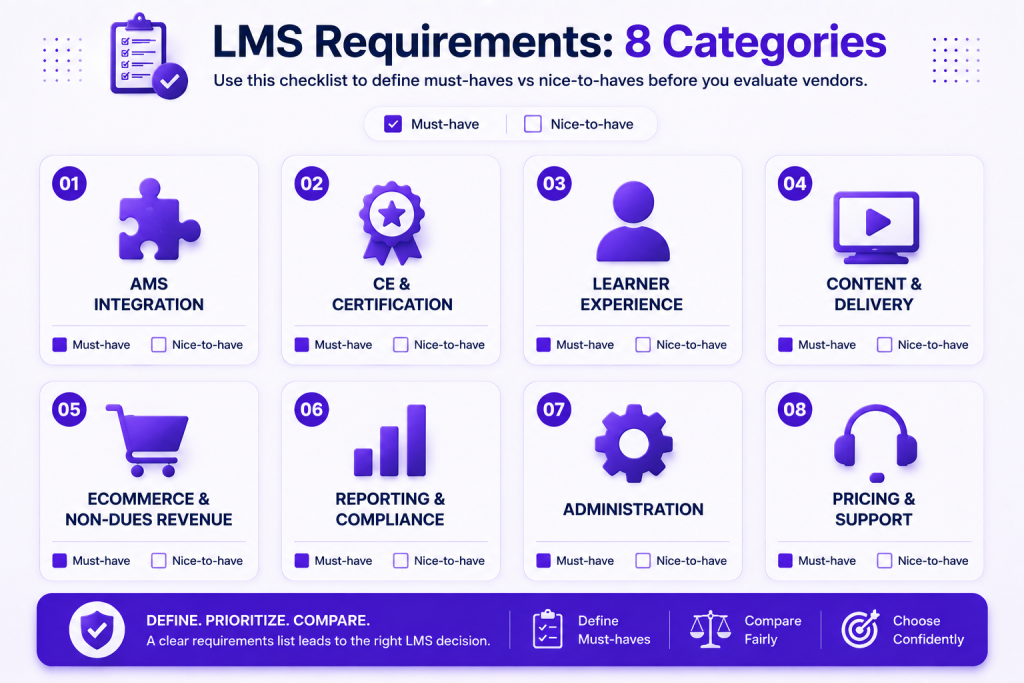
An LMS requirements checklist for an association should cover eight categories: AMS integration, CE and certification handling, learner experience, content and delivery, ecommerce and non-dues revenue, reporting and compliance, administration, and pricing and support. Specify must-haves versus nice-to-haves in each category before you shortlist vendors — a written requirements list is what keeps demos honest and comparisons fair.
Why a requirements list beats a feature wishlist
There's a difference between a list of features you'd like and a list of requirements you can hold vendors to. The first gets you a pleasant demo. The second gets you a platform that actually works for your association — because you decided what mattered before anyone started selling to you.
Copy the checklist below, mark each item must-have or nice-to-have for your organization, and use it to score every vendor. It's organized by category so nothing important slips through, and it's built for associations specifically — which means it leads with the things generic LMS checklists forget.
The checklist: eight categories to specify
1. AMS integration — the category that gates the rest.
- Native, bidirectional integration with your specific AMS (iMIS, Nimble AMS, MemberClicks, Fonteva and others )
- Single sign-on so members log in once
- Automatic member sync and tier-based enrollment
- CE credit and completion writeback to the member profile
2. CE and certification.
- Your specific credit types (CEU, CPE, CME, CLE), including fractional credits
- Certification issuance, expiry tracking and recertification workflows
- Transcript generation and accreditation-body reporting
3. Learner experience.
- Modern, mobile-responsive interface
- Accessible design (WCAG considerations)
- Intuitive navigation that doesn't need a manual
4. Content and delivery.
- SCORM and xAPI support
- Live/instructor-led training and webinar handling
- Assessments, quizzes and exam proctoring options
The checklist, continued: categories 5-8
5. Ecommerce and non-dues revenue.
- Native course ecommerce
- Member versus non-member pricing
- Bundles, subscriptions and discount handling
- Content protection / DRM
6. Reporting and compliance.
- Audit-ready completion reports and an immutable audit trail
- Custom and board-level reporting
- Automated reminders for expiring credits and certifications
7. Administration.
- Role-based admin permissions
- Bulk operations and automation rules
- Chapter / committee / group management
8. Pricing and support.
- Transparent total cost including implementation, integrations and add-ons
- Data migration support (full historical credit and learner records)
- Implementation timeline and ongoing support terms
| → For each line, don't just ask 'do you have this?' — ask vendors to show it in the demo. A checkbox on a feature grid and a working demonstration are very different things, especially for AMS integration and CE writeback. |
The bottom line
A good LMS requirements checklist turns a vendor selection from an impressionable series of demos into a fair, scored comparison. Specify your must-haves across all eight categories before you shortlist, lead with AMS integration and CE handling because those are where association-fit is won or lost, and insist on live demonstrations rather than feature-grid checkmarks. Do that and the right platform becomes obvious.
MyPass LMS was built against exactly this checklist — native integration with eight AMS platforms, full CE and certification handling, non-dues revenue tools, audit-ready reporting, and unlimited registered users. Compare it against your requirements , or start a free trial and check the boxes yourself.
Frequently Asked Questions
What should be on an LMS requirements checklist?
Eight categories: AMS integration, CE and certification handling, learner experience, content and delivery, ecommerce and non-dues revenue, reporting and compliance, administration, and pricing and support. Mark each item must-have or nice-to-have before shortlisting.
What's the most important LMS requirement for an association?
Native, bidirectional AMS integration. It gates other requirements — tier-based enrollment, SSO and accurate CE records all depend on it. Make it a must-have and verify it live in demos.
How do I use an LMS requirements checklist?
Copy it, mark each item must-have or nice-to-have for your organization, then score every vendor against it. Ask vendors to demonstrate each capability live rather than accepting a feature-grid checkmark.
Should pricing model be a requirement?
Yes. For associations, a pricing model that fits your membership — ideally unlimited registered users or flat pricing rather than per-seat — belongs in your requirements, because per-seat models penalize membership growth.
What's the difference between a requirements checklist and an RFP?
A requirements checklist defines what you need internally. An RFP formally asks vendors to respond to those requirements. Build the checklist first, then use it as the backbone of your RFP.