| OSHA requires employers to train workers on the specific hazards of their job, before exposure, plus periodic refreshers, some annual. There is no single universal course; your exact requirements depend on your industry and the OSHA standards that apply to your workplace, so the first step is identifying which standards cover your operations. |
The Short, Honest Answer
Employers ask 'what OSHA training do I need and how often?' expecting one clean list. The honest answer is that it depends on your workplace, because OSHA's training requirements live inside individual standards, and which standards apply depends on your industry and the hazards your workers face. A warehouse, a hospital and a construction site have very different obligations.
What is universal is the principle: OSHA expects you to train workers on the hazards of their specific job, in a language and manner they understand, before they are exposed to that hazard, and to refresh that training when required. This article explains how to figure out your obligations rather than pretending one checklist fits everyone.
| This is general information, not compliance advice. OSHA requirements change and vary by state (states with their own OSHA-approved plans can be stricter). Always confirm your specific obligations against the current OSHA standards and, where needed, a qualified safety professional. |
How to Find Which Training Applies to You
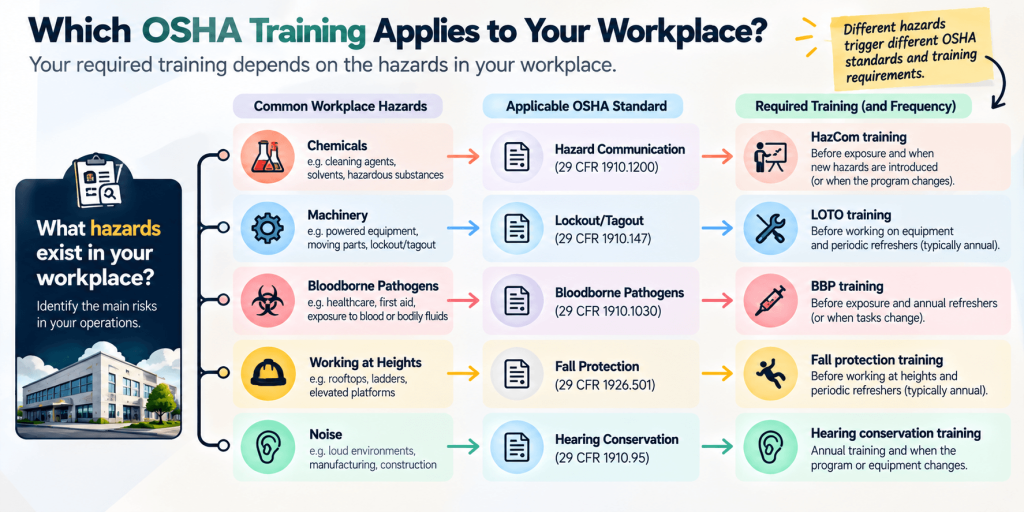
Because requirements are standard-by-standard, the practical first step is identifying which OSHA standards cover your workplace. That tells you which training you owe.
- Identify your industry standards: general industry, construction, maritime or agriculture each have their own set.
- List your workplace hazards: chemicals, machinery, heights, blood/bodily fluids, noise, electrical, and so on.
- Match hazards to standards: each hazard typically maps to a standard that specifies required training.
- Check OSHA's training library: OSHA publishes a list of which standards require training and how often.
- Check your state: state-plan states may add requirements beyond federal OSHA.
Initial Training vs Refresher Training
OSHA training generally falls into two buckets, and confusing them is a common compliance gap. Initial training happens before a worker is exposed to a hazard, when they are newly hired, change jobs, or when a new hazard is introduced. This is non-negotiable for covered hazards; you cannot put someone on a task with a hazard they have not been trained on.
Refresher training keeps that knowledge current. Some standards require refreshers on a set schedule (annual is common), others require retraining only when something changes, such as new equipment, a new process, or evidence that a worker has not retained the training. Knowing which of your standards are annual versus event-triggered is essential to building a compliance calendar that neither over-trains nor misses a deadline.
| 'Annual' is a frequent but not universal requirement. Some well-known standards call for yearly refreshers (for example, bloodborne pathogens for at-risk workers), while others are triggered by change rather than the calendar. Do not assume everything is annual, and do not assume nothing is. |
Documentation: The Part That Fails Audits
Providing training is only half of compliance; proving you provided it is the other half. In an OSHA inspection or after an incident, undocumented training often counts as no training. You need records showing who was trained, on what, when, and ideally that they understood it.
That means keeping, for each worker, the topics covered, the dates, the trainer or course, and completion or assessment records, and being able to produce them quickly. Manual spreadsheets tend to fall apart at exactly the wrong moment, when an inspector asks for evidence and half the records are missing or out of date. This is where a system that tracks assignments, completions and expiry earns its place.
How MyPass LMS Helps You Stay Audit-Ready
MyPass LMS is built to make safety-training compliance provable. You assign required courses by role, so the right workers get the right training automatically, and completions are recorded against each person with dates and assessment results, the exact evidence an audit asks for.
For refresher requirements, recurring assignments and automated reminders reschedule training on the right cycle and chase people before deadlines pass, so annual refreshers do not slip. And when an inspector or auditor asks for proof, one-click reporting produces the record of who was trained on what and when, instead of a scramble through spreadsheets.
| A practical first step: list every OSHA standard that applies to your workplace, note whether each requires annual or event-based refreshers, then set those up as recurring assignments so the system, not your memory, tracks the deadlines. |
The bottom line
OSHA does not hand employers one universal training list; it requires you to train workers on the specific hazards of their jobs, before exposure and with refreshers where standards demand them. Your obligations follow from which OSHA standards apply to your workplace, so identifying those standards, and whether each refresher is annual or event-triggered, is the real first step.
Then make compliance provable, because undocumented training fails audits. See how assignment tracking and one-click reporting keep you audit-ready in MyPass LMS features, read how one-click audit reports work, or start a free trial. Always confirm your specific obligations with OSHA and a qualified professional.
Frequently asked questions
How often is OSHA training required?
It depends on the standard. Some OSHA standards require annual refresher training (bloodborne pathogens for at-risk workers is a common example), while others require initial training only, with retraining triggered by a change such as new equipment, a new process, or evidence a worker did not retain it. There is no single frequency for all OSHA training; check each standard that applies to your workplace.
What OSHA training is mandatory for all employees?
There is no single course every employee everywhere must take. OSHA requires training tied to the hazards of a specific job and workplace, so a warehouse worker, a nurse and an electrician have different mandatory training. What is universal is the employer's duty to train workers on their job's hazards, in a way they understand, before they are exposed. Your specific list comes from the OSHA standards that cover your operations.
Does OSHA training need to be documented?
Yes, and this is where many employers fail an audit. OSHA and inspectors generally expect records showing who was trained, on what topics, when, and often that they understood the material. In an inspection or after an incident, training you cannot document often counts as training you did not provide. Keeping clear, retrievable records per worker is as important as delivering the training itself.
Can OSHA training be done online?
Much of it can, and online or LMS-based delivery is widely used for the classroom-knowledge portion of many OSHA topics, especially refreshers. However, some standards require hands-on or practical demonstration that cannot be done purely online (for example, certain equipment operation). A common approach is to deliver knowledge training and record-keeping through an LMS and handle any required hands-on component in person, with both tracked in one place.