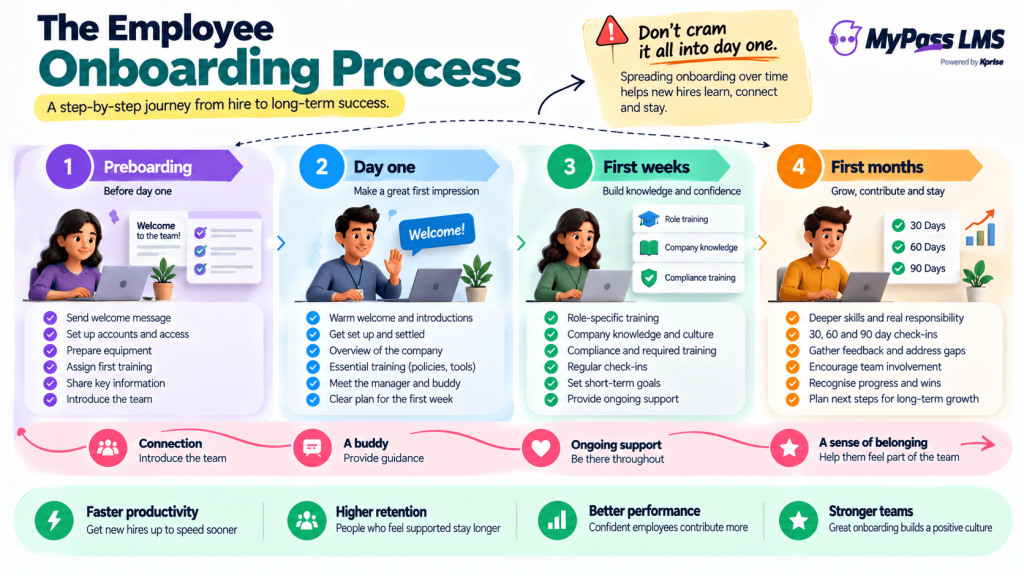
| A good employee onboarding process starts before day one, makes day one about welcome rather than paperwork, spreads role, company and compliance training across the first weeks, pairs it with connection, and checks in at 30, 60 and 90 days. Done well it gets people productive faster and keeps them longer. Software mainly helps by making it consistent. |
The First Few Weeks Decide More Than You Think
Ask anyone who's quit a job in the first few months why, and the story usually starts the same way: the beginning was a mess. No one knew they were starting. Their laptop wasn't ready. They spent day one filling in forms and day two guessing. Nobody told them who to ask. That's a bad onboarding process, and it does real damage, because those first weeks quietly decide whether a new hire feels confident and sticks around, or starts quietly reading job listings again.
The encouraging part is that good onboarding isn't expensive or complicated. It's mostly about being organised and intentional instead of winging it, giving people what they need, in a sensible order, with someone to ask. This guide walks through the process stage by stage, from before day one to the three-month mark, and is honest about where software earns its keep and where it doesn't. Whether you're fixing a shaky process or building one from scratch, the shape is the same.
| Onboarding isn't an HR formality, it's a first impression that compounds. Get the first few weeks right and people ramp up faster and stay; get them wrong and you lose good hires before they've really started. |
The Process, Stage by Stage
Onboarding is a sequence, not a single day, and most of the time it goes wrong because everything gets crammed into day one. Each stage has a job to do.
- Preboarding (before day one): accounts, access and equipment ready, first training assigned, and a friendly 'we're glad you're joining' note. It means day one isn't wasted on setup.
- Day one: a genuine welcome, the essentials to find their feet, and people, not a stack of forms. First impressions matter most here.
- First weeks: role training, company knowledge and any compliance, spread out and sequenced so it actually sinks in.
- First months: deeper skills, real responsibility, and regular check-ins at 30, 60 and 90 days.
- All the way through: connection, a buddy, the team, a manager who's actually present, so they feel they belong.
Don't Cram Everything Into Week One
If there's one mistake almost everyone makes, it's trying to do all of onboarding in the first few days. The new hire gets shown every system, every policy, every process, all at once, and remembers almost none of it, because nobody can absorb that much that fast. It feels productive to front-load everything. It isn't.
Spread it out instead. Day one is for the essentials and feeling welcome. The core of their role comes over the first couple of weeks. The deeper stuff comes over the first few months, when they've got the context to make sense of it. This matches how people actually learn, and it spares them the overwhelm that makes a new starter feel stupid right when you want them feeling capable. A 30-60-90 day plan is a simple way to phase it sensibly.
| Front-loading everything into week one feels efficient and backfires, people retain almost none of it. Give them what they need when they need it, and let the deeper material wait until they can actually use it. |
Consistency Is the Part Nobody Talks About
Here's a problem you won't notice until you look for it. In most companies, how good your onboarding is depends entirely on which manager you get. A great one gives a new hire a brilliant start. A busy or disorganised one leaves them to sink or swim. Same company, same role, completely different experience, and the new person's success partly comes down to luck. For anyone growing or running more than one location, that inconsistency quietly erodes everything.
The fix is to make the process itself the standard, so every new hire gets the same solid start regardless of who's running it. That's the real reason to put onboarding into a system rather than leaving it in people's heads: you build it once, the right training gets assigned automatically, nothing gets forgotten, and a stretched manager doesn't have to remember every step. It also means you can keep your onboarding checklist from turning into a folder nobody opens.
Where Software (Honestly) Helps
You don't strictly need onboarding software, plenty of small teams onboard well with a good checklist and an attentive manager. But as you grow, two things get hard to do by hand: keeping it consistent, and keeping up with the admin. That's where a platform like MyPass LMS actually earns its place, rather than just adding another tool.
You build your onboarding once as a structured learning path, covering role, company and compliance training, and it's assigned to each new hire automatically, so everyone gets the same complete start and nothing slips. Reminders chase people gently without a manager having to, and because it's mobile and self-paced, a new starter can work through it around real work instead of in one exhausting block. When you're hiring in waves, bulk enrolment handles the volume. If you want to see how the pieces fit, the employee onboarding solution page lays it out.
| Build your onboarding properly once and every new hire, and every manager, benefits from it automatically. In a process that's all about first impressions, that one-time effort pays back with every person you hire. |
The bottom line
A strong onboarding process is a sequence, not a scramble: prepare before day one, make day one about welcome, spread the training across the first weeks and months, pair it with connection, and check in along the way. Get it right and people become productive faster and stay longer. Get it wrong, usually by drowning them in week one, and you lose good people early.
If you're growing or running multiple sites, making the process consistent is where the biggest gains are, and it's exactly what a free trial of MyPass LMS lets you test on your own onboarding.
Frequently asked questions
What is the employee onboarding process?
It's how you welcome, set up and settle a new hire, from before their first day through their first few months. A good one runs in stages: preboarding (accounts, access and a welcome before day one), a day one focused on people rather than paperwork, role, company and compliance training spread across the first weeks, deeper development and responsibility over the first months, and a thread of connection (a buddy, the team) throughout. The goal is to get people productive faster and make them far more likely to stay.
What are the stages of onboarding?
Preboarding (setting things up and sending a welcome before day one), day one (a real welcome and the essentials, not a stack of forms), the first weeks (role, company and compliance training, sequenced rather than crammed), the first months (deeper skills, real responsibility and check-ins at 30, 60 and 90 days), and connection running through all of it. The most common failure is collapsing all these stages into the first day or two, which overwhelms people and wastes the effort.
How long should onboarding take?
Longer than most people assume, typically the first few months, because that's genuinely how long it takes someone to become confident and fully productive. Day one and week one cover the essentials and the welcome, but the real role training and deeper knowledge are best spread across the first weeks and months, often with a 30-60-90 day plan. Trying to compress onboarding into a few days feels efficient but overwhelms people and sticks far less well than a steady, structured runway.
Do I need onboarding software?
Not strictly, a small team can onboard well with a good checklist and an attentive manager. Software earns its place as you grow, because two things get hard by hand: consistency (so every hire gets the same strong start regardless of their manager) and admin (assigning, reminding, tracking). An LMS or onboarding tool lets you build the process once and run it the same way every time, with training assigned automatically and progress tracked. It's most valuable for growing or multi-site organisations and anyone hiring in volume.