| You shorten sales ramp time by defining what 'productive' actually means, structuring onboarding around weekly milestones across the first 90 days, turning your best reps' knowledge into repeatable training, adding real practice like role-plays and call reviews, and measuring where reps stall so you can fix the weakest stage. Structured onboarding beats trial-by-fire every time. |
Why Ramp Time Is So Expensive
Every month a new sales rep is not yet productive costs you twice: their salary, and the quota they are not yet carrying. When ramp time for a B2B rep can stretch across several months, a slow onboarding process quietly drains a significant amount of money and pipeline, especially if reps also churn before they ever hit full productivity.
The frustrating part is that most of that slowness is self-inflicted. Reps ramp slowly not because selling is impossibly hard to learn, but because onboarding is often unstructured: a firehose first week, then thrown onto the phones to figure it out. Structure is the single biggest lever you have on ramp time.
| Ramp time is a number you can manage, not a fixed fact of hiring. The goal of sales onboarding is not to 'get reps started' but to reach a defined productivity milestone as fast as possible, repeatably, for every hire. |
Define 'Ramped' Before You Fix Anything
You cannot shorten ramp time you have not defined. Before redesigning onboarding, decide the concrete milestone that means a rep is productive, usually something like consistently hitting a monthly quota, or reaching a set number of qualified opportunities per month. That definition turns a vague feeling ('they seem up to speed') into a measurable target.
With a clear milestone, you can measure current ramp time, set a goal to beat, and see whether each change actually helps. Without it, you are guessing. This single step separates teams that steadily improve onboarding from teams that keep running the same slow process and hoping.
Structure the First 90 Days
The biggest ramp-time killer is cramming everything into week one. New reps cannot absorb product knowledge, sales process, tools, messaging and objection handling all at once, so most of it is lost. The fix is to spread onboarding across the first 90 days as a sequence of weekly outcomes.
- Weeks 1-2: Company, product and market. What you sell, to whom, and why it matters.
- Weeks 3-4: Sales process and tools. Your pipeline stages, CRM, and how deals actually move.
- Weeks 5-8: Messaging and objections. The pitch, the common objections, and how to handle them.
- Weeks 9-12: Live selling with support. Real calls and deals, with shadowing, feedback and coaching.
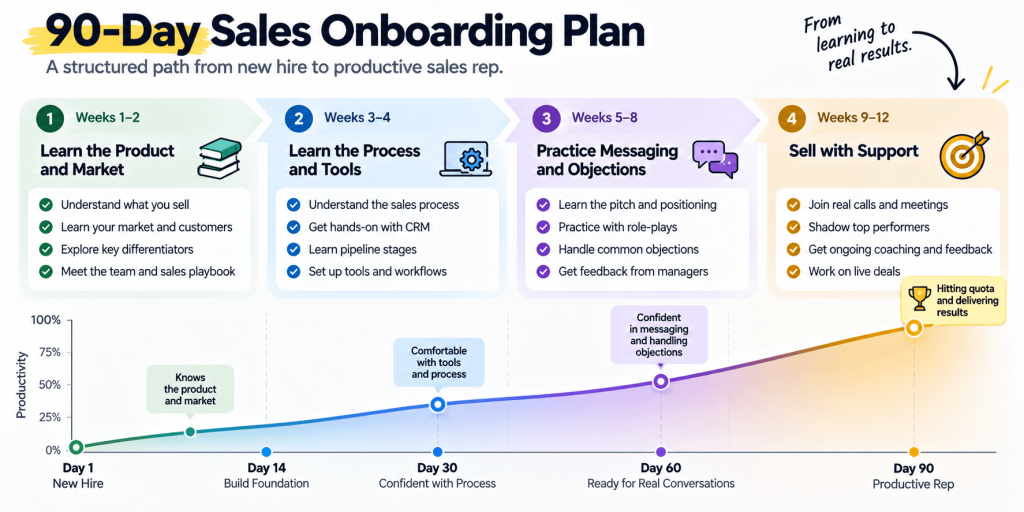
| Sequencing matters as much as content. A rep who learns the product before the process before the pitch builds on solid ground. A rep who gets all three at once on day two remembers almost none of it. |
Make It Repeatable, and Add Practice
If onboarding depends on a manager having time to explain everything personally, it will be inconsistent and it will not scale. The reps hired in a busy quarter get a worse start than those hired in a quiet one. The fix is to turn your best reps' and managers' knowledge into structured, on-demand training, so every new hire gets the same strong foundation regardless of who is busy.
But knowledge alone does not create a seller. Reps ramp fastest when training is paired with practice and feedback: role-playing the pitch, reviewing recordings of real calls, and shadowing experienced reps. Practice is where knowing becomes doing, and early feedback corrects bad habits before they harden. The combination of consistent training plus deliberate practice is what reliably compresses ramp time.
How MyPass LMS Supports Faster Ramp
MyPass LMS lets you turn sales onboarding into a structured, repeatable program instead of an ad-hoc scramble. You build the product, process and messaging training once, assign it as a sequenced learning path so reps move through it in the right order, and every new hire gets the same strong start.
Automated assignments and reminders keep reps on pace through the 90-day plan without a manager chasing them, and reporting shows who has completed what and where people stall, so you can find and fix the slowest stage. Practice elements like call reviews and coaching happen alongside, with the knowledge foundation handled consistently in the platform.
| Start by recording what your top rep does in their first 90 days that a new hire does not. That gap, turned into structured training and practice, is usually the fastest ramp-time win available to you. |
The bottom line
Slow sales ramp is expensive and mostly fixable. Define what 'productive' means so you can measure it, spread onboarding across the first 90 days instead of drowning reps in week one, make the training repeatable so every hire gets the same strong start, and pair it with real practice and feedback. Then measure where reps stall and fix the weakest stage.
Structured onboarding beats trial-by-fire every time. See how sequenced learning paths and progress reporting support faster ramp in MyPass LMS features, read the 30-60-90 day onboarding plan, or start a free trial.
Frequently asked questions
What is sales onboarding?
Sales onboarding is the structured process of getting a new sales rep from hire date to full productivity: teaching them the product, market, sales process, tools and messaging, and giving them the practice and coaching to apply it. Good sales onboarding is not a first-week orientation but a program, often spanning the first 90 days, designed to reach a defined productivity milestone as fast as possible.
How long does it take a sales rep to ramp up?
It varies by role and deal complexity, but B2B sales ramp is commonly measured in months rather than weeks, and more complex or higher-value sales take longer. The exact number matters less than defining your own 'ramped' milestone (such as consistently hitting quota) and measuring against it, because that lets you see whether changes to onboarding are actually shortening the time to productivity.
How do you reduce sales ramp time?
Define the productivity milestone you are aiming for, structure onboarding across the first 90 days as sequenced weekly outcomes rather than a single overwhelming week, turn your best reps' knowledge into repeatable on-demand training so every hire gets a consistent start, add practice and feedback (role-plays, call reviews, shadowing), and measure where reps stall so you can fix the slowest stage for the next cohort.
Why do new sales reps ramp so slowly?
Usually because onboarding is unstructured: everything is crammed into the first week, delivery depends on whoever happens to have time, and there is little deliberate practice before reps are thrown onto live deals. Reps then learn slowly by trial and error. Slow ramp is rarely about the difficulty of selling and mostly about the design of onboarding, which is exactly why structuring it produces such large gains.