How to Create an Employee Training Program in 7 Steps
To create an employee training program, tie it to a business goal, run a needs analysis, set measurable objectives, choose the right formats, build or source content, deliver it through an LMS, and measure results against the goal. The key shift in 2026 is judging success by performance change, not completion rates.
On this page 8 sections
Short answer
To create an employee training program, tie it to a business goal, run a needs analysis, set measurable objectives, choose the right formats, build or source content, deliver it through an LMS, and measure results against the goal. The key shift in 2026 is judging success by performance change, not completion rates.
Start With a Program, Not a Course
The most common mistake in employee training is starting with content. Someone decides the team needs a course, a course gets made, and nobody can say later whether it changed anything. A training program is different from a training plan: a plan is a single event or course, while a program is an ongoing system that spans roles, topics and business goals.
Building a program means building infrastructure. Done well, it delivers faster time to productivity, fewer compliance gaps, better retention and audit-ready records. Done as a pile of disconnected courses, it produces what researchers call scrap learning: content delivered but never applied. The seven steps below keep the program tied to outcomes from the start.
Key point
A training plan answers 'what will we run this month'. A training program answers 'how do we keep building the capabilities the business needs'. Aim for the second, even if you start small.
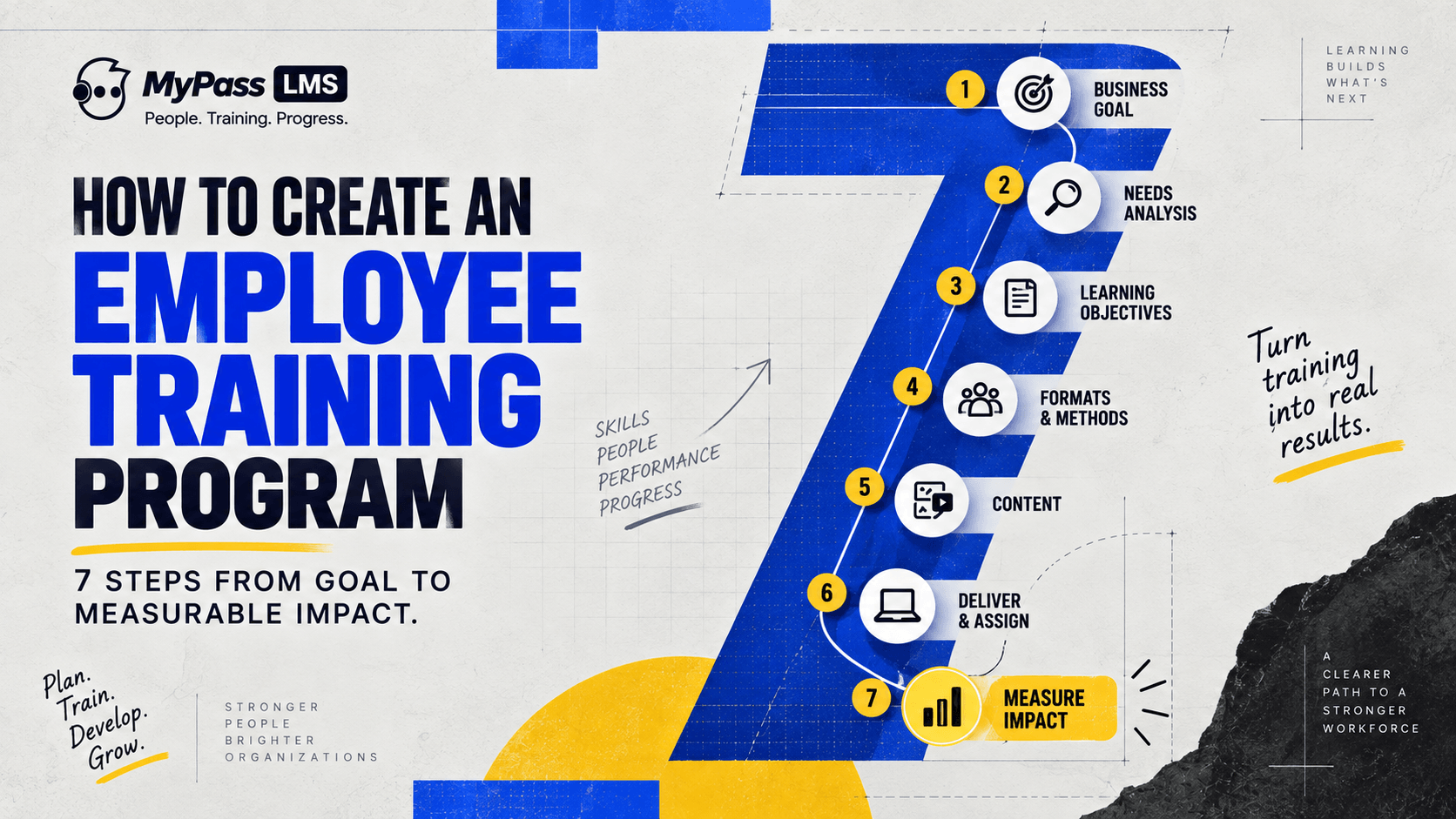
The Seven Steps
This sequence works for onboarding, compliance, upskilling or a full L&D function. Work the steps in order, because each one constrains the next.
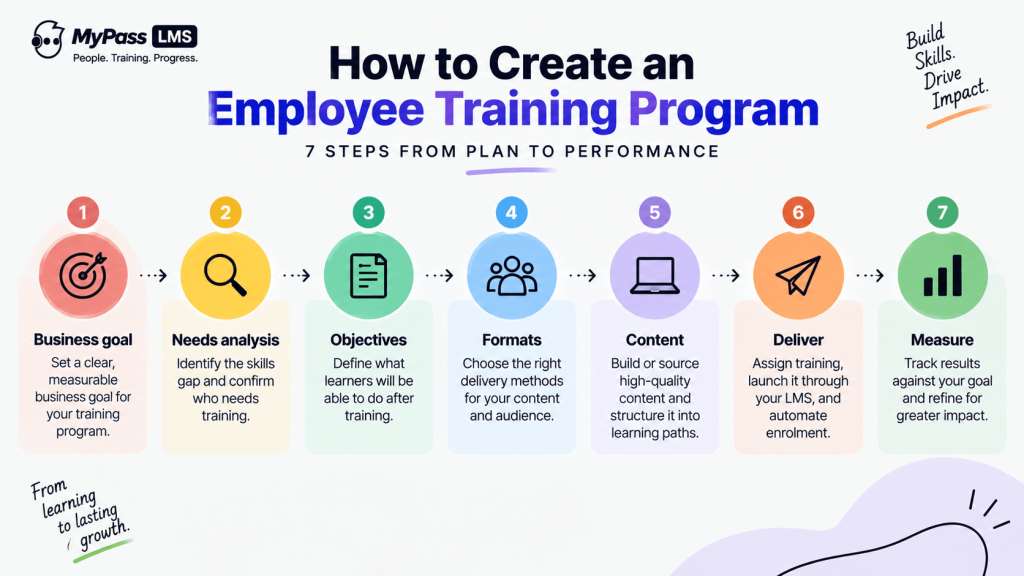
- Set a business goal: a specific, measurable outcome the program exists to move.
- Assess training needs: confirm the gap is a skills problem and find who needs what.
- Define learning objectives: clear statements of what each learner will be able to do afterward.
- Choose formats and methods: match delivery to the content and the audience.
- Build or source content: create it, buy it, or generate it, then structure it into paths.
- Deliver and assign: assign by role, automate enrolment and reminders, track completion.
- Measure and improve: evaluate against the business goal, then refine and repeat.
Step 1 to 3: Goal, Needs, Objectives
These three steps are where programs succeed or fail, and they are the ones most often skipped in the rush to make content.
Start with a business goal that is specific enough to measure: reduce safety incidents by a set amount, cut new-hire ramp time, lift assessment pass rates, or raise product-attach rates in sales. Then run a training needs analysis to confirm the gap is actually a skills problem and not a process or tooling issue that training cannot fix. Finally, turn the goal into learning objectives: precise statements of what a learner will be able to do after the training, which become the backbone of your content and your assessments.
Key point
If you cannot write a measurable business goal for a piece of training, that is a signal to pause. Training with no outcome attached is the definition of scrap learning.
Step 4 to 5: Formats and Content
With objectives set, choose the delivery that fits. The strongest programs in 2026 are blended and role-focused rather than one-format-fits-all.
- Self-paced online: for consistent knowledge that must scale and be available on demand.
- Instructor-led or virtual: for complex, interactive or high-stakes topics needing discussion and practice.
- Blended: combine the two, using live time for application rather than lecture.
- Microlearning: short units for retention and for learning in the flow of work.
- On-the-job: coaching and practice for skills that only develop by doing.
For content, you have three routes: build it in-house, buy off-the-shelf courses, or generate it with an AI course builder. Most programs use a mix. Whatever the source, organise it into structured learning paths so learners move through it in a deliberate order rather than facing a flat library of courses.
Step 6 to 7: Deliver and Measure
Delivery is where a learning management system earns its place. Assign training by role and department so the right people get the right content automatically, automate enrolment and reminders to cut chasing, and track completion in one place.
Measurement is the step that separates a real program from busywork, and it is where the field has moved most. Completion rates and seat time are now widely treated as vanity metrics. What matters is whether behaviour and business outcomes changed: assessment scores, time to proficiency, error rates, and the original business goal. Modern LMS analytics make this measurable rather than anecdotal.
Key point
The 2026 standard: stop reporting how many people finished a course and start reporting whether the training moved the number you set out to move. Completion is an input, not a result.
How MyPass LMS Supports the Whole Program
A training program touches every step above, and running it across disconnected tools is where programs get heavy. MyPass LMS covers the build-deliver-measure loop in one platform: an AI course builder to create content fast, learning paths to structure it, role-based assignment and automated reminders to deliver it, and analytics to measure completion, scores and progress against your goal.
Because assignment, delivery, assessment and reporting share one learner record, you can trace a program from its business goal through to the outcome without stitching systems together, and produce audit-ready records for anything compliance-related.
- Create content with the AI course builder or upload existing and SCORM courses.
- Structure it into role-based learning paths.
- Automate assignment, enrolment and reminders.
- Measure completion, assessment results and progress in one place.
The bottom line
Creating an employee training program is about building a system, not stacking courses. Anchor it to a business goal, confirm the need, set measurable objectives, pick the right formats, deliver through an LMS, and judge it by performance change rather than completion. That sequence turns training from an expense into something you can prove works.
The practical requirement is a platform that supports the whole loop. See how content creation, learning paths and analytics work in MyPass LMS features, read our training needs analysis guide for step two, or start a free trial to build your first program.
Frequently asked questions
How do I create an employee training program?
Start with a measurable business goal, run a training needs analysis, define clear learning objectives, choose formats that fit the content, build or source the content, deliver and assign it through an LMS, then measure results against the goal and refine. The order matters: each step constrains the next, and skipping the goal and needs steps is the most common cause of ineffective training.
What is the difference between a training program and a training plan?
A training plan is a single-event document for one course or session. A training program is an ongoing system that spans multiple topics, roles and business goals over time. A plan answers what you will run next; a program answers how you will keep building the capabilities the business needs. Effective L&D builds programs, not just isolated plans.
How do you measure if a training program is working?
Judge it by performance change, not completion. Completion rates and seat time are inputs, not results. Measure assessment scores, time to proficiency, behaviour change, error or incident rates, and the specific business goal the program was built to move. Modern LMS analytics make these outcomes trackable, so you can prove impact rather than just participation.
How long does it take to build a training program?
It varies with scope. A focused program for one goal can be live in a few weeks, especially if you use off-the-shelf or AI-generated content and an LMS that automates delivery. A full L&D program spanning onboarding, compliance and upskilling is built in phases. The key is to start with one measurable goal rather than trying to build everything at once.