
Knowledge Transfer in 2027: A Practical Plan to Keep Expertise When People Leave
On this page 13 sections
- What Is Knowledge Transfer?
- Why Is Knowledge Transfer Urgent in 2027?
- What Knowledge Should You Transfer First?
- Which Knowledge Transfer Methods Actually Work?
- How Do You Build a Knowledge Transfer Plan?
- How Do You Capture Tacit Knowledge Before Someone Leaves?
- How Can an LMS Support Knowledge Transfer?
- How Do You Know Knowledge Transfer Worked?
- What Are the Most Common Knowledge Transfer Mistakes?
- Where This Comes From
- The bottom line
- Frequently asked questions
- Sources
Knowledge transfer is the planned process of moving skills, know-how and context from one person to another so work carries on when someone leaves. A good plan identifies who holds critical knowledge, separates what can be written down from what must be shown, pairs each with the right method, and checks the successor can actually do the work.
What Is Knowledge Transfer?
Knowledge transfer is moving what one person knows to someone else in a way that sticks. It covers two kinds of knowledge: explicit knowledge, which can be written down in a document or procedure, and tacit knowledge, which lives in experience and judgment and mostly has to be shown, practiced and talked through.
The difference matters because most failed handovers treat everything as explicit. Someone writes a 20-page handover document, leaves, and their successor still can't do the job. The philosopher Michael Polanyi described the problem in 1966: "we can know more than we can tell."
| Explicit knowledge | Tacit knowledge | |
| What it is | Facts, steps and rules that can be written down | Judgment, instinct and know-how built from experience |
| Examples | How to run month-end close. Where the supplier contracts are stored. The steps to calibrate a machine | Knowing a machine is about to fail from the sound it makes. Which client needs a call before bad news goes out in writing. When to bend a rule |
| How it's captured | Documents, SOPs, checklists, recorded walk-throughs, courses | Shadowing, mentoring, paired work, guided practice, stories from the expert |
| How you check it transferred | A quiz or a completed checklist | The successor handles a real case without help |
Most roles hold both. A payroll specialist's process is explicit. Knowing which managers always submit late, and how to chase them without starting a fight, is tacit. A good plan treats each kind differently.
Why Is Knowledge Transfer Urgent in 2027?
Because experienced people are leaving faster than their knowledge is being passed on. Workers aged 55 and older make up nearly a quarter of the US labor force, most organizations have no reliable way to capture what retirees know, and Gartner now lists critical knowledge loss as one of the top L and D trends for 2027.
Here's what the research shows.
- Nearly 1 in 4 workers is 55 or older. The US Bureau of Labor Statistics puts workers aged 55 and older at 22.9 percent of the labor force in 2025, rising to a projected 23.4 percent by 2035.
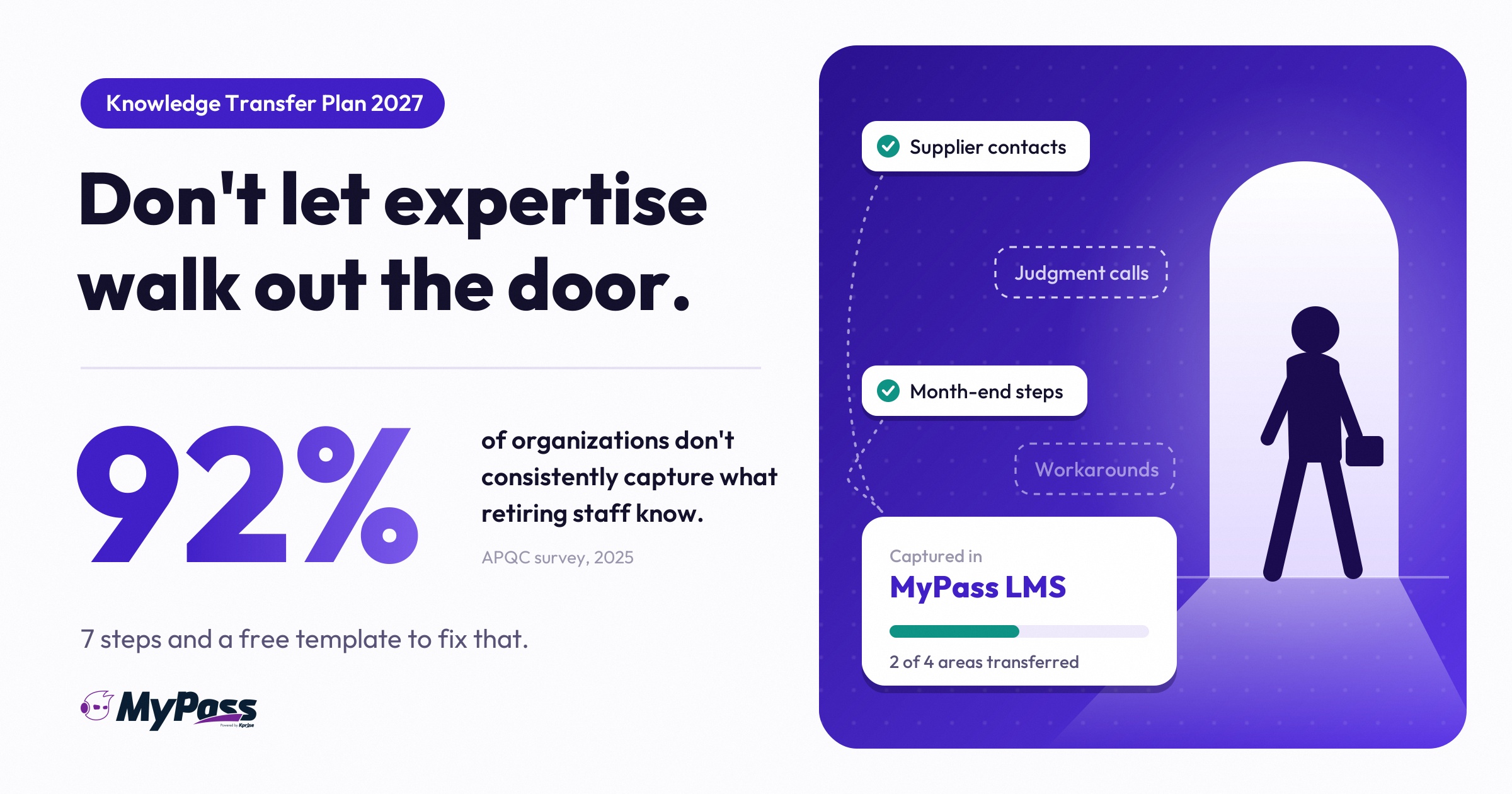
- Almost nobody captures it consistently. In APQC's 2025 survey of 1,000 professionals, 92 percent of organizations said they don't consistently capture knowledge from employees about to retire.
- Leaders know it's a problem. In the same survey, 58 percent of C-suite respondents said they're very worried about knowledge loss.
- Gartner is flagging it for 2027. Gartner's Rebecca Burton warned that organizations are "losing critical knowledge faster than they are transferring it" and said knowledge transfer is ad hoc at many companies.
- A lot of knowledge sits with one person. Panopto's 2018 survey of 1,000 US workers found 42 percent of institutional knowledge is unique to the individual, not shared with coworkers.
Retirement isn't the only trigger. Resignations, internal moves, restructures and automation-driven role changes all create the same gap, often with far less notice than a planned retirement.
Key point
The cost of lost knowledge rarely shows up as one big failure. It shows up as slower decisions, repeated mistakes, longer time to proficiency for new hires, and a former employee getting phone calls months after they've left.
What Knowledge Should You Transfer First?
Start with knowledge that is both critical to the business and held by very few people, especially when the holder may leave soon. Rate each role on how much damage losing it would cause and how concentrated the know-how is, then work through the high-high quadrant before anything else.
You can't transfer everything at once, and you shouldn't try. A quick risk assessment tells you where to spend time. For each key role, ask two questions.
1. How critical is this knowledge? What breaks, slows down or becomes risky if nobody knows it tomorrow? Think safety, compliance, revenue, customer relationships and systems only one person understands.
2. How concentrated is it? Does one person hold it, or could three people on the team step in today?
Then factor in timing. A planned retirement in nine months gives you room. An expert who's eligible to retire and hasn't said anything yet is a quieter risk that's just as real.
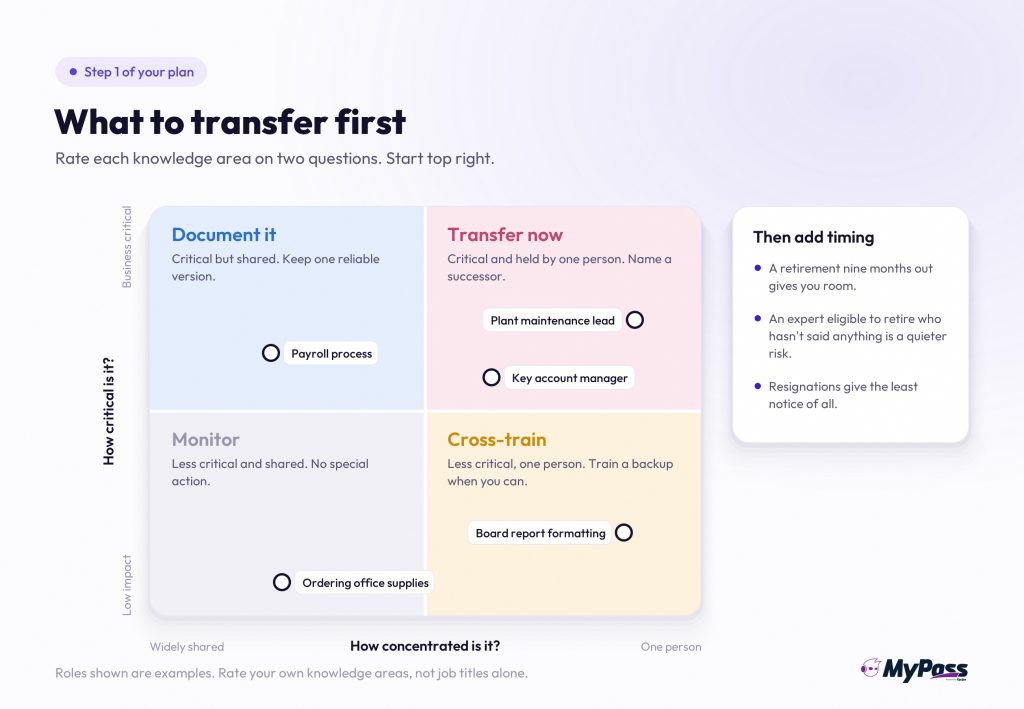
- Critical and held by one person: transfer now, with a named successor and a deadline.
- Critical but shared: document it, so the team keeps one reliable version.
- Less critical, held by one person: cross-train someone when the workload allows.
- Less critical and shared: monitor it, with no special action needed.
Which Knowledge Transfer Methods Actually Work?
The methods that work best match the type of knowledge. Written procedures, recorded walk-throughs and courses suit explicit knowledge. Shadowing, mentoring, paired work and after-action reviews suit tacit knowledge, because they let the successor watch, try and get feedback while the expert is still around.
Nonaka and Takeuchi's SECI model, from their 1995 book The Knowledge-Creating Company, is a useful way to think about this. Knowledge moves in four ways: person to person (socialization), from a person's head into a document (externalization), from documents into better documents (combination), and from documents back into a person through practice (internalization). A complete plan uses more than one.
| Method | Best for | How it works | Watch out for |
| Job shadowing | Tacit | The successor watches the expert do the real work and asks questions as it happens | Watching isn't doing. Follow it with reverse shadowing |
| Reverse shadowing | Tacit | The successor does the work while the expert watches and corrects | Needs time before the expert leaves, so start early |
| Mentoring | Tacit | Regular one-to-one sessions on judgment calls, relationships and history | Without an agenda it drifts into general chat |
| Expert interviews | Tacit to explicit | Structured questions that draw out decisions, exceptions and warnings, recorded and written up | Generic questions get generic answers |
| After-action reviews | Tacit to explicit | A short debrief after a project or incident on what happened, why, and what to do next time | Only works if the notes are stored somewhere people find them |
| SOPs and job aids | Explicit | Step-by-step procedures and checklists kept in one place | Go out of date fast without an owner |
| Recorded walk-throughs | Explicit | The expert records their screen or the task while talking it through | Long recordings don't get watched. Keep them short |
| Courses and learning paths | Explicit | Captured material turned into structured training with a check at the end | Can't replace practice on the real job |
| Communities of practice | Both | A group that meets to share problems and fixes in a specialty | Fades without someone to run it |
We cover the explicit side in more depth in SOP training, and the hands-on side in on-the-job training.
How Do You Build a Knowledge Transfer Plan?
Build it in seven steps: find the critical knowledge, name the expert and successor, split explicit from tacit, choose a method for each piece, set a schedule with overlap, capture everything in one place, and confirm the successor can do the work alone. Each step produces something concrete you can check.
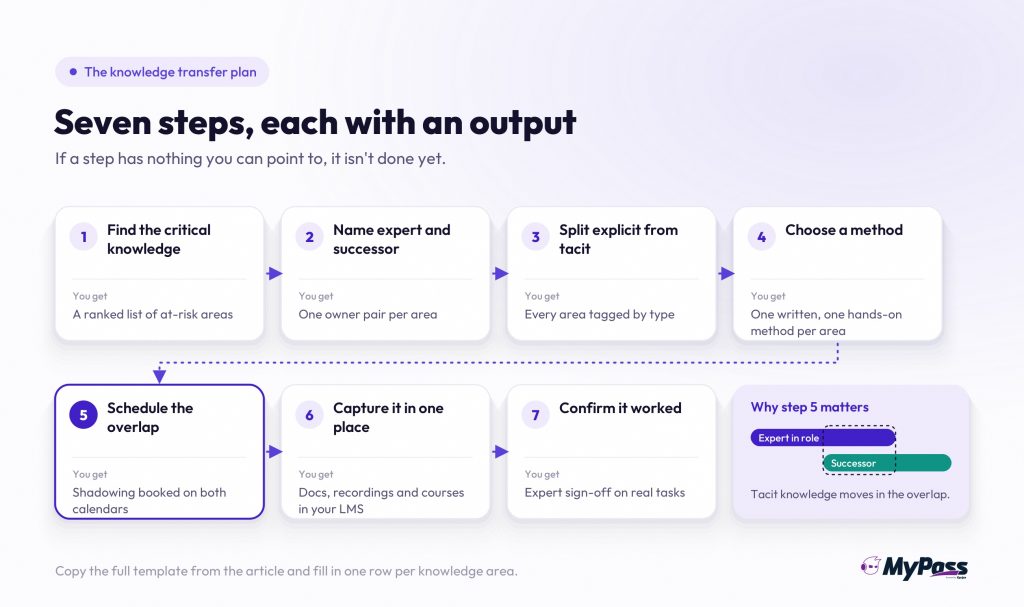
1. Find the critical knowledge. Use the priority matrix above. List the specific tasks, decisions, systems and relationships at risk, not just the job title.
2. Name the expert and the successor. One expert and one named successor for each knowledge area. Shared ownership usually means nobody owns it.
3. Split explicit from tacit. For each area, mark what can be written down and what has to be shown or practiced.
4. Choose a method for each piece. Use the methods table. Most areas need one explicit method and one tacit method.
5. Set a schedule with overlap. Book shadowing and reverse shadowing while the expert is still in the role. Protect the time on both calendars, or it'll get pushed aside by day-to-day work.
6. Capture it in one place. Store documents, recordings and courses where the successor and future hires will find them, not in the expert's inbox or personal drive.
7. Confirm the transfer worked. The successor completes real tasks without help, and the expert signs off before leaving.
Here's a template you can copy into a spreadsheet. Fill in one row per knowledge area.
| Knowledge area | Expert | Successor | Type | Risk | Method | Deadline | Evidence it transferred |
| Example: supplier price negotiations | Senior buyer | Buyer | Tacit | High | Shadow three negotiations, then lead two with the expert watching | Before notice period ends | Successor closes a renewal without help |
| Example: month-end stock reconciliation | Senior buyer | Buyer | Explicit | Medium | SOP, recorded walk-through and a short course with a quiz | Week 4 | Successor runs month-end alone and the numbers balance |
Key point
Write 'evidence it transferred' as something you can observe, like a task done alone, a sign-off or an error rate. 'Successor understands the process' can't be checked. 'Successor runs month-end alone and the numbers balance' can.
How Do You Capture Tacit Knowledge Before Someone Leaves?
Ask about decisions, exceptions and warnings rather than processes, then have the successor practice while the expert watches. Experts rarely know which parts of their knowledge are unusual, so specific questions about real situations get much more out of them than asking them to write everything down.
These interview questions tend to surface what handover documents miss.
- "What would you warn your successor about?" This finds the traps that never made it into the procedure.
- "When do you break the rule, and why?" Exceptions are often where the real expertise sits.
- "Who do you call when this goes wrong?" Relationships and informal networks are some of the hardest things to replace.
- "Walk me through the last time this went badly." Real stories carry context that a list of steps leaves out.
- "What do you check that nobody asked you to?" Habits like this are often what's preventing problems nobody sees.
- "What did it take you longest to learn?" This points to where the successor will struggle most.
After a project or an incident, run a short after-action review. The format was developed by the US Army and compares what was supposed to happen with what actually happened, why there was a difference, and what to keep or change next time. It turns one person's hindsight into something the whole team can use.
Then switch roles. Reverse shadowing, where the successor does the work and the expert watches, is the quickest way to find gaps. Gaps show up when the successor hesitates, and the expert can explain right there instead of months later over the phone.
How Can an LMS Support Knowledge Transfer?
An LMS turns captured knowledge into structured training that new and future hires can follow, and gives you a record of who has completed it. It won't capture tacit knowledge by itself, but it makes sure the explicit side doesn't disappear into old inboxes, and it keeps every handover in one searchable place.
Here's how MyPass LMS supports each part of the plan.
- Turn expert documents into a course quickly. The MyPass LMS AI course builder can draft a course from a document, so an expert's SOP or interview write-up becomes training in minutes. The expert then reviews it for accuracy. Read more about the AI course builder.
- Build lessons without a separate tool. Built-in SCORM authoring lets you create and edit content inside the platform.
- Put it in the right order. Learning paths with sequencing take a successor from the basics to the harder material in a set order. See learning paths.
- Check it worked. Assessments confirm the explicit side transferred, and certificates record sign-off, with expiry and renewal tracking where skills need refreshing.
- Track live sessions too. Instructor-led session management and QR code attendance record shadowing sessions, workshops and expert-led training alongside online courses.
- Keep retirees and contractors in the system at no extra cost. MyPass LMS includes unlimited registered users on every plan, so a retired expert who comes back as a part-time instructor doesn't add a seat cost.
- Reach teams in other languages. AI translation into more than 120 languages helps when the successor team works in a different language from the expert.
Key point
Be realistic about what software can do. An LMS stores, structures and tracks knowledge. It can't sit next to the expert and watch how they make a judgment call. Plan shadowing and mentoring time alongside the courses, not instead of them.
If your expert will also train others after they leave, our guide to a train-the-trainer program covers how to set that up.
How Do You Know Knowledge Transfer Worked?
You know it worked when the successor handles real work alone, at the expected standard, without calling the person who left. Measure it with observable outcomes such as tasks completed independently, time to proficiency, error rates and escalations, rather than with course completions alone.
- Independent task completion. The successor completes each critical task in the plan without help, and the expert signs it off.
- Time to proficiency. How long it takes the successor to reach the expected standard. Track it so the next handover can be planned more accurately.
- Error and rework rates. Compare them before and after the handover in the area being transferred.
- Escalations to the former expert. If they're still getting calls three months later, something didn't transfer.
- Assessment results. Useful for the explicit side, but not proof on their own.
Revisit the plan after 90 days. Ask the successor what they wish they'd been told earlier, and add the answer to the documentation for the next person.
What Are the Most Common Knowledge Transfer Mistakes?
The most common mistakes are starting too late, relying on one handover document, giving the expert no time to teach, and never checking that the successor can do the work. Each one is avoidable with a plan that starts early, uses more than one method and protects time on both calendars.
- Starting in the notice period. Two weeks is enough for explicit knowledge at best. Tacit knowledge needs months of overlap.
- Treating the handover document as the plan. It covers the explicit side only.
- Adding teaching on top of a full workload. If the expert's day job doesn't shrink, the transfer is the first thing to slip.
- No named successor. Knowledge handed to a team in general tends to end up with nobody.
- Storing it in the wrong place. Files in a personal drive or inbox are lost the day the account is closed.
- Skipping the check. A course completion shows the successor saw the material. It doesn't show they can do the job.
Knowledge transfer and succession planning work together. Succession planning decides who steps into a role. Knowledge transfer makes sure they can actually do it.
Where This Comes From
The Gartner material comes from HR Dive's report on Gartner's four L and D trends for 2027, published 3 November 2026, quoting Gartner's Rebecca Burton.
Labor force figures come from the US Bureau of Labor Statistics employment projections.
The retirement knowledge figures come from APQC's 2025 study with eGain, a survey of 1,000 professionals.
The 42 percent figure comes from Panopto's 2018 Workplace Knowledge and Productivity Report, a survey of 1,000 US workers, as reported by HR Dive. It's an older survey and a vendor study, so treat it as directional.
The Polanyi quotation comes from The Tacit Dimension (1966), the SECI model from Nonaka and Takeuchi's The Knowledge-Creating Company (1995), and the after-action review background from the US Army Research Institute's 1999 report on the process. Organizations that want a formal framework can look at ISO 30401, the international standard for knowledge management systems.
MyPass LMS features come from our own product documentation.
The bottom line
Knowledge transfer in 2027 isn't a nice-to-have. With nearly a quarter of the workforce aged 55 or older and most organizations still handling handovers ad hoc, the knowledge that walks out the door is often the knowledge you can least afford to lose.
Start with the priority matrix. Pick the one or two roles where critical knowledge sits with a single person, name a successor, and book the first shadowing session this month. One well-run handover teaches you more than a perfect plan that never starts.
Then make it routine. When capture, practice and sign-off happen every time someone moves on, nobody has to rely on calling the person who left.
Frequently asked questions
What is an example of knowledge transfer?
A retiring maintenance engineer spends three months showing a successor how to diagnose a machine by sound and vibration, records walk-throughs of key repairs, and signs off once the successor fixes faults alone.
What's the difference between knowledge transfer and knowledge management?
Knowledge management is the ongoing system for capturing, storing and sharing what an organization knows. Knowledge transfer is moving specific knowledge from one person to another, often at a handover.
How long should knowledge transfer take?
It depends on the role. Explicit knowledge can move in weeks. Tacit knowledge usually needs months of overlap, so start as soon as a departure is likely, not when notice is given.
What should a knowledge transfer plan include?
The critical knowledge areas, the expert and named successor for each, whether it's explicit or tacit, the method, a deadline, and observable evidence that the successor can do the work alone.
Sources
- Gartner, via HR Dive, '4 trends to expect in L and D in 2027', 3 November 2026. Rebecca Burton of Gartner on critical knowledge loss, ad hoc knowledge transfer and knowledge manager roles.
- US Bureau of Labor Statistics, Employment Projections, civilian labor force summary table. Workers aged 55 and older were 22.9 percent of the labor force in 2025, projected at 23.4 percent in 2035.
- APQC, 'The Great Retirement: Knowledge Loss, AI and the Workforce Shift', with eGain, announced October 2025. Survey of 1,000 professionals: 92 percent of organizations don't consistently capture knowledge from soon-to-be retirees, and 58 percent of C-suite respondents are very worried about knowledge loss.
- Panopto, Workplace Knowledge and Productivity Report, 2018, survey of 1,000 US workers, as reported by HR Dive. 42 percent of institutional knowledge is unique to the individual, and employees lose 5.3 hours a week waiting for information or recreating it.
- Michael Polanyi, The Tacit Dimension, 1966.
- Ikujiro Nonaka and Hirotaka Takeuchi, The Knowledge-Creating Company, 1995. The SECI model.
- US Army Research Institute, Foundations of the After Action Review Process, Special Report 42, 1999.
- ISO 30401:2018, Knowledge management systems: Requirements.
- MyPass LMS features: the Kprise product brief.
Keep reading
Associations & CE
AI Knowledge Assistant for Association Education: Worth It?
L&D strategy