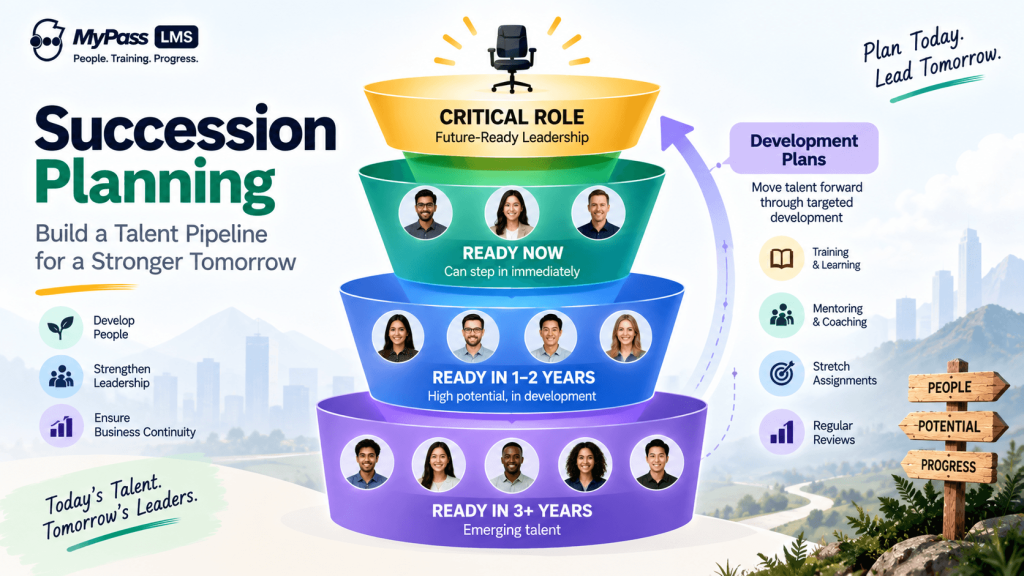
| Succession planning is the process of identifying critical roles and preparing people to fill them before they open, so the business keeps running through departures and retirements. It runs in five steps: identify critical roles, assess talent, map successors, build development plans, and review regularly. It builds a pipeline, not a single backup. |
What Succession Planning Actually Is
Succession planning is the systematic process of identifying the roles a business cannot afford to leave empty and preparing people to step into them when the time comes, whether through promotion, retirement, resignation or an unexpected departure. It is not the same as replacement planning, which is reactive and names one backup per role. Succession planning is proactive and builds a deeper bench.
The distinction matters because the org chart usually looks fuller than reality. Years of flat middle-management hiring and a wave of retirements have left many organizations with fewer ready internal leaders than they assume. A real succession plan closes that gap deliberately, rather than hoping the right person happens to be ready when a key role opens.
| Replacement planning asks 'who covers this role tomorrow if someone leaves?' Succession planning asks 'who will be ready to grow into this role over the next one to three years, and how do we get them there?' Aim for the second. |
The Five-Step Process
Most durable succession programs follow the same sequence. Work the steps in order, because each one narrows the next.
- Identify critical roles: the positions whose loss would most hurt the business.
- Assess current talent: rate potential successors on performance and potential.
- Map successors to roles: name candidates and rate their readiness for each role.
- Build development plans: close each successor's gaps with training and experience.
- Review and update: revisit the plan regularly as roles and people change.
Assessing Talent: The 9-Box Grid
The most widely used tool for the assessment step is the 9-box grid, used by a large share of Fortune 500 companies. It plots each person on two axes, current performance and future potential, producing nine cells that make talent decisions visible and comparable rather than based on gut feel.
The grid stops succession planning from becoming a popularity contest. A high performer with low potential may be a valuable specialist but not a successor; a high-potential employee performing modestly in the wrong role may be exactly who to develop. Plotting people forces those distinctions into the open.
| Low potential | High potential | |
| High performance | Valued specialist | Ready successor |
| Moderate performance | Solid contributor | Develop and stretch |
| Low performance | Manage or move | Wrong role, reassess |
Why Succession Planning Pays Off
A succession plan is not just insurance against departures; it is a retention and cost strategy. When people can see a path forward, they stay, and filling roles internally is faster and cheaper than hiring externally.
- Continuity: critical roles do not sit empty or go to an unprepared replacement.
- Retention: high-potential employees stay when they see a future inside the organization.
- Speed and cost: internal successors ramp faster than external hires and cost less to onboard.
- Knowledge protection: deliberate handover preserves institutional knowledge that would otherwise walk out the door.
| A hidden risk succession planning catches: knowledge concentration. When one person is the only one who understands a critical system, their departure is a crisis. Succession planning forces that knowledge to be documented and shared before it is lost. |
How MyPass LMS Supports Succession Planning
The development step is where succession planning meets your learning platform. Once you know who your successors are and where their gaps sit, you need to close those gaps in a structured, trackable way, and prove readiness rather than assume it.
MyPass LMS supports that with role-based learning paths that map to the target role, an AI course builder to create the specific development content each successor needs, and analytics that show progress against the readiness bar rather than just course completion. Because pricing is flat with unlimited registered users, development can extend across the whole potential-successor pool without a per-seat penalty.
| Tip: build a learning path per critical role, capturing the competencies a successor must demonstrate. Then a successor's progress through that path becomes a concrete, visible measure of readiness rather than a subjective judgement. |
The bottom line
Succession planning protects the business from the roles it cannot afford to leave empty, by preparing successors before those roles open. Identify critical roles, assess talent honestly with a tool like the 9-box grid, map successors by readiness, and close their gaps with real development. Done well, it also retains your best people and preserves knowledge.
The development step is where a platform earns its place. See how role-based learning paths and analytics support successor development in MyPass LMS features, read our reskilling vs upskilling guide, or start a free trial.
Frequently asked questions
What is succession planning?
Succession planning is the process of identifying critical roles and preparing people to step into them before they become vacant, whether through promotion, retirement or departure. Unlike reactive replacement planning, which names one backup per role, succession planning proactively builds a deeper talent pipeline so the business maintains continuity and stability through leadership changes.
What are the steps in succession planning?
The core process has five steps: identify critical roles whose loss would most hurt the business, assess current talent on performance and potential, map named successors to roles and rate their readiness, build development plans to close each successor's gaps, and review and update the plan regularly. It is a continuous cycle, not a one-time exercise.
What is the 9-box grid in succession planning?
The 9-box grid is a talent-review tool that plots each employee on two axes, current performance and future potential, creating nine cells. It makes succession decisions visible and comparable, distinguishing ready successors from valued specialists and high-potential employees who need development. It is widely used because it replaces gut feel with a structured, defensible assessment.
How is succession planning different from replacement planning?
Replacement planning is reactive and role-specific: it names one emergency backup per position. Succession planning is proactive and builds a broader pipeline, developing several high-potential people over time so multiple candidates are ready to grow into critical roles. Replacement planning covers tomorrow's emergency; succession planning builds the bench for the next few years.