Reskilling vs Upskilling: What Is the Difference?
On this page 7 sections
Short answer
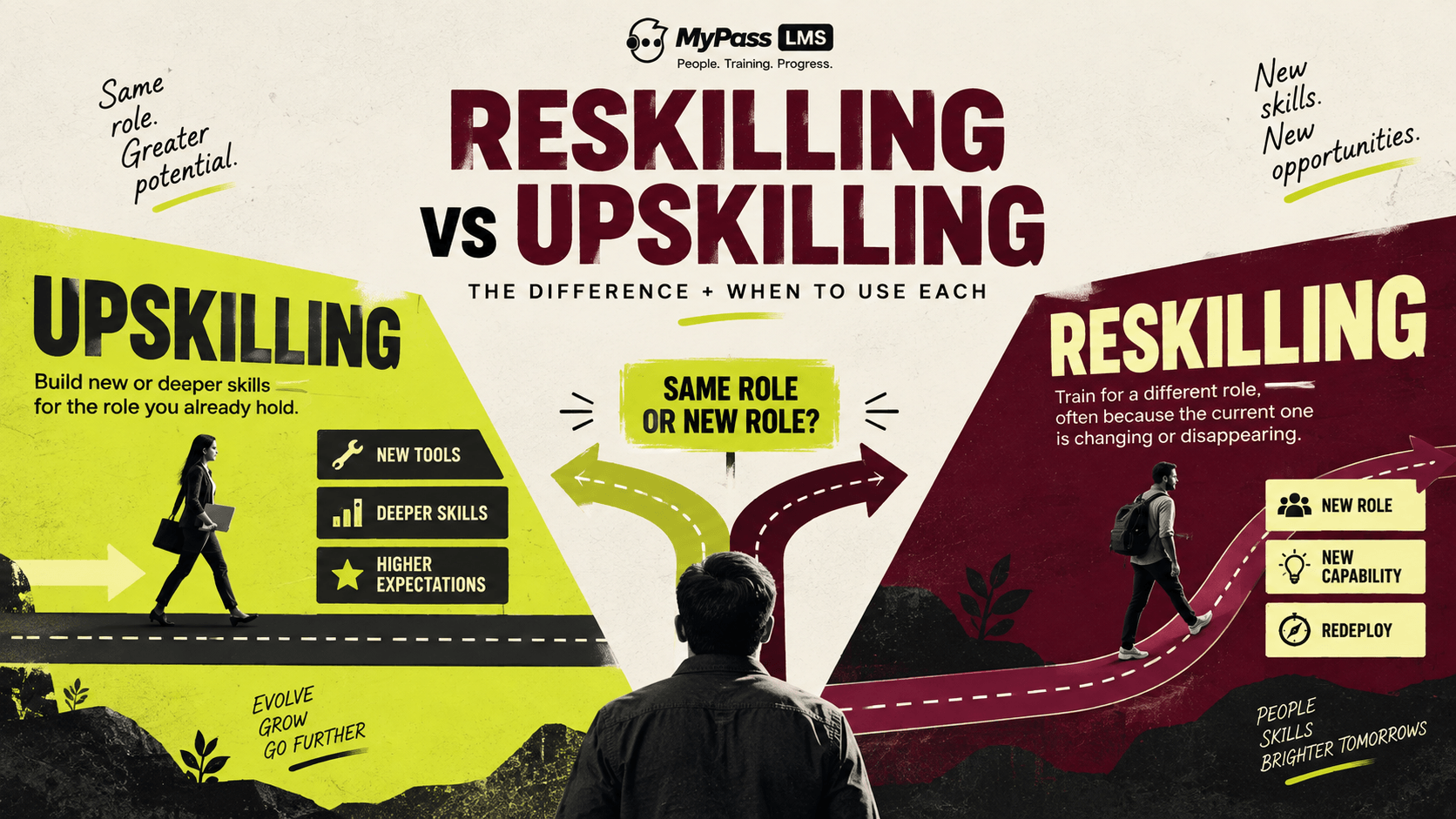
Upskilling teaches employees new or deeper skills for the role they already hold. Reskilling trains them for a different role entirely, usually because their current one is changing or disappearing. Upskilling asks how to make someone better at their job; reskilling asks how to prepare them for a new one. Most organizations need both.
The Core Difference
Upskilling and reskilling are both workforce development strategies, but they answer different questions. Upskilling means teaching an employee new or deeper skills for the role they already hold, so they keep performing it well as the work changes. Reskilling means training an employee for a different role altogether, usually because their current role is being automated, eliminated or fundamentally changed.
A quick example makes it concrete. A financial analyst learning Python to work with larger datasets is upskilling: same role, deeper capability. A warehouse coordinator training to become a robotics technician is reskilling: a different role entirely. The distinction is not academic, because it changes who you target, what you build and how you measure success.
| Upskilling | Reskilling | |
| Question it answers | How do we make someone better at their current job? | How do we prepare someone for a different job? |
| Role | Same role, deeper or new skills | New role entirely |
| Typical trigger | The role is evolving | The role is shrinking or being automated |
| Scale and cost | Cheaper, scales across teams | Fewer people, longer, more sponsored |
Why Both Matter More Than Ever
The urgency is not hype; it is measurable. The World Economic Forum's Future of Jobs research estimates that around 39 percent of workers' core skills will change by 2030, and that on a representative 100 workers, 59 will need training, roughly 29 upskilled in their existing roles, 19 reskilled into new ones, and 11 at risk of being left behind without it.
Two things drive this. AI and automation are changing what tasks roles contain, and the half-life of a technical skill has shrunk to a couple of years. That means development is no longer a one-off; it is a continuous requirement, and organizations that treat it as a capital investment rather than an expense are the ones keeping their talent.
Key point
The choice is rarely upskilling or reskilling. Most organizations run both in parallel: upskilling the many whose roles are evolving, and reskilling the smaller number whose roles are disappearing.
When to Choose Which
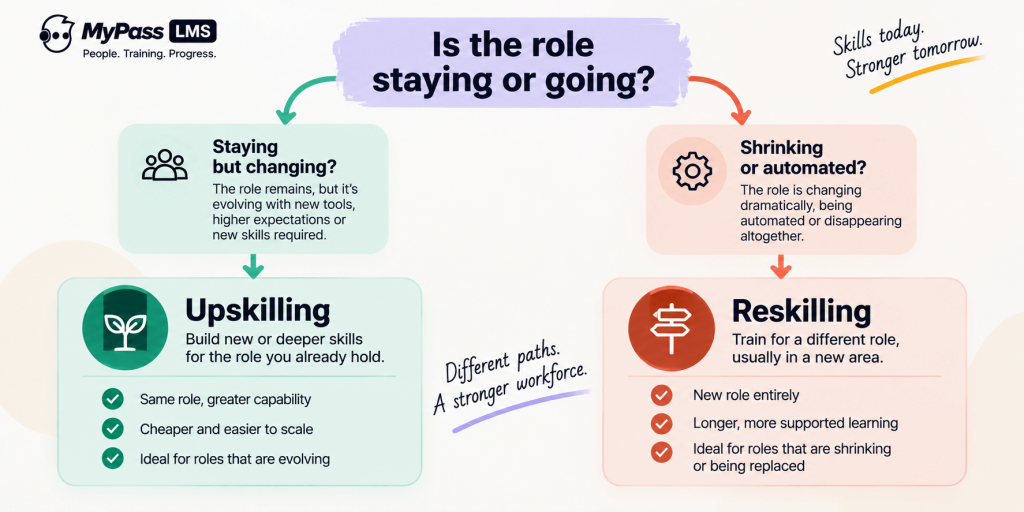
The right strategy depends on what is happening to the role, not the person. Use this as a decision guide.
- Choose upskilling when the role remains but is getting more demanding: new tools, new techniques, higher expectations.
- Choose reskilling when the role is shrinking or being automated and the person is worth redeploying elsewhere.
- Upskill broadly and cheaply through short modules and on-the-job practice across a whole team.
- Reskill selectively, since it means fewer, longer transitions that usually need real employer sponsorship.
- Use upskilling as a bridge to reskilling: basic new skills first can make a full role change less daunting.
How to Build a Program for Either
Whether you upskill or reskill, the underlying program mechanics are the same, and they start with knowing your gaps.
- Identify the gaps: use a skills view and a training needs analysis to see current versus required capabilities.
- Prioritise by business impact and risk: which gaps threaten performance or which roles are most exposed.
- Build role-based learning paths: sequence the training so it maps to the target role or the evolving one.
- Deliver and track: assign by role, and track progress and competency, not just course completion.
- Measure the outcome: for upskilling, improved performance; for reskilling, successful redeployment.
Reskilling in particular benefits from internal mobility: an internal talent marketplace tends to catch the people who would otherwise leave, turning a retention risk into a redeployment win.
How MyPass LMS Supports Both
Both strategies need the same platform capabilities: a way to see gaps, structure targeted learning, and prove people reached the required level. MyPass LMS supports role-based learning paths that map to either an evolving role or a new one, an AI course builder to create the specific content each path needs, and analytics to track progress against the target rather than just completion.
Because it is one platform with unlimited registered users, you can run broad upskilling across an entire workforce and focused reskilling for smaller groups without a per-seat penalty for training everyone, which matters when workforce development is meant to reach the whole organization.
Key point
Whichever strategy you pick, measure the right thing. Upskilling succeeds when performance improves in the current role. Reskilling succeeds when someone is redeployed successfully, not when they finish a course.
The bottom line
Reskilling and upskilling solve different problems: upskilling makes people better at the role they hold, reskilling prepares them for a new one. With around 39 percent of core skills set to change by 2030, most organizations need both, upskilling broadly and reskilling selectively, and they need to treat development as continuous rather than one-off.
The practical foundation is a platform that can see gaps, deliver role-based paths and prove results at scale. See how learning paths and analytics work in MyPass LMS features, or read our training needs analysis guide to find the gaps first.
Frequently asked questions
What is the difference between reskilling and upskilling?
Upskilling teaches an employee new or deeper skills for the role they already hold, so they keep performing it well as it changes. Reskilling trains an employee for a different role entirely, usually because their current one is being automated or eliminated. Upskilling improves someone in place; reskilling moves them to a new role.
When should a company reskill instead of upskill?
Reskill when a role is shrinking, disappearing or being automated and the employee is worth redeploying into a different role. Upskill when the role remains but is becoming more demanding through new tools or higher expectations. Reskilling is fewer, longer, sponsored transitions; upskilling scales cheaply across a team. Many organizations do both in parallel.
Why are reskilling and upskilling important in 2026?
Because skills are changing fast. The World Economic Forum estimates about 39 percent of workers' core skills will change by 2030, and that 59 of every 100 workers will need training. AI and automation are reshaping roles and the half-life of technical skills has shrunk to a couple of years, making continuous development a business necessity rather than a nice-to-have.
How do you measure reskilling and upskilling success?
Measure outcomes, not completion. Upskilling succeeds when performance improves in the current role, visible through assessment scores, quality and productivity. Reskilling succeeds when the person is successfully redeployed into the new role. Tracking progress against the target competency, rather than counting finished courses, is what shows whether the investment paid off.
Keep reading
Choosing an LMS
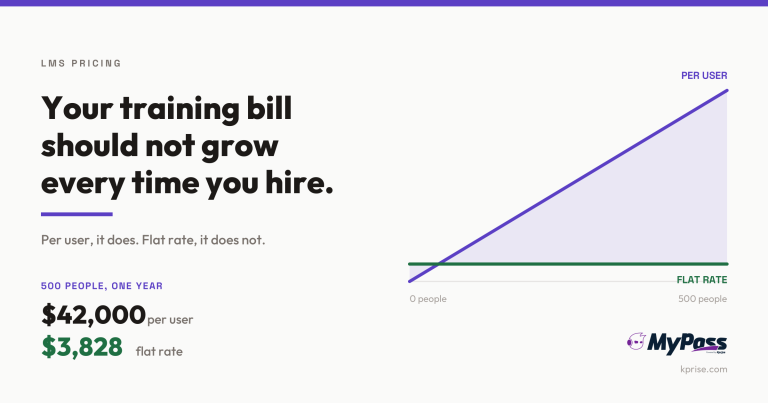
LMS Pricing Without Per-User Fees: What Flat-Rate Actually Costs

Choosing an LMS
Free LMS or Free Trial? The Five Kinds of Free

Choosing an LMS
Open edX Alternatives: 7 Options Worth Comparing
Choosing an LMS