| The main Open edX alternatives are Moodle, Chamilo, Canvas, Totara, open-core platforms such as MyPass LMS, and commercial systems like TalentLMS or Docebo. Most teams look for an alternative not because Open edX lacks features, but because running it needs infrastructure and engineering skills they do not have. |
Why Teams Look for Open edX Alternatives
Almost nobody leaves Open edX because the software is bad. It came out of MIT and Harvard, it runs some of the largest course catalogues in the world, and its assessment tools beat most commercial systems you can buy. People leave because of what sits underneath it.
Open edX is free to licence and costs real money to operate. Four things carry that cost, and only the first one usually makes it into the budget:
- Infrastructure. The published minimum for a Tutor install is two CPU cores and 4 GB of RAM. Production is four or more cores with 8 to 16 GB, and it grows from there.
- People who know the stack. Docker, and at scale Kubernetes, with both MySQL and MongoDB behind it. Patching, backups and monitoring are a job, not a task.
- Upgrades, twice a year, forever. Open edX ships two named releases annually. Verawood arrived in July 2026 and Willow is expected in early 2027. Older releases stop being supported on a schedule.
- Everything that is not configured out of the box. Theming, integrations, email, backups, security hardening. None of it ships set up for your organisation.
Scale matters here too. Community reports describe around 40 GB of RAM across four servers for roughly 300 users, with a single instance running out of headroom near 1,500 active learners. If you are delivering compliance modules to 400 members, that is a lot of engine you will never use.
What Open edX Actually Costs to Run
There are two honest ways to run it, and they cost very different amounts in very different shapes.
| Self-hosted | Managed hosting | |
| Typical cost | 50,000 to 200,000 dollars a year | 600 to 2,400 dollars a month, often plus setup |
| Who runs it | Your team | The provider |
| Skills needed in-house | Docker, Kubernetes, Linux, MySQL, MongoDB | None |
| Upgrades | Your project, twice a year | Included |
| Best for | Teams who already employ engineers | Teams who need Open edX specifically but have no ops staff |
Published prices from the main providers, checked in autumn 2026, land roughly here: Abstract Technology from around 599 euros a month, Raccoon Gang from around 800 dollars, Cubite at 1,260 dollars for up to 1,000 concurrent learners, and OpenCraft at 1,435 to 2,255 euros a month plus a setup fee of several thousand.
One caveat on the self-hosted figure. It comes from a provider that sells managed hosting, so treat it as the high end of an interested estimate. Even halved, it is not what most people picture when they read the word free, and managed Open edX often lands in the same price band as a commercial LMS. Our guide to self-hosting an LMS covers the real workload if you are weighing the two.
Is Open edX Still Maintained? The 2U Question
This comes up in every evaluation and most comparison articles skip it. The short answer is yes, and the confusion is worth clearing up.
- edX and Open edX are not the same thing. edX is the course website. Open edX is the open-source platform. They parted company years ago.
- What was sold. edX, the website, went to the education company 2U in 2021 for 800 million dollars. The open-source platform was never part of that sale.
- What happened to 2U. It filed for Chapter 11 bankruptcy in July 2024, with the debt from that acquisition widely cited as a major cause.
- Who runs the platform now. The original nonprofit, renamed Axim Collaborative, still funds Open edX development, and the project still ships two named releases a year.
- The fair caveat. It has fewer engineers than before the layoffs of that period, and its roadmap is no longer steered by a large commercial platform.
None of that is a reason to rule it out. It is a reason to spend twenty minutes on the project's GitHub activity and community forum before committing, which is sensible due diligence for any open-source LMS, not just this one.
The Seven Alternatives, Compared
These are the options that genuinely come up when organisations move away from Open edX. One of them is ours, and it is marked.
| Platform | Model | Best for | The honest catch |
| Moodle | Open source | Teams who want a huge plugin ecosystem | Same hosting problem as Open edX, plus an interface that needs work to feel modern |
| Chamilo | Open source | Smaller teams wanting open source without the weight | Smaller community, fewer integrations, less third-party help |
| Canvas LMS | Open core | Schools, colleges and universities | Built around academic terms and gradebooks, awkward for corporate or member training |
| Totara | Moodle-derived, commercial | Compliance-heavy workplaces needing audit trails | Paid, and sold through partners, so pricing depends who you talk to |
| MyPass LMS (ours) | Open core, free Community Edition | Associations, nonprofits and certification bodies wanting a free start with nothing to install | The free edition is not the full product. CE credit tracking sits in the paid tiers |
| TalentLMS or Docebo | Commercial SaaS | Corporate teams who want it fully handled | Per-user pricing, so the bill grows with headcount whether people log in or not |
| Google Classroom | Free SaaS | Simple assignment handouts in a school setting | Not really an LMS: no certification, compliance tracking or reporting worth the name |
A pattern worth noticing. Open source solves the licence cost and leaves you the operating cost. SaaS solves the operating cost and charges you per person. Open core sits between the two. Which shape fits you has more to do with whether you employ someone technical than with any feature list.
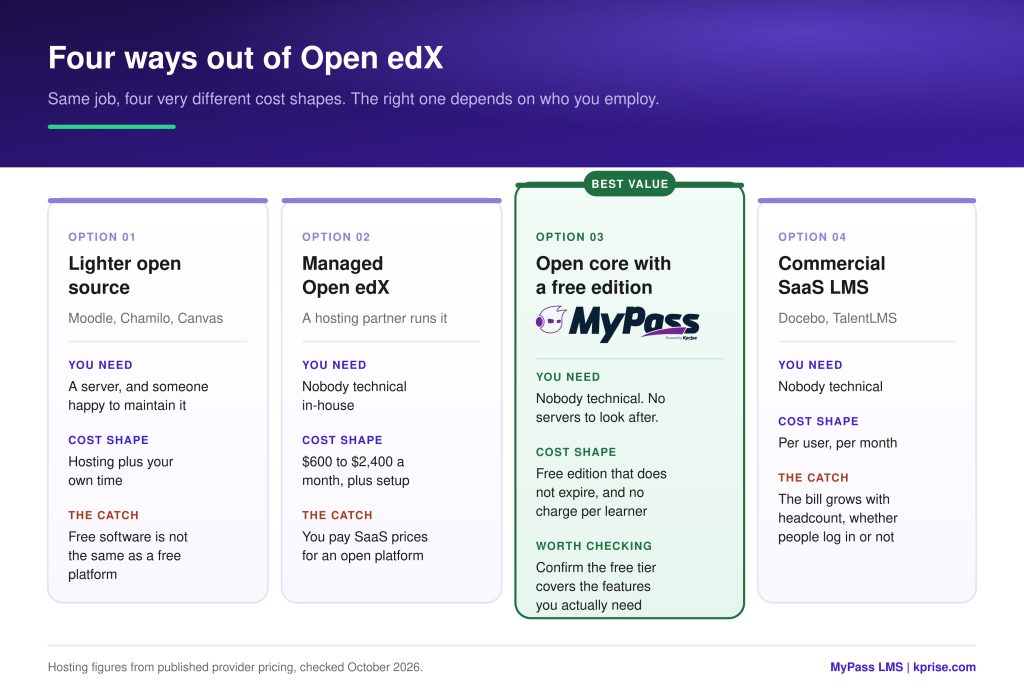
A Closer Look at Open Core, and Where MyPass LMS Fits
Open core is the newest of these three shapes and the least understood. We build MyPass LMS, so treat this as us showing our working rather than a neutral review.
The model is simple. The core platform is open and free to use, and the company earns from heavier features and hosting rather than charging per person. You get the free starting point people want from open source, without the part that catches everyone out, which is running servers. The difference between open core and open source is worth reading if that distinction is new, because the two terms get used interchangeably and they are not the same.
Where MyPass LMS sits:
- Nothing to install. No Docker, no database to maintain, no upgrade project twice a year.
- A free edition that stays free. The Community Edition launched on 1 October 2026 and does not expire into a trial.
- No charge per learner. Adding your whole membership or workforce does not change the bill.
- No technical staff required. Setting it up and keeping it running does not need an engineer.
- Already in production. More than 40 organisations are running on it.
The limits, because an alternatives article that oversells its own product is not worth your time. The free edition is a real LMS rather than a demo, but it is not the full product, and continuing education credit tracking sits in the paid tiers. If CE credits are the reason you are shopping, check that first.
A fair way to judge any free edition, ours included: ask what happens the day you outgrow it. A price increase is normal. Having to migrate to a different product entirely is a dead end dressed up as a free tier.
How to Choose: Five Questions
These settle most evaluations faster than any feature matrix.
1. Do you employ someone comfortable with Docker, Linux and databases, and will they still be here in two years? If not, every self-hosted option is off the table, including Moodle.
2. How many learners, and how fast is that growing? Per-user pricing is fine at 50 people and painful at 5,000. Flat pricing works the other way round.
3. Do you issue certificates or have to prove compliance? This narrows things quickly, because many free options cannot produce a defensible audit trail.
4. Do you need to sell courses? Built-in ecommerce is the difference between running one system and running three.
5. What happens if you want to leave in three years? Ask every vendor how you export your data and your course content, and make them show you.
That last one is the one people forget and the one that hurts. The reason open source appeals in the first place is usually a fear of lock-in, so it is worth checking the alternative does not reintroduce the problem in a different form. If free is where you need to start, our complete guide to free LMS options covers what each free edition in this market includes and where the limits sit.
When Open edX Is Still the Right Answer
An alternatives article that concludes you should always leave is not worth reading, so here is the other side.
| Stay with Open edX if | Look elsewhere if |
| You run a large public course catalogue | Your learner numbers are in the hundreds, not the tens of thousands |
| You need its assessment and courseware depth specifically | You mainly need compliance tracking and certificates |
| You already employ engineers who know the stack | Nobody on your team wants to own a Kubernetes cluster |
| You intend to modify the platform itself | You need to launch in weeks rather than months |
There is no shame in the right-hand column. Most organisations are in it, and choosing a platform that matches the size of your problem is not settling. If Moodle is also on your shortlist, our guide to Moodle alternatives covers that comparison in the same detail.
The bottom line
Open edX is strong software with an operating cost that catches people out. The licence is free. The servers, the specialist skills, the twice-yearly upgrades and the configuration are not, and realistic self-hosted totals run well into five figures a year once staff time is counted. Managed hosting removes that burden but typically costs as much as a commercial LMS, which undoes the reason many teams started looking at open source.
So the real decision is not Open edX against a list of rivals. It is which cost you would rather carry: engineering, a monthly fee, or a per-person licence. Answer the five questions above honestly and the shortlist usually writes itself.
If you want the open-source benefits without running infrastructure, that is the gap MyPass LMS was built for, with a free edition that does not expire and no per-seat charge. See what the free edition includes.
Frequently asked questions
What are the best alternatives to Open edX?
Moodle and Chamilo if you want to stay open source, Canvas if your use case is academic, Totara for compliance-heavy workplaces, open-core platforms such as MyPass LMS if you want a free edition without running servers, and TalentLMS or Docebo if you want it fully handled. The right one depends less on features than on whether you employ someone who can maintain infrastructure. If nobody on your team is comfortable with Docker, Linux and databases, every self-hosted option is effectively off the list.
Is Open edX really free?
The software licence is free and always has been. Running it is not. Production needs four or more CPU cores with 8 to 16 GB of RAM, growing with learner numbers, plus people who know Docker, Kubernetes, MySQL, MongoDB and Linux. One hosting provider estimates all-in self-hosting at 50,000 to 200,000 dollars a year including staff time, though that provider sells managed hosting, so treat it as an interested estimate. Managed Open edX typically runs from 600 to 2,400 dollars a month.
Open edX or Moodle: which should I choose?
They share the same underlying trade-off, so the choice is narrower than it looks. Open edX is stronger for large catalogues and sophisticated assessment, and heavier to run. Moodle is lighter to host, has a far bigger plugin ecosystem and many more people who know it, but its interface usually needs work to feel current. Both are free to licence and both need you to provide hosting and maintenance. If neither of those appeals, the answer is probably a third option.
Did Open edX shut down when 2U went bankrupt?
No. The two are separate. edX, the course website, was sold to 2U in 2021 for 800 million dollars, and 2U filed for Chapter 11 in July 2024. The open-source Open edX platform was never part of that sale. It stayed with the original nonprofit, now called Axim Collaborative, which still funds its development, and the project continues to ship two named releases a year. The fair caveat is that it has fewer engineers than before, so checking current GitHub activity before committing is sensible.