A free LMS comes in three main forms: free tiers of paid platforms, which cap users or features; open-source platforms like Moodle, which are free to self-host but cost money to run; and open-core Community Editions, which give you a full self-hostable core free with unlimited users. The key is understanding what free actually includes, since most free LMS options either limit scale or shift the cost from licensing to hosting and maintenance.
Free means at least three different things
Search for a free LMS and you will get results that are all called free but work nothing alike. One is free until you hit ten users. Another is free forever but you have to host and maintain it yourself. A third is free but so limited that it is really a trial in disguise. Choosing well means knowing which kind of free you are actually looking at.
This guide breaks the free LMS landscape into its real categories, explains what each type actually costs once you account for everything, and helps you match one to your situation. Free can be genuinely great, but only if you go in understanding the trade.
The three types of free LMS
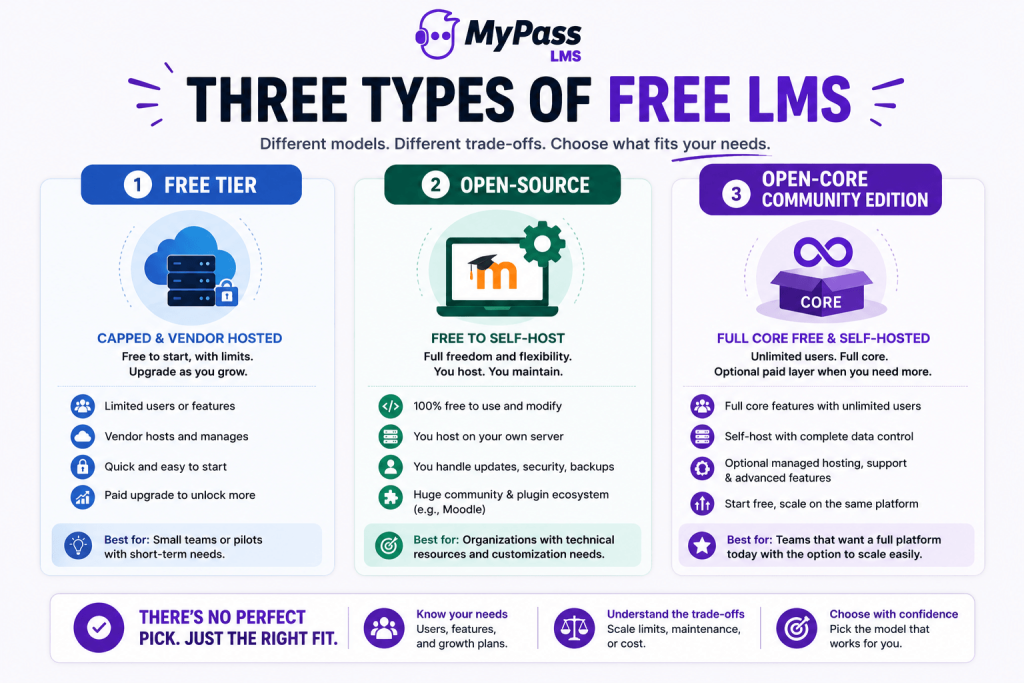
Free tiers of paid platforms. Many commercial LMS vendors offer a free plan capped at a small number of users or a limited feature set. Useful for piloting, but designed to nudge you into a paid tier as you grow.
Open-source platforms. Software like Moodle is free to download and self-host under an open license, with no per-user fee. You get full control and customization, but you own hosting, security, upgrades and administration.
Open-core Community Editions. An open-core platform gives you a full, self-hostable core edition free, often with unlimited users, plus an optional paid managed version from the same vendor. MyPass LMS Community Edition is this type.
What free actually costs: the hidden line items
The word free hides different costs depending on the type. Being honest about them is the whole point of this guide.
- Free tiers cost you scale. The moment you exceed the user cap or need a gated feature, you are on a paid plan. The free tier is real but temporary for most growing organizations.
- Open-source costs you operations. The license is free, but you pay for hosting, which can be a few dollars a month for a small server and far more for a large one, plus security, upgrades and admin time. Industry guides put self-hosted Moodle staff time at a meaningful fraction of a full-time role.
- Open-core Community Editions cost you hosting only, if you self-host. You avoid both the user cap and the per-user license, and pay for the server and upkeep, or move to the vendor's managed tier when you would rather not run it yourself.
| → The rule that cuts through the noise: with free tiers you pay in scale, with open-source and self-hosted open-core you pay in operations, and with managed paid plans you pay in money. There is no option where you pay in nothing. Pick the trade that fits you. |
How to choose the right free LMS
Match the type to your situation and technical capacity:
- If you need only a handful of users and want zero setup, a vendor free tier may be enough, as long as you know the cap.
- If you have strong technical staff and want deep customization, open-source like Moodle gives you total control at the cost of ongoing maintenance.
- If you want a full platform with unlimited users and no per-seat fee, but also the option to hand hosting to the vendor later, an open-core Community Edition is usually the most flexible free path.
That last option is why open-core has become such a practical answer for organizations that want free without a permanent operations burden or a hard user cap. You start on the free core, and the paid managed version is there only if and when you want it.
The bottom line
A free LMS is genuinely achievable in 2026, but free means three different things: a capped free tier, a self-hosted open-source platform, or a full open-core Community Edition. Each trades cost somewhere, in scale, in operations, or in money, so the smart move is choosing the trade that fits your team rather than the word free alone. For most organizations wanting a full platform without a user cap, an open-core Community Edition offers the most flexibility.
See a full, free core with unlimited users in MyPass LMS Community Edition, learn how open-core differs from open-source, or start a free trial.
Frequently Asked Questions
What is the best free LMS?
It depends on your needs. Vendor free tiers suit tiny teams that accept a user cap, open-source platforms like Moodle suit technical teams wanting customization, and open-core Community Editions like MyPass LMS suit organizations wanting a full platform with unlimited users and an optional managed upgrade path.
Is there a truly free LMS with unlimited users?
Yes. Open-core Community Editions can offer a full, self-hostable core with unlimited registered users at no license cost. MyPass LMS Community Edition is an example. You provide the hosting, or move to managed hosting if you prefer the vendor to run it.
Is Moodle a free LMS?
Moodle is free to self-host as open-source software under the GNU General Public License, with no per-user fee. However, you pay for hosting, security, upgrades and administration, so the software is free but the deployment is not.
What's the catch with a free LMS?
Every free LMS trades cost somewhere. Free tiers cap your users or features, open-source and self-hosted options require you to handle hosting and maintenance, and only paid managed plans remove both. Understanding which trade you are accepting is the key to choosing well.
Can a free LMS work for a growing business?
Yes, if you pick the right type. A capped free tier will force an upgrade as you grow, but an open-core Community Edition with unlimited users scales without a per-seat penalty, and lets you move to managed hosting later without changing platforms.