An open-source LMS makes its entire codebase free to use, modify and self-host, with no paid edition behind it, and Moodle is the best-known example. An open-core LMS gives you a free, self-hostable core product and adds an optional paid managed or commercial layer on top. The practical difference is support and hosting: pure open-source leaves you to run everything yourself, while open-core lets you start free and self-hosted, then move to a managed version if and when you want the vendor to run it for you. MyPass LMS uses the open-core model.
Two words that sound alike and mean different things
If you have started researching free or open LMS options, you have probably seen both terms used almost interchangeably: open-source and open-core. They are related, but they describe different business models, and the difference has real consequences for what you pay, who maintains the software, and what happens when you need help.
This guide explains both models plainly, shows where each one wins, and uses MyPass LMS, which is open-core, as a worked example. By the end you will be able to tell which model actually fits your organization rather than choosing on the word alone.
What open-source LMS means
An open-source LMS publishes its complete source code under a license, commonly the GNU General Public License, that lets anyone use, modify and self-host it for free. There is no paid edition of the core product. Moodle is the dominant example, running a substantial share of the world's e-learning.
- The software itself is genuinely free at any scale, with no per-user license fee.
- You can modify the code and extend it, often through a large plugin ecosystem.
- You keep full control of your data and where it lives.
- You are responsible for hosting, security, upgrades, plugin vetting and administration, either with your own staff or a third-party partner you pay separately.
| → The honest line about pure open-source, which even Moodle-focused guides repeat: the license is free, and the total cost rarely is. The cost moves from licensing to hosting, maintenance and specialized admin time. |
What open-core LMS means
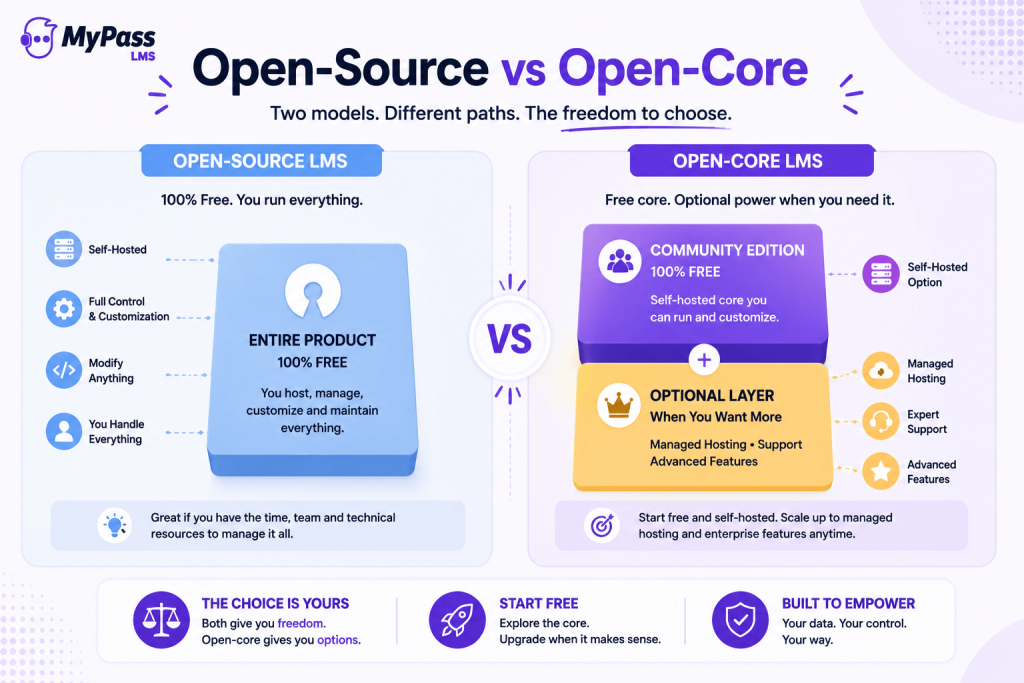
An open-core LMS also gives you a free, self-hostable core, but it pairs that core with an optional paid layer, usually managed hosting plus advanced features and support, from the same vendor. You choose which side you use.
- The core product is free and self-hostable, with the same data control and no per-user license fee as open-source.
- An optional managed edition means the vendor hosts, secures, updates and supports the platform for you, for a fee.
- Because one vendor maintains both, you can start free and self-hosted, then move to managed later without changing platforms.
- Advanced or enterprise features may sit in the paid layer, which funds ongoing development of the free core.
MyPass LMS is open-core. Its free Community Edition is a full, self-hostable core with unlimited registered users, and its managed hosting adds the option of letting the MyPass LMS team run everything for you.
The real differences that affect your decision
Set side by side, the two models diverge on a few things that actually matter:
| Factor | Open-Source LMS | Open-Core LMS |
| Core software cost | Free | Free (Community Edition) |
| Self-hosting | Yes, required for free use | Yes, optional |
| Managed option from same vendor | No, use third parties | Yes |
| Who supports it | Community or paid partners | Vendor (paid tier) or community |
| Path from free to managed | Migrate to a different host or vendor | Stay on the same platform |
| Example | Moodle | MyPass LMS |
The single most useful way to think about it: with pure open-source, free and managed are two different worlds, and moving between them means changing vendors. With open-core, they are two doors into the same platform, so the decision is reversible.
Which model fits you
Neither model is better in the abstract. The right one depends on your technical capacity and how much you want to own.
- Choose pure open-source, like Moodle, if you have strong in-house technical staff, want maximum customization through a huge plugin ecosystem, and are comfortable owning hosting, security and upgrades permanently.
- Choose open-core, like MyPass LMS, if you want the free, self-hosted option available but also want the choice to hand hosting and support to the vendor later, without migrating to a new platform.
For many organizations, especially those without a dedicated LMS administrator, the open-core promise of start free, stay free if it suits you, and upgrade to managed only when you want is the more practical path. You get the same data control and zero-license-fee core as open-source, with a safety net if self-hosting turns out to be more than you want to take on. That is exactly why MyPass LMS built its free Community Edition as a full product rather than a limited trial.
The bottom line
Open-source and open-core both give you a free, self-hostable LMS core with real data control and no per-user license fee. The difference is what sits alongside that core. Pure open-source, like Moodle, leaves hosting and support to you or third parties permanently. Open-core, like MyPass LMS, adds an optional managed layer from the same vendor, so you can start free and self-hosted and move to managed whenever you choose, without changing platforms. Match the model to your technical capacity, and the choice becomes clear.
See what the free core includes in MyPass LMS Community Edition, compare it with managed hosting, or start a free trial.
Frequently Asked Questions
What is the difference between open-core and open-source LMS?
An open-source LMS makes its entire codebase free to self-host with no paid edition, like Moodle. An open-core LMS gives you a free, self-hostable core plus an optional paid managed layer from the same vendor. Open-core lets you move from free to managed without changing platforms.
Is MyPass LMS open-source or open-core?
MyPass LMS is open-core. It offers a free, self-hostable Community Edition with unlimited registered users as its core, plus optional managed hosting where the MyPass LMS team runs the platform for you, adding advanced features and support.
Is an open-source LMS really free?
The software license is free, but deployment is not. With a pure open-source LMS you pay for hosting, security, upgrades, plugin vetting and admin time, either through your own staff or paid partners. The cost shifts from licensing to maintenance.
What is the advantage of an open-core LMS?
You get the free, self-hosted, data-controlled core of open-source, plus the option to hand hosting and support to the vendor later without migrating to a new platform. The decision between free and managed stays reversible.
Is Moodle open-core?
No. Moodle is a pure open-source LMS, released under the GNU General Public License. It offers self-hosted free deployment, a hosted MoodleCloud option and an enterprise Moodle Workplace edition, but the core model is open-source rather than open-core.