The main alternatives to Moodle are Open edX, Canvas LMS and Chamilo among open-source platforms, and open-core options like MyPass LMS that offer a free self-hostable core plus optional managed hosting. Moodle is free, endlessly customizable and pedagogically deep, which is why institutions use it, but teams look for alternatives when its dated interface, admin overhead and maintenance burden outweigh those strengths. The best alternative depends on whether you want a simpler experience, an easier hosting path, or a lower total cost of ownership.
Why people look past Moodle
Moodle is free, open-source and runs a large share of the world's e-learning. It is genuinely capable: quizzes, gradebooks, SCORM, competencies, rubrics and a plugin for almost everything. Institutions standardize on it for good reason. And yet a steady stream of organizations go looking for alternatives, and they tend to give the same reasons.
This guide is honest about both sides. It covers where Moodle genuinely wins and you should stay, the real reasons teams leave, and the strongest alternatives across open-source and open-core, including our own. The goal is to help you decide based on your situation, not on a sales pitch.
Where Moodle genuinely wins, stay if this is you
An alternatives guide that only criticizes Moodle would not be useful, because for many organizations Moodle remains the right answer. Stay with Moodle if:
- You need maximum customization and have the technical staff to do it. With over 2,000 plugins and full source-code access, Moodle bends to almost any requirement if you can build it.
- You are an educational institution with pedagogically deep needs, since Moodle's assessment depth, from question types to rubrics to competency frameworks, is exceptional and academic-grade.
- Data sovereignty is paramount and you have the staff to self-host, which is why many governments and universities standardize on it.
- You genuinely need free at very large scale and have existing IT staff whose time is not charged to the LMS budget.
| → Moodle's honest line is the one to stare at: the license is free, and the total cost rarely is. If you have the technical staff to absorb that cost and you value the customization, Moodle is hard to beat. If you do not, that is exactly when alternatives start to make sense. |
The real reasons teams leave Moodle
The reasons are consistent across review sites and migration stories:
- A dated learner experience. Moodle's interface has improved for two decades and still gets described as clunky. Since course completion is partly a user-experience metric, that friction quietly suppresses engagement.
- Administration became someone's job. Running a Moodle site takes real, ongoing effort. Guides estimate self-hosted Moodle absorbs a meaningful fraction of a full-time role in staff time, so the free license effectively gets paid for in salary.
- Maintenance overhead. Hosting, security hardening, version upgrades and plugin vetting are all on you, permanently, unless you pay a partner.
- You are a business, not an institution. Moodle's academic depth is overkill for many corporate training, compliance and association use cases that just need clean delivery and tracking.
The best Moodle alternatives compared
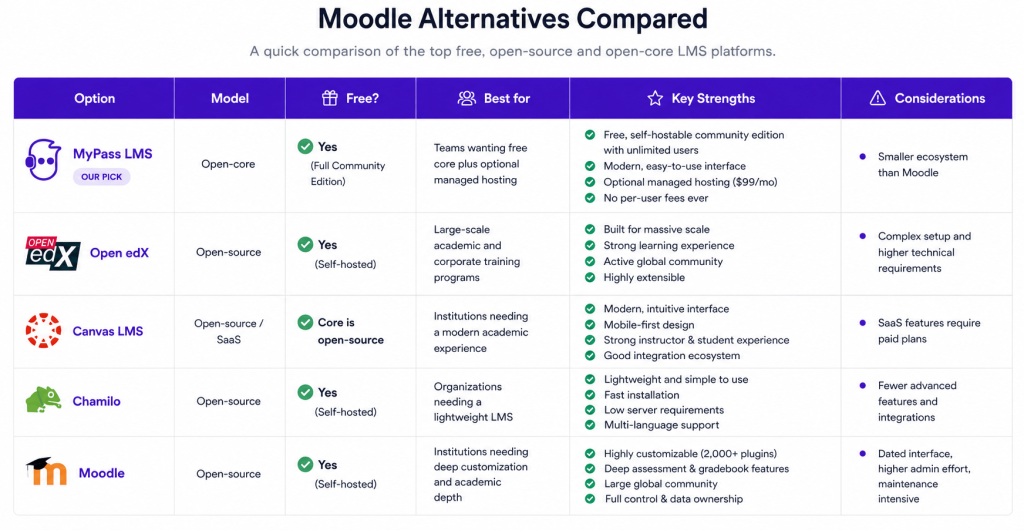
| Option | Model | Free? | Best for |
| MyPass LMS | Open-core | Yes, full Community Edition | Teams wanting free core plus optional managed hosting |
| Open edX | Open-source | Yes, self-hosted | Massive-scale deployments |
| Canvas LMS | Open-source / SaaS | Core is open-source | A more modern academic interface |
| Chamilo | Open-source | Yes, self-hosted | Lightweight, simpler self-hosting |
| Moodle | Open-source | Yes, self-hosted | Deep customization, academic depth |
A quick read on each:
- MyPass LMS. Open-core, so you get a free self-hostable Community Edition with unlimited users, plus the option of managed hosting from a flat rate. Strong for organizations that want free without the permanent maintenance burden, with compliance, certification and AI included.
- Open edX. The open-source platform behind large MOOCs, built for massive scale. Powerful, but heavier to run than Moodle for a typical organization.
- Canvas LMS. Has an open-source core and a more modern interface than Moodle, popular in education. A managed SaaS version exists at a cost.
- Chamilo. A lighter open-source option that is simpler to self-host than Moodle, good for smaller deployments that still want open-source.
Where MyPass LMS fits as a Moodle alternative
If the reason you are leaving Moodle is the maintenance burden and dated experience rather than a desire for a different open-source platform to self-manage, MyPass LMS is built for exactly that. As an open-core platform, it keeps the parts people like about Moodle, which are free, self-hostable and no per-user fee, while removing the parts they do not.
The key difference is the escape hatch. With Moodle, moving from free self-hosting to a managed setup means finding and paying a third-party partner. With MyPass LMS, the free Community Edition and managed hosting are the same platform, so you can self-host for free and hand hosting to the vendor later without migrating. For a business, association or nonprofit that wants Moodle's zero-license-fee freedom without Moodle's operational weight, that is often the deciding factor.
The bottom line
Moodle is a genuinely strong open-source LMS, and for institutions with technical staff and deep customization needs it remains hard to beat. Teams look for alternatives when its dated interface and ongoing maintenance burden outweigh those strengths. The best alternative depends on what you want: Open edX for scale, Canvas for a modern academic feel, Chamilo for lighter self-hosting, or an open-core platform like MyPass LMS for a free core with an optional managed path and no per-user fee.
See how MyPass LMS compares as a free, open-core Moodle alternative, learn how open-core differs from open-source, or start a free trial.
Frequently Asked Questions
What are the best alternatives to Moodle?
The main Moodle alternatives are Open edX for massive scale, Canvas LMS for a modern academic interface, and Chamilo for lighter self-hosting among open-source options, plus open-core platforms like MyPass LMS that offer a free self-hostable core with optional managed hosting.
Is there a free alternative to Moodle?
Yes. Open-source alternatives like Open edX and Chamilo are free to self-host, and open-core Community Editions like MyPass LMS offer a full free core with unlimited users plus optional managed hosting. Each trades cost in operations or an optional fee rather than licensing.
Why do people switch from Moodle?
Common reasons include a dated learner interface, the ongoing administration and maintenance burden, hosting and upgrade overhead, and the fact that Moodle's academic depth is often overkill for corporate, compliance or association training that just needs clean delivery and tracking.
Is MyPass LMS a good Moodle alternative?
For organizations that want Moodle's free, self-hostable, no-per-user-fee model without its maintenance burden, yes. As an open-core platform, MyPass LMS offers a free Community Edition plus optional managed hosting on the same platform, so moving from free to managed does not require migrating.
What's the difference between Moodle and an open-core LMS?
Moodle is pure open-source: free to self-host, with managed options only through third-party partners. An open-core LMS like MyPass LMS offers a free self-hostable core plus optional managed hosting from the same vendor, so you can move from free to managed without changing platforms.