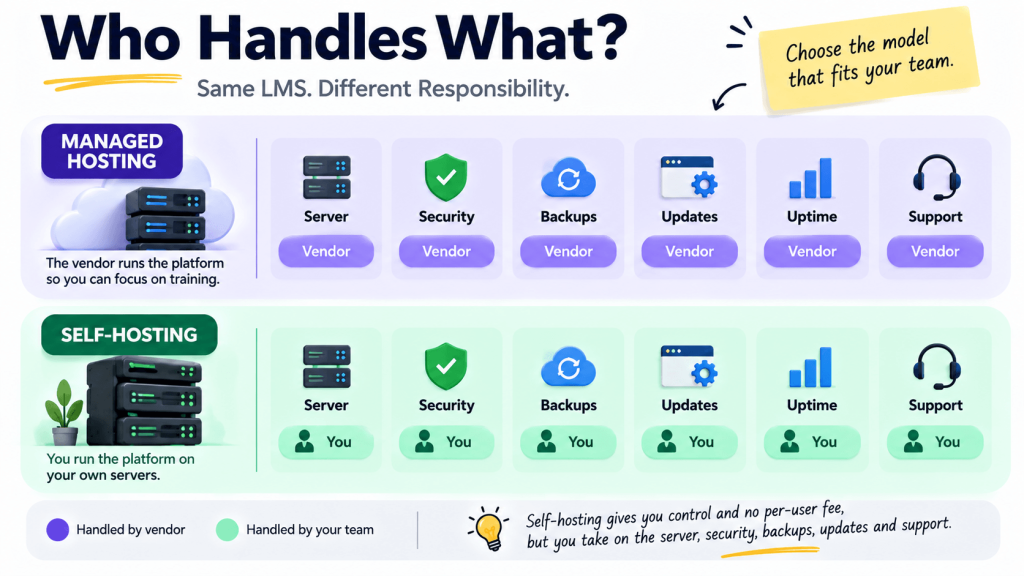
| Self-hosting an LMS means running the platform on your own servers instead of a vendor's cloud. You gain full control, data residency and no per-user fee, but you take on the server, security, backups, updates and the staff time to manage them. It suits teams with standing IT capacity or strict data requirements. |
What Self-Hosting Actually Means
Self-hosting an LMS means you run the software on infrastructure you control, your own servers or your own cloud account, rather than paying a vendor to host it for you. You hold the data, control the environment, and typically avoid per-user license fees, especially with open-source or open-core platforms.
The appeal is control and cost. You decide where data lives, how the platform is configured, and you are not billed per seat. The reality is responsibility: everything a hosting vendor would normally handle, uptime, security, backups, updates, becomes your job. Self-hosting is not free; it trades a hosting fee for staff time and infrastructure cost.
| Self-hosting swaps a predictable hosting bill for infrastructure cost plus staff time. Whether that is cheaper depends entirely on whether you already have the IT capacity to absorb the work, or have to add it. |
What You Actually Take On
Before self-hosting, be clear about the full list of responsibilities, because underestimating them is the classic mistake. These do not go away just because the software is free.
- The server: provisioning, sizing and paying for infrastructure that can handle your load.
- Security: firewalls, access control, patching and protecting learner data.
- Backups: regular, tested backups so a failure does not lose your training records.
- Updates: applying platform updates and fixes without breaking your setup.
- Uptime: monitoring and responding when something goes down, potentially out of hours.
- Support: no vendor help desk by default; your team is the first line.
When Self-Hosting Makes Sense
Self-hosting is the right choice for specific situations, and the wrong one for others. It comes down to capacity, control requirements and cost at your scale.
- You have standing IT capacity: a team that already runs servers can absorb an LMS without much extra cost.
- You have data-residency or policy requirements: rules that require training data to stay on your own infrastructure.
- You want maximum control: full ownership of configuration, customisation and environment.
- You have a large audience and want to avoid per-user fees: self-hosting can be very cost-effective at scale.
| The deciding question is not 'is self-hosting free?' but 'do we already have the team to run it?' If yes, self-hosting is often cheaper and gives more control. If no, the staff time you would add usually costs more than managed hosting. |
When Managed Hosting Wins
For many organizations, especially smaller ones, managed hosting is cheaper once you count honestly. When you do not have spare IT capacity, self-hosting means either adding staff or diverting people from other work, and that hidden cost usually exceeds a managed hosting fee.
Managed hosting also removes the risk that keeps small teams up at night: a security lapse, a failed backup, or downtime nobody is equipped to fix. For organizations without a dedicated infrastructure team, paying a vendor to handle uptime, security and updates is often the more economical and safer choice, even though it looks more expensive on the surface.
How MyPass LMS Handles Both
MyPass LMS lets you choose without changing platforms. MyPass Community Edition is a free, self-hosted edition with unlimited registered users, so if you have the IT capacity, you can run it yourself at no license cost. If you would rather not run a server, managed hosting starts at 99 dollars a month, with MyPass LMS handling infrastructure, security, backups, updates and support.
The advantage is flexibility: you can start self-hosted and move to managed hosting later as a data migration on the same platform, rather than replatforming. That means the self-hosting decision is not permanent, you can change your mind as your capacity or requirements change, without losing your data or rebuilding.
| A practical middle path: start with the free self-hosted Community Edition to prove value at zero license cost, then move to managed hosting if running the server becomes more work than it is worth. Because it is the same platform, that move is a migration, not a rebuild. |
The bottom line
Self-hosting an LMS gives you control, data residency and no per-user fee, but you take on the server, security, backups, updates and the staff time to run them. It is a strong choice if you already have IT capacity or strict data requirements, and a false economy if you would have to add the capacity, since that usually costs more than managed hosting.
The good news is you do not have to decide permanently. See self-hosted vs managed hosting, learn how MyPass LMS pricing works, or download the Community Edition to start self-hosted for free.
Frequently asked questions
What does it take to self-host an LMS?
Self-hosting an LMS means running it on your own infrastructure and taking on the server, security, backups, updates, uptime monitoring and first-line support. You need staff with the technical capacity to handle these, plus the infrastructure cost. The software may be free of license fee, especially open-source or open-core, but self-hosting trades that for staff time and infrastructure responsibility.
Is self-hosting an LMS cheaper than managed hosting?
It depends on whether you already have the IT capacity. If a team already runs servers, self-hosting can be cheaper, especially at scale where per-user fees would be high. If you would have to add staff or divert people to run it, that hidden cost usually exceeds a managed hosting fee. Count total cost, including staff time, not just the license price.
When should you self-host an LMS?
Self-host when you have standing IT capacity to absorb the work, a data-residency or policy requirement to keep training data on your own infrastructure, a desire for maximum control over configuration, or a large audience where avoiding per-user fees at scale is valuable. If you lack a dedicated infrastructure team, managed hosting is usually cheaper and safer once staff time is counted.
Can you switch from self-hosting to managed hosting later?
With some platforms, yes, and it matters. On an open-core platform like MyPass LMS, you can start with the free self-hosted Community Edition and later move to managed hosting as a data migration on the same platform, rather than replatforming onto a different product. That makes the self-hosting decision reversible as your capacity or requirements change, without losing data or rebuilding.