
Home / Research / CPA Society CPE Pricing
408 CPE courses · 16 state CPA societies · prices checked 22 November 2026
CPE Pricing at 16 State CPA Societies: Do Member Dues Pay Off?
State CPA societies charge members less for CPE. We priced 408 courses on 16 societies' own websites to see how much less, and whether that discount covers the cost of joining. Members pay a median 23% less per credit. In 9 of 13 states, the discount on 40 credits, a typical year's requirement, is worth more than the dues.
How many credits before membership pays for itself
The bar is the number of CPE credits a CPA has to buy from the society, at member prices, before the savings add up to the annual dues. The dashed line is 40 credits: many state boards, Oklahoma's and Washington's among them, require 120 hours every three years, so 40 is the average year. Shorter bars mean membership pays for itself sooner.
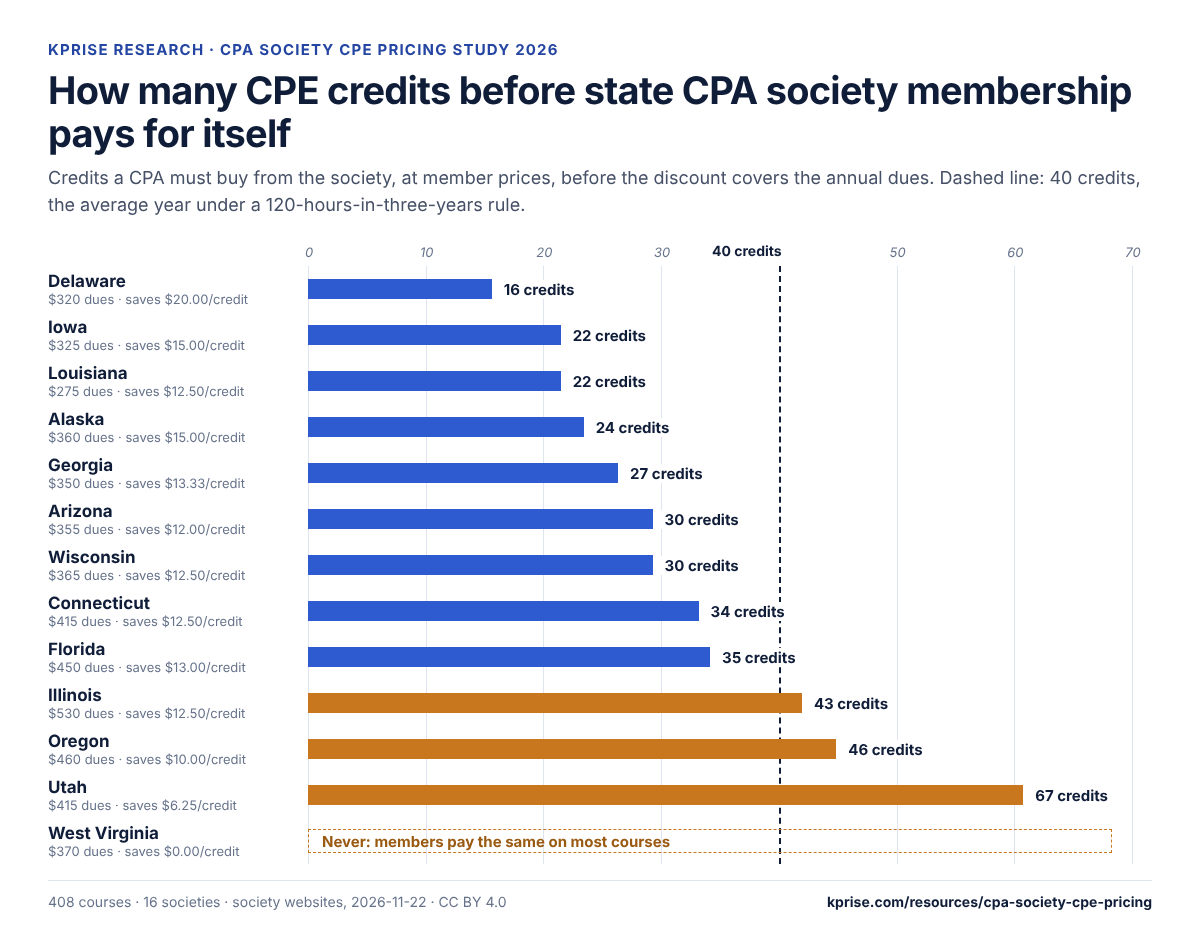
Break-even is the society's dues divided by its median saving per credit (non-member price per credit minus member price per credit, across the courses we priced), rounded up. Dues are the highest published rate for an individually licensed CPA, so a CPA in a cheaper category breaks even sooner. Florida Institute of CPAs membership also includes 20 hours of free CPE a year, which this calculation leaves out, so Florida members come out further ahead than the chart shows. Not charted, because dues are not published: Oklahoma (current dues are shown only after member login; the only public schedule is a 2022 PDF); Washington (dues amounts are shown only in the member portal); Indiana (the latest public schedule is for 2025–26).
What members and non-members pay per credit
Each row runs from the median member price per CPE credit (blue) to the median non-member price (orange), largest discount first. Across all 408 courses, non-members paid more on 91% of them, and most discounts fell between 11% and 34%.
West Virginia Society of CPAs is the exception. Most of its catalog is webinars from outside providers, sold at one price to everyone: 36 of the 37 courses we priced cost members exactly what they cost non-members. Its own live events do carry a member price, but there are only a handful on the calendar.
What this means
If you are a CPA deciding whether to join
Count the credits you actually buy from the society, not the credits you need. Firm-paid training, free vendor webinars and national providers all reduce what the member discount is worth to you. If you buy 40 credits a year through the society, membership pays for itself on CPE alone in 9 of the 13 states we could check. If you buy half that, it covers the dues only in Delaware.
If you price CE for an association
The societies in this study cluster around a 23% member discount, with most between 11% and 34%. The ones whose discount pays the dues within a typical year can put that in the renewal email as a number; the others are asking members to join for reasons the price list doesn't show. If you're setting member and non-member prices per course and want them to follow AMS membership status automatically, that is what MyPass does for associations.
How we did it
- All 50 state CPA societies, their own sites only. A headless browser loaded each society's CPE catalog under the identity KpriseResearch/1.0 (+https://kprise.com), followed robots.txt including crawl delays, and opened up to 40 course pages per society. 36 sites showed CPE prices.
- Both prices labelled, or the course is out. A course counts only when the society's own page labels a member price and a non-member price. We drop bundles, passes and subscriptions, credit counts outside 0.5–40, and anything where the unit isn't a CPE credit.
- At least 5 courses per society. 16 societies had enough. Nevada Society of CPAs (3) and Tennessee Society of CPAs (3) had too few priced courses to report on their own; their courses are in the CSV.
- Dues from each society's published schedule. We used the highest rate for an individually licensed CPA, the conservative choice for break-even, and linked every figure to its source in the table. Tennessee adds chapter dues by location; where that applies we used the highest.
- Checked by hand. We reopened 20 courses picked at random and compared the member price, non-member price and credits with the live page. All 20 matched.
- Limits. This is a snapshot of each catalog on 22 November 2026, weighted toward what was on sale that week, so live webinars outnumber conferences. Prices were read without logging in, so member-only offers and early-bird rates may be missing.
Questions people ask
Is state CPA society membership worth it for the CPE discount alone?
It depends on the state and on how much CPE you buy from the society. In 9 of the 13 states where we could match published dues to course prices, a CPA who buys 40 credits a year from the society saves more than the dues. The break-even point runs from 16 credits (Delaware Society of CPAs) to 67 (Utah Association of CPAs). If your firm pays for your CPE or you take free webinars, the discount is worth less to you, and the case for membership rests on the other benefits.
How much do state CPA societies charge for CPE?
Across 408 courses at 16 societies, the median price was $44.50 per CPE credit for members and $57.32 for non-members. An 8-credit day course at those rates is about $356 for a member and $459 for a non-member.
How much cheaper is CPE for CPA society members?
The median member discount was 23% off the non-member price, which is the same as non-members paying 29% more. Most courses sat between 11% and 34% off. Non-members paid more on 91% of the courses; almost all the exceptions were third-party webinars West Virginia Society of CPAs sells at one price to everyone.
Which states have the smallest member discount?
West Virginia Society of CPAs charges members and non-members the same for 36 of the 37 courses we priced, so the discount never covers its dues. Illinois CPA Society (43 credits), Oregon Society of CPAs (46 credits), Utah Association of CPAs (67 credits) need more than 40 credits to break even.
Why does the study cover 16 states and not all 50?
We only use a course when the society's own page labels both the member and the non-member price, and we only give a society its own figures with at least 5 such courses. 36 society sites showed CPE prices; the rest either showed one price, sent members to a partner site, or put prices behind a login.
Can I reuse this data?
Yes. It is CC BY 4.0: quote it, chart it or republish the table, with a link to this page as the source. The CSV lists every course with its prices, credits and the page we took them from.
Use it
The data is CC BY 4.0: quote it, chart it, put the table in your own article, and link here as the source. Citation line: Kprise, "CPA Society CPE Pricing Study 2026," November 2026, kprise.com/resources/cpa-society-cpe-pricing. Spotted a price that's changed or wrong? Tell us and we'll correct it.