SCORM vs xAPI vs AICC: eLearning Standards Explained
SCORM vs xAPI vs AICC: what each eLearning standard tracks, where it works, and which to choose for your LMS and content. A plain-English comparison.
On this page 7 sections
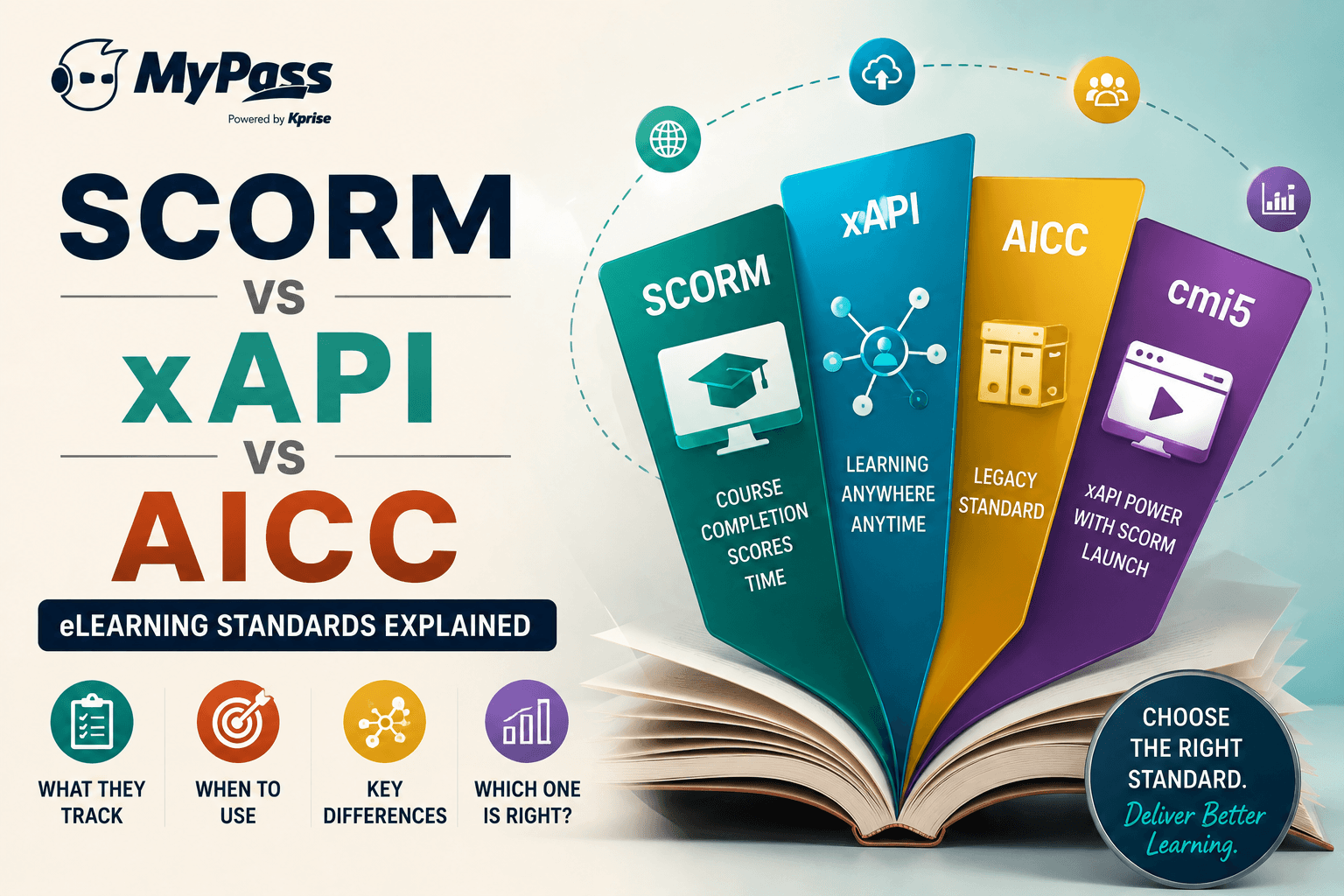
SCORM is the most widely supported eLearning standard and tracks completion, time and score inside an LMS. xAPI tracks far richer activity, including learning that happens outside the LMS, but needs a Learning Record Store. AICC is the older predecessor, largely legacy now. cmi5 combines xAPI's data model with SCORM-style course launching.
Why this is confusing, and what actually matters
These four names get thrown around as though choosing between them were a major strategic decision. For most organizations it is not. The practical question is narrower: will the content I have, or plan to buy, work in the platform I am choosing, and does it capture the data I actually need?
Here is what each standard does, in plain terms, and how to decide without over-engineering it.
The four standards, plainly
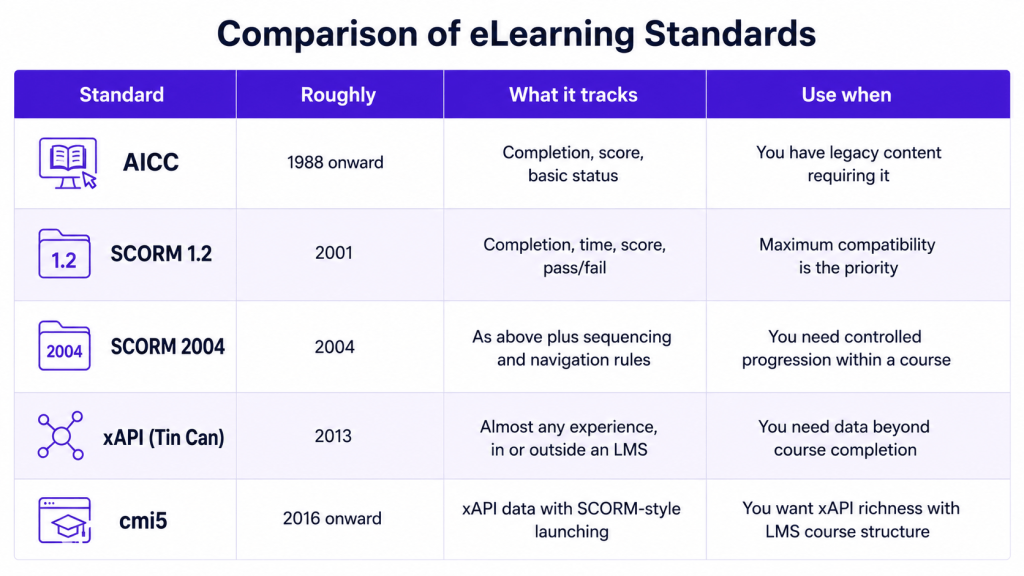
- AICC came first, predating the web as we know it, and is largely legacy. You mainly encounter it when inheriting old content. If you have no AICC content, you can safely ignore it.
- SCORM is the workhorse. SCORM 1.2 is the most universally supported version anywhere; SCORM 2004 adds sequencing rules that control how learners move through a course. Nearly every authoring tool exports SCORM and nearly every LMS imports it.
- xAPI, originally called Tin Can, broke the assumption that learning happens inside a course in an LMS. It records statements in an actor, verb, object form, so it can capture reading an article, attending a session, completing a simulation or performing a task in another system.
- cmi5 is the practical bridge, using xAPI's data model while keeping the LMS in charge of launching and structuring courses, which is what most organizations actually want from xAPI without abandoning course structure.
The trade-off nobody mentions upfront
xAPI is genuinely more capable, and that is exactly why it is not automatically the right answer.
SCORM's limitation is also its strength: it tracks a small, fixed set of things, and because that set is small, support for it is near-universal and implementation is simple. You upload a package, it works, completions appear.
xAPI's power comes with dependencies. You need a Learning Record Store to hold the statements, someone has to design what statements get sent and what they mean, and you need a plan for what you will actually do with the data. Organizations frequently adopt xAPI, accumulate an enormous volume of statements, and never build the analysis that would justify it.
Key point
The honest test for xAPI: name the specific question you cannot answer today and will answer with xAPI data, and name who will act on the answer. If you cannot fill in both, SCORM will serve you better for now, and you can move later.
How to choose
- Choose SCORM 1.2 if you want the safest, most compatible option and your need is course completion, time and score. This covers the majority of compliance, onboarding and certification programmes.
- Choose SCORM 2004 if you need controlled sequencing, meaning learners must complete parts in a defined order with rules governing progression.
- Choose xAPI or cmi5 if you genuinely need to track learning beyond courses, such as on-the-job performance, simulations or activity in other systems, and you have a Learning Record Store plus a plan for the data.
- Support AICC only if you have inherited content that requires it.
For most organizations the answer is SCORM, and that is not a compromise. The standard has been carrying corporate and compliance training for two decades because it does its narrow job reliably.
What to check when evaluating a platform
- Which SCORM versions are supported, since 1.2 and 2004 are not the same thing and some platforms support one only.
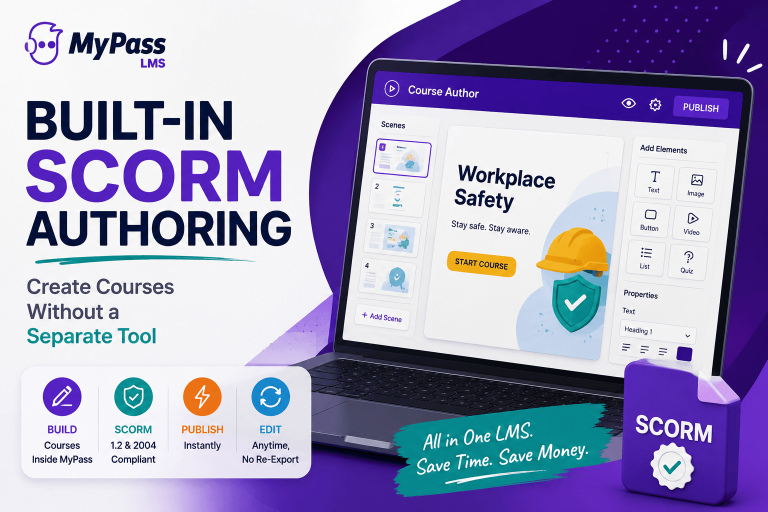
- Whether the platform can author SCORM as well as play it, which removes the need for a separate authoring tool.
- Whether xAPI support means genuine Learning Record Store integration or only partial statement sending.
- How completion data flows into reporting, since standards compliance is worthless if the resulting records are hard to extract.
MyPass LMS supports both SCORM 1.2 and SCORM 2004, and includes built-in SCORM authoring, so you can create standards-based content and play imported packages in the same platform. Completions in either case feed the same tracking and audit reporting.
The bottom line
SCORM remains the sensible default in 2026 because it does a narrow job reliably and is supported almost everywhere. Choose SCORM 1.2 for maximum compatibility, SCORM 2004 when you need controlled sequencing, and xAPI or cmi5 only when you have a specific question that course-completion data cannot answer and a Learning Record Store ready to receive the statements. AICC matters only if you have inherited content that requires it. The standard is a means to an end, so pick the simplest one that captures what you will actually use.
See how MyPass LMS handles SCORM, explore the platform features, or start a free trial.
Frequently asked questions
What is the difference between SCORM and xAPI?
SCORM tracks a fixed set of data, mainly completion, time and score, inside an LMS, and is supported almost universally. xAPI tracks far richer activity including learning outside the LMS, but requires a Learning Record Store and a plan for using the data.
Is SCORM still used in 2026?
Yes, widely. SCORM remains the most compatible eLearning standard and continues to carry the majority of corporate compliance, onboarding and certification training, because its narrow scope makes it simple and reliably supported.
What is the difference between SCORM 1.2 and SCORM 2004?
SCORM 1.2 tracks completion, time, score and pass or fail, and has the broadest support of any version. SCORM 2004 adds sequencing and navigation rules, letting you control the order in which learners move through course content.
Should I use xAPI instead of SCORM?
Only if you have a specific question that completion data cannot answer, plus a Learning Record Store and someone who will act on the data. Many organizations adopt xAPI, collect large volumes of statements, and never build the analysis to justify it.
What is cmi5?
cmi5 combines xAPI's richer data model with SCORM-style course launching and structure. It suits organizations that want xAPI's data capability while keeping the LMS in charge of how courses are launched and organised.
Is AICC still relevant?
Rarely. AICC predates SCORM and is largely legacy. It matters mainly when an organization has inherited older content that requires it. If you have no AICC content, you can safely disregard the standard.
Keep reading
Course design & delivery
What Is eLearning? A Clear, No-Jargon Guide
Course design & delivery
Built-In SCORM Authoring: Create Courses Without a Separate Tool
Compliance training
Accessible E-Learning: How to Make Training Work for Everyone
Course design & delivery