How to Write Learning Objectives That Actually Work
How to write learning objectives: a simple formula, measurable verbs from Bloom's taxonomy, and before-and-after examples you can adapt for any course.
On this page 8 sections
Short answer
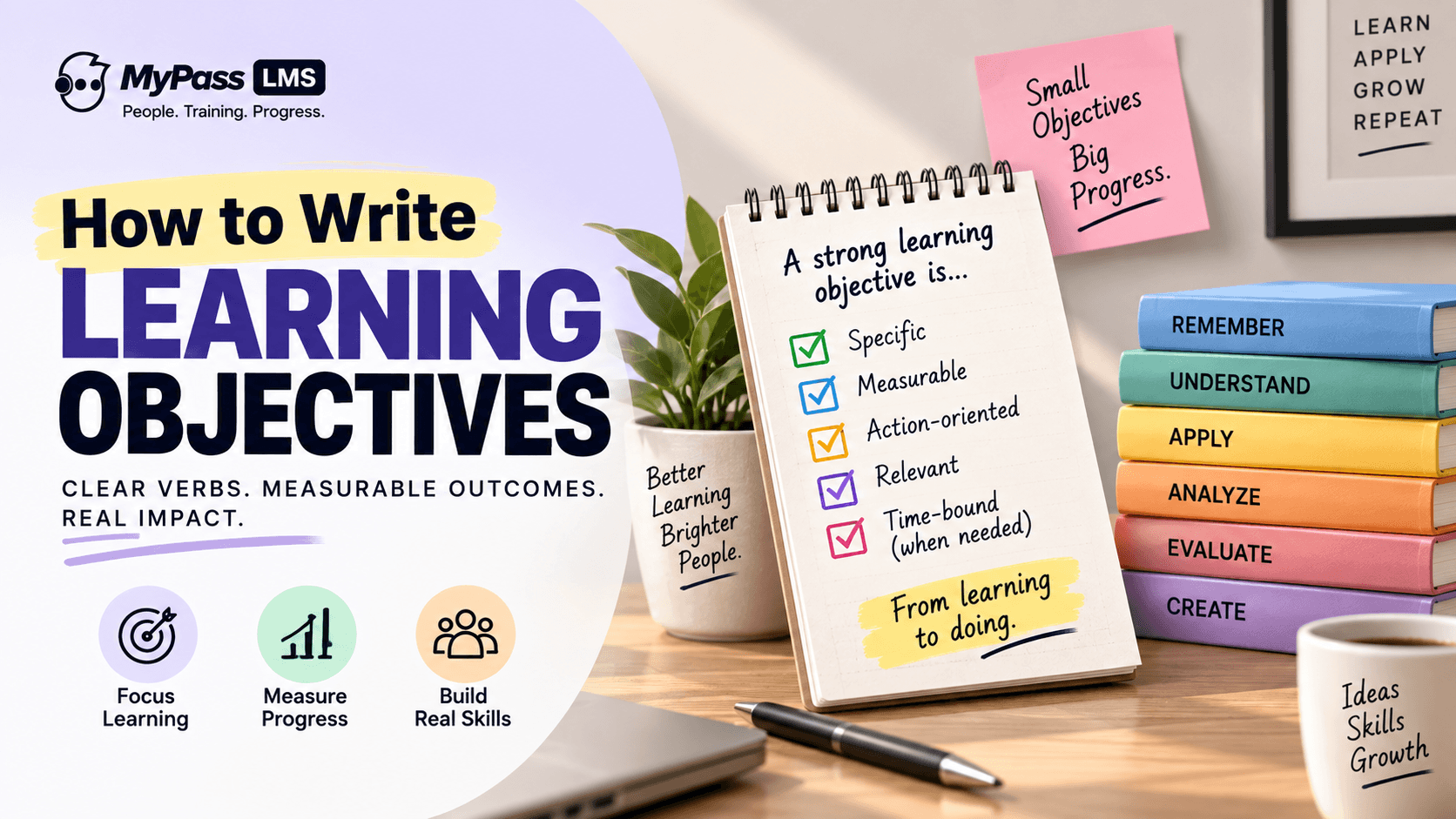
To write a learning objective, state what the learner will be able to do after training, using a measurable action verb from the right level of Bloom's taxonomy. A strong objective combines an observable verb, a clear outcome, and where useful a condition and criterion. Avoid vague verbs like understand or know.
What a Learning Objective Is
A learning objective is a clear, specific statement of what a learner will be able to do after a piece of training. The emphasis is on do. Most training tells learners what a course will cover; a good objective flips that to what the learner will be able to do with it, which is the shift from delivering content to building capability.
That distinction matters because objectives are the backbone of course design. They shape what content you build, how you structure it, and how you assess it. Write them well and everything downstream lines up. Write them vaguely and the course, and the way you measure it, drifts.
Key point
The test of a learning objective: can you observe and measure whether the learner did it? 'Understand phishing' fails the test. 'Identify three signs of a phishing email' passes it.
Objectives vs Outcomes, and Why Verbs Decide Everything
Learning objectives and learning outcomes are often used interchangeably, and the distinction is less important than one thing they share: both must be measurable, and the verb is what makes them measurable. An objective built on a vague verb cannot be assessed, which makes it useless for proving learning happened.
The core rule of instructional design here is simple. Use observable, measurable action verbs. Avoid verbs that describe an internal state you cannot see.
| Avoid (not measurable) | Use instead (measurable) |
| Understand | Explain, summarise, describe |
| Know | List, define, identify |
| Appreciate | Justify, evaluate, critique |
| Learn | Apply, demonstrate, perform |
| Be aware of | Recognise, classify, distinguish |
Key point
The single rule that fixes most weak objectives: if you cannot measure it by observing the learner, rewrite the verb. You can measure whether someone can classify a risk; you cannot measure whether they appreciate it.
Bloom's Taxonomy: Matching the Verb to the Goal
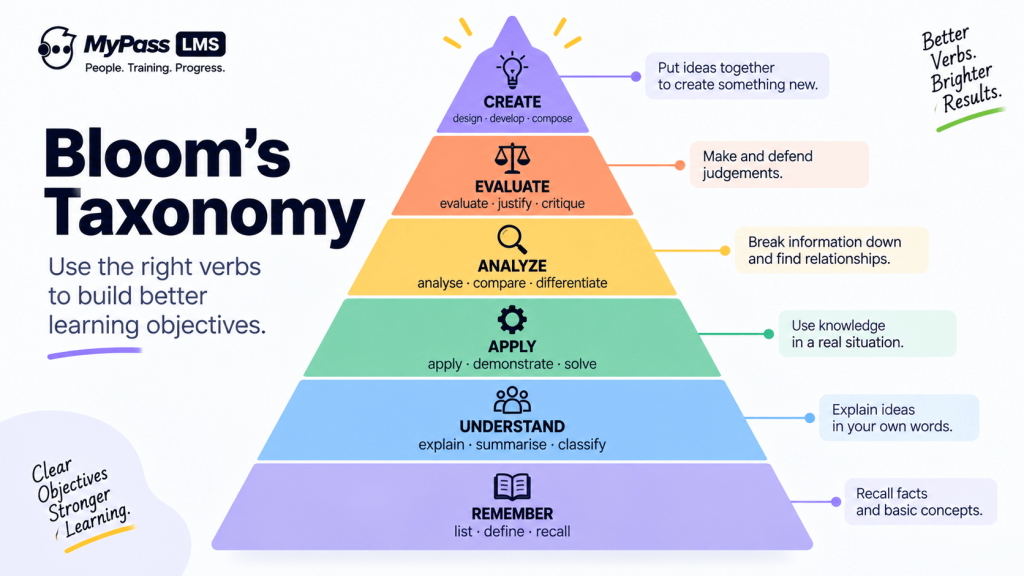
The most widely used framework for choosing the right verb is Bloom's taxonomy, first published in 1956 and revised by Anderson and Krathwohl in 2001. The revision renamed the levels as verbs and put Create at the top, reflecting a focus on what learners can do, not just what they know.
It sorts cognitive skills into six levels, from simple recall to complex creation. The point is to match the level to the real goal: a compliance refresher may only need Remember and Understand, while a leadership program aims for Evaluate and Create.
- Remember: recall facts. Verbs: list, define, name, recall.
- Understand: explain ideas. Verbs: explain, summarise, describe, classify.
- Apply: use knowledge in a situation. Verbs: apply, demonstrate, calculate, use.
- Analyze: break information down. Verbs: analyse, compare, differentiate, examine.
- Evaluate: make judgements. Verbs: evaluate, justify, critique, defend.
- Create: produce something new. Verbs: design, develop, compose, construct.
The Anatomy of a Strong Objective
A well-formed objective has up to four parts. The verb and outcome are essential; the condition and criterion are added when they make the objective clearer or more testable. A common way to express this is the ABCD approach: Audience, Behaviour, Condition, Degree.
- Audience: who the learner is (often implied, 'the learner will be able to').
- Behaviour: the measurable action verb plus the outcome. This is the core.
- Condition: the circumstances, such as 'given a sample dataset' or 'without notes'.
- Degree: the standard of success, such as 'with at least 90 percent accuracy'.
Key point
Worked example. Weak: 'Understand data protection.' Strong: 'Given a customer scenario, the learner will be able to identify which data protection principle applies, with at least 80 percent accuracy.' The second is observable, conditional and measurable.
Common Mistakes to Avoid
Most weak objectives fail in one of a few predictable ways. Checking against this list fixes the majority of them.
- Vague verbs: understand, know, appreciate, be aware of. Not observable, not measurable.
- Describing the course, not the learner: 'this course covers X' is a topic, not an objective.
- Too many objectives: more than a handful per course becomes impossible to assess meaningfully.
- Mismatched assessment: writing an Apply objective then testing it with a Remember-level quiz.
- Bundling several outcomes into one objective, so you cannot tell which part the learner missed.
Writing and Using Objectives in Your LMS
Objectives are only useful if they drive the course and the assessment. In practice that means the objective, the content and the quiz question should all sit at the same Bloom's level, and the platform should let you check whether learners actually met each one.
MyPass LMS supports this loop: the AI course builder can draft a course and assessment from your objectives, learning paths sequence content toward them, and assessment reporting shows whether learners met the objective rather than just finished the course. When objectives, content and assessment live in one platform, alignment is far easier to keep.
Key point
A practical tip: write your objectives before your content, and your assessment questions straight after your objectives. That order keeps all three aligned and stops the course drifting away from what you set out to teach.
The bottom line
Writing good learning objectives comes down to one discipline: describe what the learner will be able to do, in a verb you can measure. Use Bloom's taxonomy to match the verb to the real goal, add a condition and criterion when they sharpen the objective, and keep the assessment aligned to the same level. Everything good in course design follows from this.
Once your objectives are set, the next step is building content and assessment around them. See how the AI course builder and learning paths help in MyPass LMS features, or read how to create an employee training program to see where objectives fit in the wider process.
Frequently asked questions
How do you write a learning objective?
State what the learner will be able to do after the training, using a measurable action verb from the appropriate level of Bloom's taxonomy. Combine an observable verb with a clear outcome, and add a condition and success criterion where they make the objective more testable. Avoid vague verbs like understand, know or appreciate, which cannot be measured.
What is the difference between a learning objective and a learning outcome?
The terms are often used interchangeably. Some define an objective as the instructor's goal for the training and an outcome as what the learner demonstrably achieves. The distinction matters less than the shared requirement: both must be measurable. Whichever term you use, the verb has to be observable so you can assess whether it was met.
What verbs should you use for learning objectives?
Use observable, measurable action verbs matched to the Bloom's taxonomy level you are targeting: list and define for Remember, explain and summarise for Understand, apply and demonstrate for Apply, analyse and compare for Analyze, evaluate and justify for Evaluate, and design and develop for Create. Avoid verbs like understand, know, learn and appreciate, which cannot be measured.
What is Bloom's taxonomy used for in learning objectives?
Bloom's taxonomy classifies cognitive skills into six levels, from Remember up to Create, and gives you the right action verbs for each. It helps you match the objective's verb to the real goal of the training, so a simple refresher targets lower levels while advanced training aims higher, and it keeps objectives, content and assessment aligned at the same level.
Keep reading
Course design & delivery
LMS With Built-In Authoring and Assessments: What You Actually Need
Course design & delivery
What Is eLearning? A Clear, No-Jargon Guide
Course design & delivery
Personalized and Adaptive Learning: Training That Fits the Learner
Course design & delivery