| Employees ignore compliance training because it's often boring, irrelevant to their day, badly timed and has no real accountability, so it becomes a click-through chore. You fix it by making it relevant and shorter, setting clear deadlines with automated reminders, having leaders visibly take it too, and tracking completion so it's followed up, not just assigned. |
The Quarterly Ritual Nobody Enjoys
You assign the mandatory training. A week before the deadline, half the team hasn't started. You send the reminder emails, someone from your team chases the stragglers, and in the final two days everyone clicks through as fast as the module will let them. The completion report eventually turns green, and everyone quietly agrees to repeat the whole dance next quarter.
If that sounds familiar, the problem isn't that your people are irresponsible. It's that compliance training is usually designed in a way that makes ignoring it the rational choice. Understanding why that happens is the first step to fixing it, and the fixes are more practical than you might expect.
| When people click through training as fast as possible, that's not laziness, it's a signal. They've decided the content isn't worth their attention, and they're usually reacting to how it was designed and delivered, not to the topic itself. |
Why People Tune It Out
Compliance training tends to fail for a few very human reasons. None of them are about people not caring about doing the right thing, they're about the training getting in its own way.
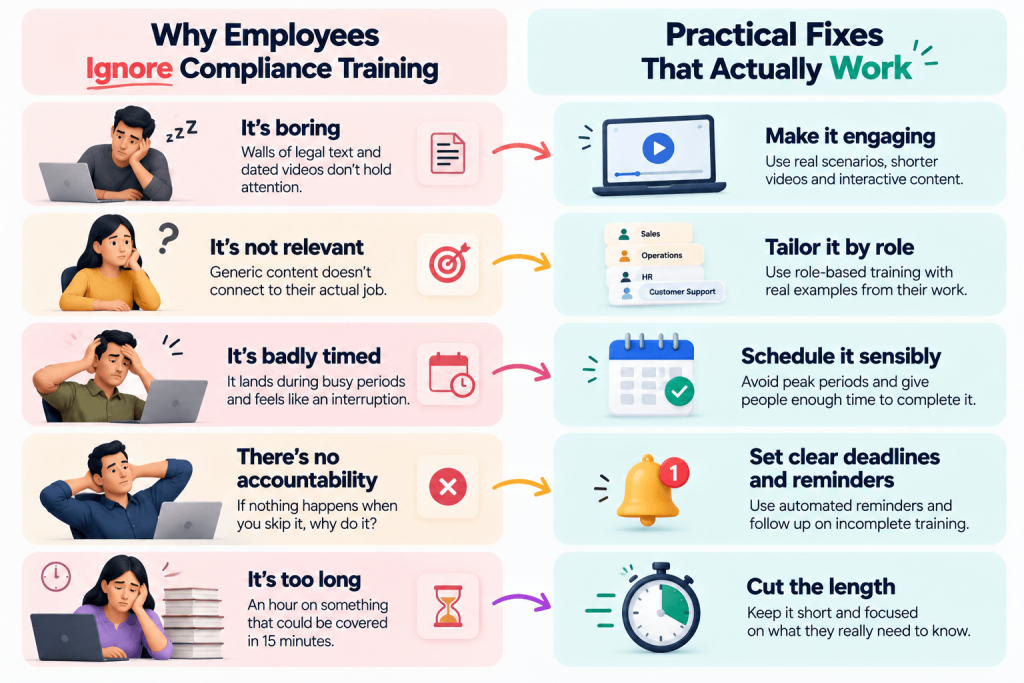
- It's boring: walls of legal text and dated videos signal "this doesn't respect your time."
- It's not relevant: generic content that never connects to the person's actual role.
- It's badly timed: dumped on people during their busiest weeks, so it's a resented interruption.
- There's no accountability: if nothing happens when you skip it until the last minute, why not?
- It's too long: an hour on something that could be covered well in fifteen minutes.
The Real Risk: Compliance Theatre
There's a deeper problem than low completion numbers, and it's worth naming. When training becomes a box-ticking exercise, you can hit 100% completion and still have people who learned nothing. That's compliance theatre: the report says everyone is trained, but if an incident happened tomorrow, half of them wouldn't know what to do.
This matters because the whole point of compliance training is to change behaviour and reduce risk, not to produce a certificate. A green dashboard built on click-throughs gives you a false sense of safety, which is arguably worse than knowing your people aren't prepared. Fixing completion is really about fixing whether the training works, and the two go together.
What Actually Lifts Completion
The good news is that the same changes that make people finish training also make it work better. You're not trading engagement for rigour, you get both.
- Make it relevant: tailor content to roles, so people see why it applies to them.
- Shorten it: cover what matters well, and cut everything that's there just to pad the time.
- Set clear deadlines and automate reminders, so chasing isn't a manual job.
- Get leaders to take it visibly, because people copy what leadership actually does.
- Track and follow up, so completion is expected and noticed, not optional.
| Leadership modelling is the most underused lever. If a manager says "just get it done" while visibly skipping it themselves, the message lands loud and clear. When leaders complete it first and mention it, completion follows. |
How MyPass LMS Takes the Chasing Off Your Plate
Most of what kills compliance completion is friction and manual follow-up, and that's exactly what an LMS should remove. In MyPass LMS you assign training by role, so people get what's relevant to them rather than one generic course for everyone, and automated reminders handle the chasing on a schedule instead of your team sending emails by hand.
For anything with a recurring or annual requirement, you can set it to reassign on the right cycle so nothing quietly lapses. And when an auditor or your own leadership asks, one-click reporting shows exactly who's completed what and when, real evidence, not a spreadsheet scramble. Because pricing is flat with unlimited registered users, putting everyone on the platform doesn't add per-seat cost, so there's no reason to leave anyone off.
| Pick your worst-performing course and change one thing this quarter, usually cutting its length or turning on automated reminders. Prove the lift on one course, then apply what worked to the rest. |
The bottom line
Employees don't ignore compliance training because they're careless, they ignore it because it's often boring, irrelevant, badly timed and never really followed up. The fixes are practical: make it relevant and shorter, set deadlines with automated reminders, have leaders take it visibly, and track completion so it's noticed. Those same changes also make the training actually work, which is the real goal.
Aim for genuine understanding, not just a green dashboard. See how role-based assignment, reminders and one-click reporting remove the chasing in MyPass LMS features, or read how to improve course completion rates. Want to see it on your own training? Start a free trial.
Frequently asked questions
Why do employees ignore compliance training?
Usually because it's boring, not relevant to their actual role, dropped on them at busy times, too long for what it covers, and never really followed up, so skipping or rushing it becomes the rational choice. It's rarely about people not caring about doing the right thing. The fixes address the design and process: make it relevant and shorter, time it sensibly, set deadlines with reminders, and track completion so it's expected and noticed.
How do you increase compliance training completion rates?
Make the content relevant to each role so people see why it matters, cut it to the length the material actually needs, set clear deadlines with automated reminders so chasing isn't manual, get leaders to complete it visibly (people copy what leadership does), and track completion so it's followed up rather than optional. The same changes that lift completion also make the training more effective, so you're not choosing between the two.
What is compliance theatre?
Compliance theatre is when training becomes a box-ticking exercise: the completion report shows everyone is 'trained,' but people clicked through without learning anything, so they wouldn't actually know what to do in a real situation. It's a real risk because it creates a false sense of safety, a green dashboard built on click-throughs, when the point of compliance training is to change behaviour and reduce risk, not just to generate certificates.
How can an LMS help with compliance training?
An LMS removes the friction and manual follow-up that kill completion. It lets you assign training by role so it's relevant, automate reminders so no one is chasing people by hand, reassign recurring or annual training on the right cycle so nothing lapses, and produce completion records instantly when an auditor or leadership asks. That turns compliance from a quarterly manual scramble into a tracked, largely automatic process, and gives you real evidence rather than a spreadsheet.