Free HIPAA compliance training should cover the Privacy Rule, the Security Rule, breach notification, and role-specific handling of protected health information (PHI) — but 'free' content is only half the job. The part that actually satisfies an auditor is documented proof that each person completed it: a dated, exportable training record you can produce on demand. Free training materials without tracking will not pass an audit.
The catch with 'free' HIPAA training
Search for free HIPAA training and you'll find plenty of it — slide decks, videos, PDFs. And for teaching people what HIPAA requires, some of it is genuinely fine. But here's the gap nobody mentions until an auditor is sitting across the table: HIPAA compliance isn't demonstrated by showing people a video. It's demonstrated by proving, with documentation, that the right people completed the right training on a specific date.
That's the distinction that matters. Free content answers 'what do we teach?' It doesn't answer 'can we prove we taught it?' — and under HIPAA, the second question is the one that carries penalties. So this guide covers both: what a solid HIPAA training program should include, and how to track completion so the program actually protects you.
| → The uncomfortable truth: a free training video everyone watched but nobody documented is, from an auditor's perspective, training that didn't happen. Proof of completion is the compliance artifact, not the content. |
What HIPAA compliance training should cover
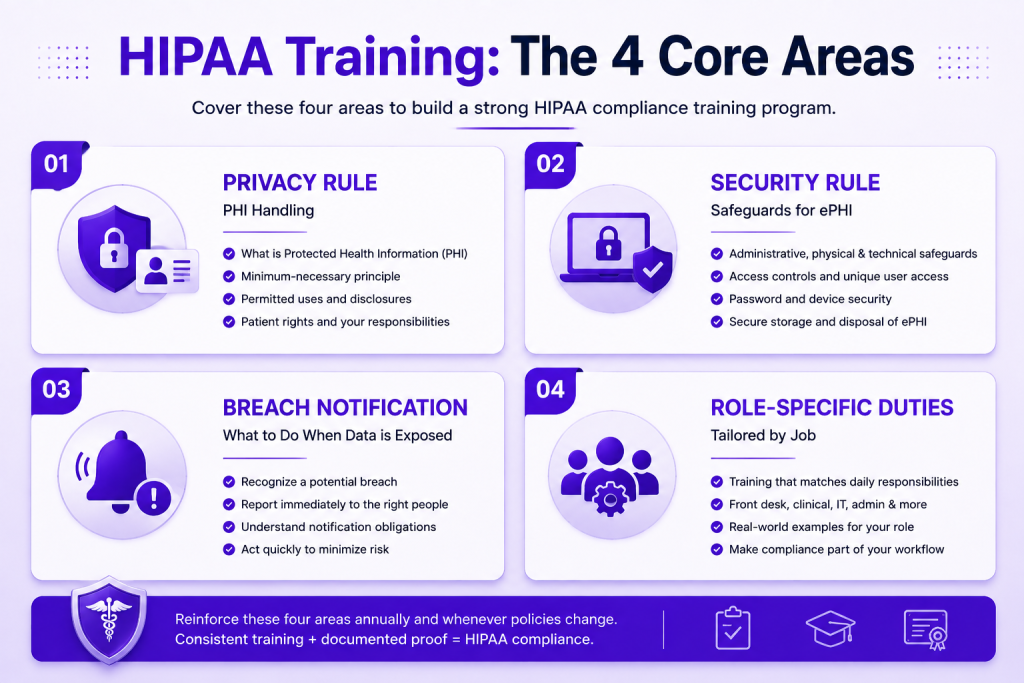
A defensible HIPAA training program covers four areas. Adjust the depth by role — a front-desk clerk and a systems administrator need different emphasis, but everyone needs the fundamentals.
- The Privacy Rule. What counts as protected health information (PHI), the minimum-necessary principle, and how PHI may and may not be used or disclosed.
- The Security Rule. Administrative, physical and technical safeguards for electronic PHI (ePHI) — passwords, device security, access controls, and secure disposal.
- Breach notification. How to recognize a potential breach, who to report it to internally, and the notification obligations that follow. Speed matters here.
- Role-specific duties. Tailored guidance for how each role actually handles PHI day to day, so training is concrete rather than abstract.
Cover these four and reinforce them annually — HIPAA training isn't a one-time event, and an auditor will expect to see a recurring cadence with dated records for each cycle.
Why tracking is the part that actually protects you
Imagine an audit or, worse, a breach investigation. The question won't be 'do you train staff on HIPAA?' It will be 'show me that this specific employee completed HIPAA training, on what date, and what it covered.' If your answer is a shared drive full of PDFs and a vague sense that everyone watched the video, you have a problem.
This is exactly where free content falls short and where a learning platform earns its place. An LMS with proper compliance tracking records who completed what and when, stores it as a dated, exportable record, and lets you produce an audit-ready training report in minutes rather than reconstructing it from memory. That's the difference between training that decorates a shared drive and training that holds up under scrutiny.
Running HIPAA training without the manual overhead
You can absolutely use free or low-cost content — the material doesn't have to be expensive to be effective. What you need alongside it is a way to assign it, confirm completion, and document that completion automatically. A good setup looks like this:
- Assign the training to the right people automatically, based on role.
- Track completion and send reminders without someone chasing individuals by email.
- Store each completion as a dated, immutable record.
- Export an audit-ready report on demand, filtered by person, date or department.
| → The same tracking approach applies to your other mandatory programs — GDPR training , anti-harassment training , security awareness. Build the documentation habit once and it covers all of them. |
The bottom line
Free HIPAA compliance training can teach your people what they need to know — the content genuinely can be free. But compliance isn't proven by content; it's proven by documentation. Cover the Privacy Rule, Security Rule, breach notification and role-specific duties, then make sure every completion is tracked as a dated, exportable record. That combination is what turns training from a checkbox into actual protection.
MyPass LMS lets you deliver HIPAA and other compliance training with automatic assignment, completion tracking and audit-ready reporting — with an immutable audit trail on every plan, including the free Community Edition. See how to prove training compliance in an audit , or start a free trial .
Frequently Asked Questions
Is free HIPAA compliance training enough for compliance?
Free training content can teach the required material, but content alone doesn't demonstrate compliance. HIPAA compliance requires documented proof that specific people completed training on specific dates — tracking and records, not just materials.
What should HIPAA compliance training cover?
Four core areas: the Privacy Rule (PHI handling), the Security Rule (safeguards for electronic PHI), breach notification procedures, and role-specific duties. Training should be reinforced annually with dated records for each cycle.
How do I prove employees completed HIPAA training?
Use a learning platform that records who completed what and when, stores it as a dated, exportable record, and can produce an audit-ready report on demand. A shared drive of PDFs won't satisfy an auditor.
How often is HIPAA training required?
HIPAA training should be recurring, not one-time — typically annually, plus when policies change or a new employee joins. Auditors expect to see a regular cadence with dated completion records for each cycle.
Can I use free HIPAA content with a paid tracking system?
Yes, and it's a sensible approach. The content doesn't have to be expensive to be effective. Pair free or low-cost material with a platform that assigns it, tracks completion and documents it automatically for audits