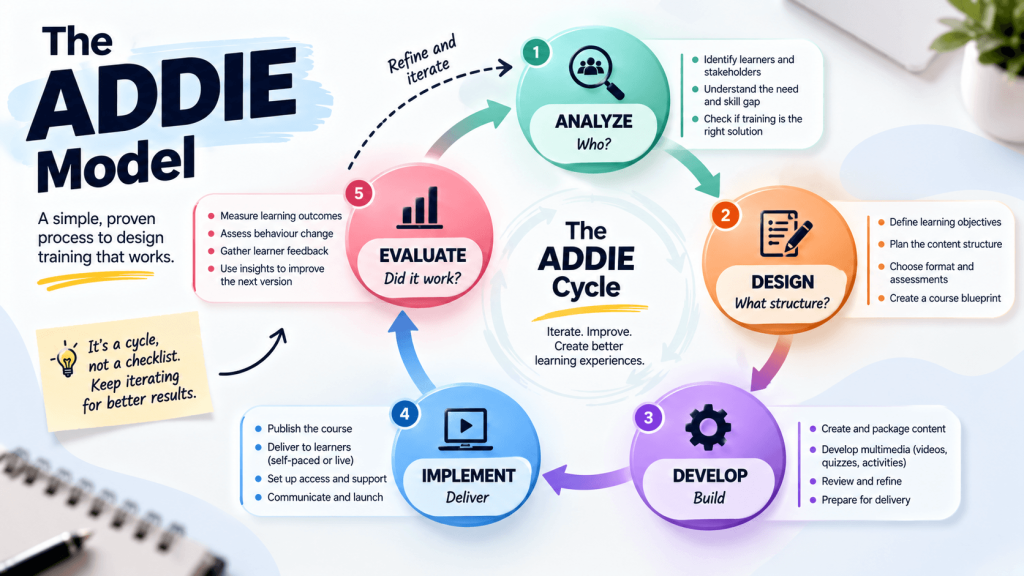
| ADDIE is a five-phase instructional design process: Analyze the need and audience, Design the objectives and structure, Develop the actual content, Implement it with learners, and Evaluate whether it worked. It gives anyone building training a repeatable order of work, and it is best used as an iterative cycle rather than a strict one-way sequence. |
What ADDIE Is and Why It Helps
If you have ever been handed a topic and told to 'make a course,' you know the hardest part is knowing where to start. The ADDIE model solves exactly that. It is the most widely used instructional design framework, and it breaks course creation into five clear phases: Analyze, Design, Develop, Implement and Evaluate. The name is simply the first letter of each.
ADDIE matters because it stops you from jumping straight to building slides before you know what the training is supposed to achieve. That single discipline, understanding the need before creating content, is the difference between a course people finish and forget and one that actually changes how they work.
| ADDIE is not a rigid waterfall. In practice the best designers loop back: what they learn in Develop or Evaluate sends them back to refine the Design. Treat it as a cycle you iterate, not a checklist you complete once. |
The Five Phases, One at a Time
Each phase answers a specific question and produces a specific output that feeds the next.
- Analyze: Who are the learners, what must they be able to do, and what is the gap? Output: a clear training need.
- Design: What are the objectives, structure, assessments and format? Output: a course blueprint, before any content exists.
- Develop: Build it: write content, record video, create quizzes, assemble the course. Output: the finished materials.
- Implement: Deliver to learners, self-paced or instructor-led, and make sure access and support work. Output: a live course.
- Evaluate: Did learners meet the objectives and did behaviour change? Output: findings that improve the next version.
Analyze: Get the Need Right First
The Analyze phase is where good courses are won or lost, and it is the phase people are most tempted to skip. Before you design anything, you find out who you are training, what they actually need to be able to do afterwards, and the gap between where they are now and that goal. You also check whether training is even the right fix, because some performance problems are caused by broken processes or unclear expectations, not a lack of knowledge.
Get this wrong and everything downstream is wasted effort: a beautifully built course that solves the wrong problem. Get it right and the rest of ADDIE becomes straightforward, because every later decision has a clear reference point.
Design and Develop: Blueprint, Then Build
Design is where you turn the need into a plan. You write measurable learning objectives (what the learner will be able to do), decide the structure and sequence, choose the format (self-paced, instructor-led or blended), and plan how you will assess whether people learned. Crucially, you do all of this before building content. A blueprint is cheap to change; a finished course is not.
Develop is the build phase everyone pictures when they think of course creation: writing the content, recording or sourcing video, creating quizzes and assembling everything. Because you designed first, Develop becomes execution rather than invention, which is faster and produces a more coherent course.
| Write your objectives before you write any content. An objective like 'the learner can process a return in the system without help' tells you exactly what to build and exactly how to test it. Vague goals like 'understand returns' give you neither. |
Implement and Evaluate: Deliver, Then Learn From It
Implement is delivery. For self-paced digital training this means publishing the course in your LMS, assigning it to the right people, and making sure access, reminders and support all work. For instructor-led training it means scheduling, preparing facilitators and running the sessions. The goal is a smooth experience so the content, not the logistics, is what learners remember.
Evaluate closes the loop and is the phase most often neglected. You measure whether learners met the objectives and, ideally, whether their behaviour actually changed on the job. Those findings are not a report you file; they are the input to the next version of the course. That feedback is what turns ADDIE from a one-time project into a process that gets better every cycle.
How MyPass LMS Fits Into ADDIE
ADDIE is a process, not a tool, but the right platform removes friction from the Develop, Implement and Evaluate phases. In MyPass LMS you can build the course itself, including with a built-in course builder and SCORM authoring, so Develop does not require a separate authoring tool.
For Implement, role-based assignment and automated reminders get the course to the right people and keep it moving. For Evaluate, reporting shows completion and assessment results so you can see whether objectives were met, and feed that back into the next design cycle rather than guessing.
| A simple way to start: take one small, real training need and run it through all five phases once. A short course done properly end to end teaches you ADDIE far better than reading about it, and gives you a template for the next one. |
The bottom line
ADDIE gives anyone asked to build training a clear, repeatable order of work: Analyze the need, Design the blueprint, Develop the content, Implement it, and Evaluate the result. Its real value is forcing you to understand the need before you build, and to treat evaluation as the start of the next cycle rather than the end of the project.
Use it as an iterative loop, not a strict sequence. See how a built-in course builder supports the Develop phase in MyPass LMS features, read how to write learning objectives for the Design phase, or start a free trial.
Frequently asked questions
What does ADDIE stand for?
ADDIE stands for Analyze, Design, Develop, Implement and Evaluate: the five phases of the most widely used instructional design model. Analyze defines the need and audience, Design produces the objectives and blueprint, Develop builds the content, Implement delivers it to learners, and Evaluate measures whether it worked. Each phase feeds the next, and the findings from Evaluate feed back into the next cycle.
Is ADDIE still relevant?
Yes. Although newer approaches like SAM and Agile-inspired methods exist, ADDIE remains the most widely taught and used instructional design framework because its logic, understand the need before you build, then measure whether it worked, is sound regardless of format. The main modern adjustment is treating ADDIE as an iterative loop rather than a rigid waterfall, revisiting earlier phases as you learn.
Which ADDIE phase is most important?
Analyze is the most important and the most skipped. If you misjudge who you are training or what they actually need to do, every later phase produces polished work that solves the wrong problem. Getting the analysis right makes Design, Develop, Implement and Evaluate far easier, because every decision has a clear reference point to measure against.
How is ADDIE different from writing learning objectives?
Learning objectives are one output of ADDIE's Design phase, not a substitute for the whole model. ADDIE is the end-to-end process; objectives are the specific, measurable statements of what a learner will be able to do that you write during Design. Good objectives depend on a good Analyze phase, and they later tell you exactly what to build and what to measure in Evaluate.