What Is CPD? What Professional Bodies Actually Require
On this page 9 sections
Short answer
Continuing professional development is the learning a professional does to stay competent after qualifying. Professional bodies set their own rules, so CPD can mean counting hours, counting only verifiable hours, or writing reflective records with no hours at all. The requirement depends entirely on which body regulates you.
What CPD Means, and How It Differs From CE Credits
CPD stands for continuing professional development: the learning you do after qualifying, to stay current and keep your registration. The confusion starts because people assume it works like the American continuing education system. It often does not.
- CE credits are a currency. A course is worth a defined number of credits, awarded by an accredited provider, and you collect enough of them. Our guide to CEUs and continuing education units covers that model.
- CPD is a duty. Most bodies describe it as an obligation to remain competent. How you evidence that varies enormously, and in several professions it is not measured in hours at all.
- Nobody owns the term. Unlike the CEU, which has a published definition, CPD is defined separately by each regulator and professional body. There is no universal CPD hour.
Which is why the first question is never how many CPD hours do I need. It is which body regulates this, and what does that body count.
The Three Models Bodies Actually Use
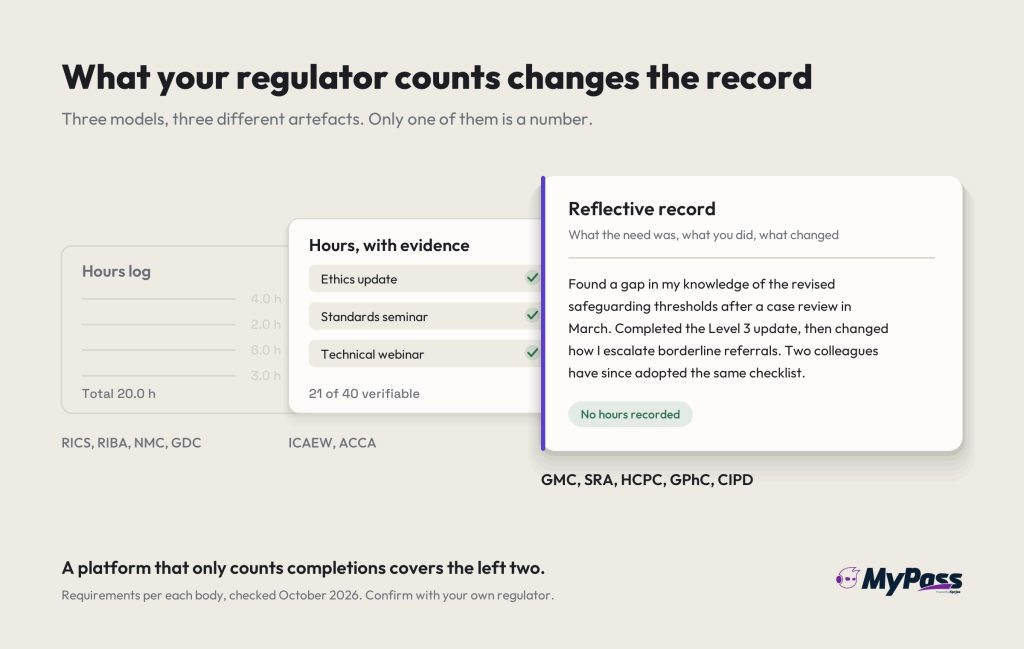
Underneath the variation there are only three patterns, and knowing which one applies tells you what your records have to look like.
- Count the hours. A flat annual total, often with a minimum that must be structured or verifiable. RICS and RIBA work this way.
- Count the verifiable portion. A total, split into verifiable and non-verifiable, where only the verifiable part needs third-party evidence. ACCA is the clearest example.
- Count nothing. Evidence the thinking. No hours at all. You are judged on whether you identified learning needs, acted on them, and reflected on the outcome. The SRA, HCPC and GMC sit here.
That third model is the one that catches out systems designed for CE credits. If your regulator does not count hours, an LMS that produces a tidy credit total has given you something nobody asked for and missed what they did.
What the Main UK Bodies Require
Figures below are from the CPD Standards Office summary, checked 6 July 2026, which links to each body's own rules. Confirm with your regulator before relying on any of it, because these change.
| Body | Requirement | Structured or verifiable | Cycle |
| RICS | At least 20 hours a year | At least 10 hours structured | Calendar year, recorded by 31 January |
| RIBA | At least 35 hours a year | At least 20 from the ten Core Curriculum topics | Annual, via RIBA's recording tool |
| ICAEW | 20 to 40 hours, by work category | At least 1 hour of verifiable ethics | 1 November to 31 October |
| ACCA | 40 units a year, 1 unit is 1 hour | At least 21 verifiable | Annual declaration due 1 January |
| GDC (dentists) | 100 verifiable hours per cycle | All 100 verifiable | Five years, at least 10 in any two-year period |
| NMC (nurses) | 35 hours per cycle | At least 20 participatory | Three-year revalidation |
| GPhC (pharmacy) | Four CPD entries a year | At least two planned | Annual, with registration renewal |
| HCPC | No fixed hours | Outcome based | Two-year renewal, written profile on request |
| SRA (solicitors) | No minimum hours | Reflection based | Annual declaration at renewal |
| GMC (doctors) | No fixed hours | Appraisal based | Revalidation every five years |
| CIPD | No mandate, around 30 planned hours suggested | Not specified | Calendar year, three reflective records |
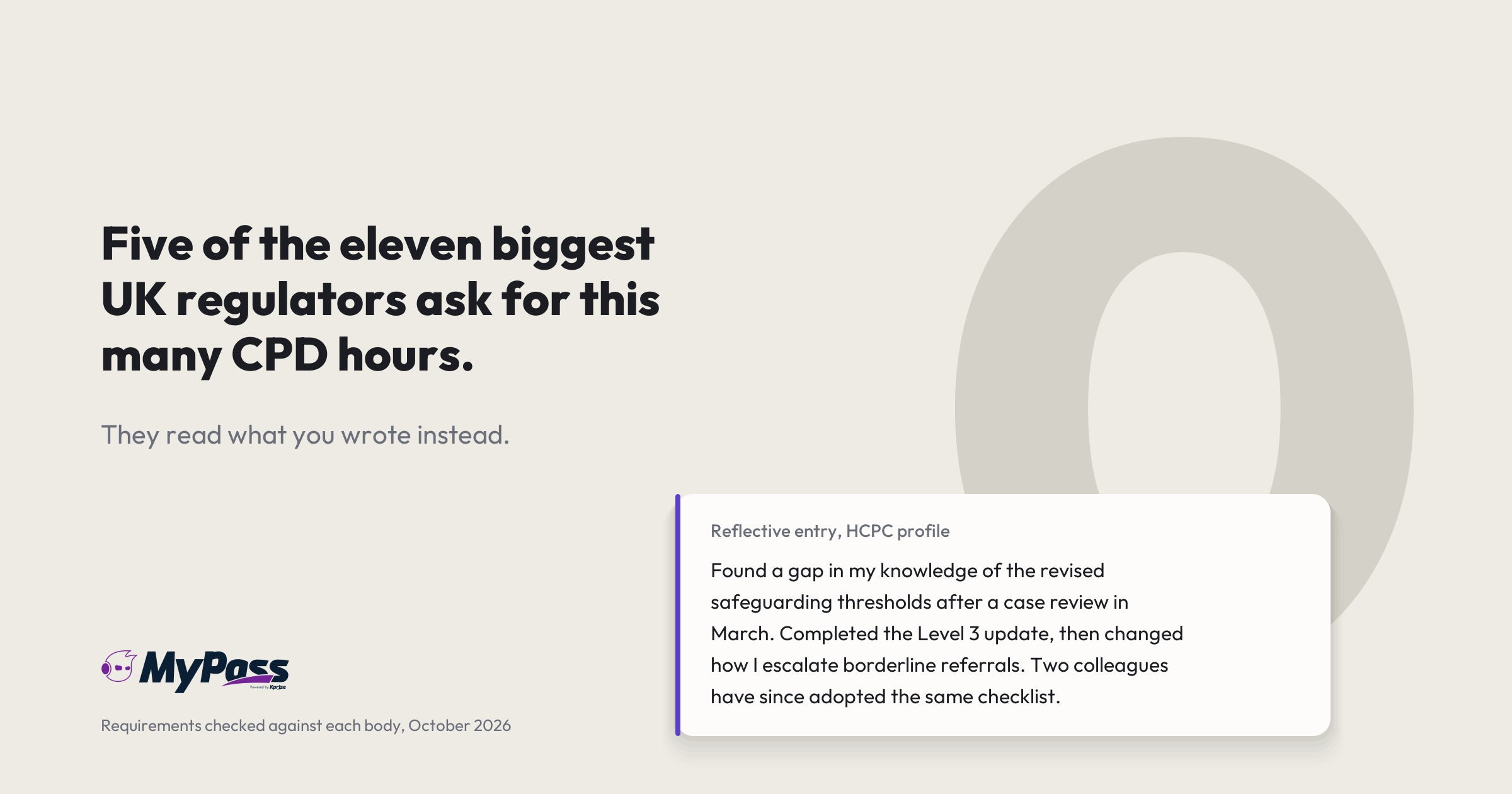
Read down the first column and the point makes itself. Five of these eleven set no hours requirement at all, and the six that do disagree about the total, the split and even when the year starts.
The Part That Breaks Most Systems: Reflection
Where hours are not counted, what gets assessed is a written reflective record. That is a very different artefact to a completion certificate.
- It is written by the member, not the system. Nobody can auto-generate it, because the content is the person's own account of what changed in their practice.
- It has to connect to practice. Typically what the learning need was, what was done about it, and what difference it made at work.
- Some bodies specify the format. The GPhC requires a peer discussion record and a reflective account among its four annual entries. The CIPD asks for at least three reflective records a year.
- It gets sampled, not inspected. Most regulators audit a random percentage, which means the record has to be retrievable years later, not just submitted once.
- Evidence retention has its own clock. ACCA, for instance, expects evidence to be kept for three years.
So a CPD system needs somewhere for members to write and store reflection, attached to the activity it relates to. A platform that only records completions covers maybe half the requirement.
What a CPD System Actually Has to Do
If you run a scheme for members, this is the functional list worth testing a platform against.
1. Hold hours and entries, not just completions. Including activity the member did elsewhere, since most CPD happens outside your catalogue.
2. Separate structured from unstructured. Most hours-based bodies set a minimum structured portion, so the split has to be a field, not a calculation someone does by hand.
3. Let members record reflection against an activity. Free text, saved, editable, retrievable.
4. Follow your cycle, not the calendar. ICAEW runs November to October. The GDC runs five years. A system hard-coded to a calendar year will not fit.
5. Produce a member's full record on demand. When a member is sampled for audit, you should be able to hand them a complete record in minutes.
Point four catches more schemes than any other. If you administer CPD for a body whose year does not start in January, check that before anything else. For the wider picture of what a membership platform needs, the best LMS for associations covers the rest of it.
How MyPass LMS Handles CPD
We build this for professional bodies, so here is what is actually in the platform and where the edges are.
- Hours and credits tracked against a member record. Including activity completed outside the platform, which is where most CPD comes from.
- Custom cycles. Schemes that run November to October, or on a rolling three or five year cycle, rather than only a calendar year.
- Certificates issued automatically. Branded, on completion, which is covered in the certificate builder.
- Audit on demand. One-click audit reports produce a member's full record when they are sampled, rather than assembling it by hand.
- Ask us about reflective records specifically. If your regulator is outcome-based and needs members to write and store reflection, raise it with us directly rather than assuming. It is a specific capability and you should get a specific answer.
That last point matters more for CPD than for most things. A scheme regulated on reflection has a different requirement to one regulated on hours, and you should make every vendor, us included, show you the reflective record working before you commit.
The bottom line
CPD is not one requirement. It is roughly three, wearing the same three letters. Some bodies want a total number of hours with a structured minimum. Some want a verifiable portion backed by certificates. And several of the largest regulators want no hours at all, only evidence that you identified a learning need, acted on it and reflected on what changed.
Before choosing any system to run a scheme, answer three questions: which model does our regulator use, when does our cycle start and end, and can a member produce their full record on the day they are sampled. Most procurement goes wrong because the first question was never asked.
If you run CPD for members and the reflective half is where your current setup struggles, that is worth a conversation. See what the free edition includes.
For the American equivalent and its credit types, our guide to continuing education for associations covers CEUs, PDUs, CPE and CLE.
Frequently asked questions
What does CPD stand for?
Continuing professional development. It is the learning a professional does after qualifying to stay competent and keep their registration. Each professional body defines its own requirements, so there is no single CPD standard.
How many CPD hours do I need a year?
It depends entirely on your body. RICS requires at least 20, RIBA 35, ACCA 40 units. The SRA, HCPC and GMC set no hours at all and assess reflection instead. Check your own regulator's current rules.
What is the difference between structured and unstructured CPD?
Structured or verifiable CPD is formal, evidenced learning such as a course or conference with a certificate. Unstructured is self-directed, like reading or informal discussion. Most hours-based bodies set a minimum structured portion.
What is the difference between CPD and CEUs?
CEUs are an American credit currency with a published definition, awarded by accredited providers. CPD is a broader duty defined separately by each professional body, and in several professions it is measured by reflection rather than hours.
Sources
- CPD Standards Office summary of CPD requirements by UK professional body, checked 6 July 2026, which links through to each body's own published rules.
- Published CPD rules from RICS, RIBA, ICAEW, ACCA, the General Dental Council, the General Medical Council, the Nursing and Midwifery Council, the Health and Care Professions Council, the Solicitors Regulation Authority, the General Pharmaceutical Council and the CIPD.
- Requirements change, sometimes at short notice. Every figure here should be confirmed against the relevant body before you rely on it.