
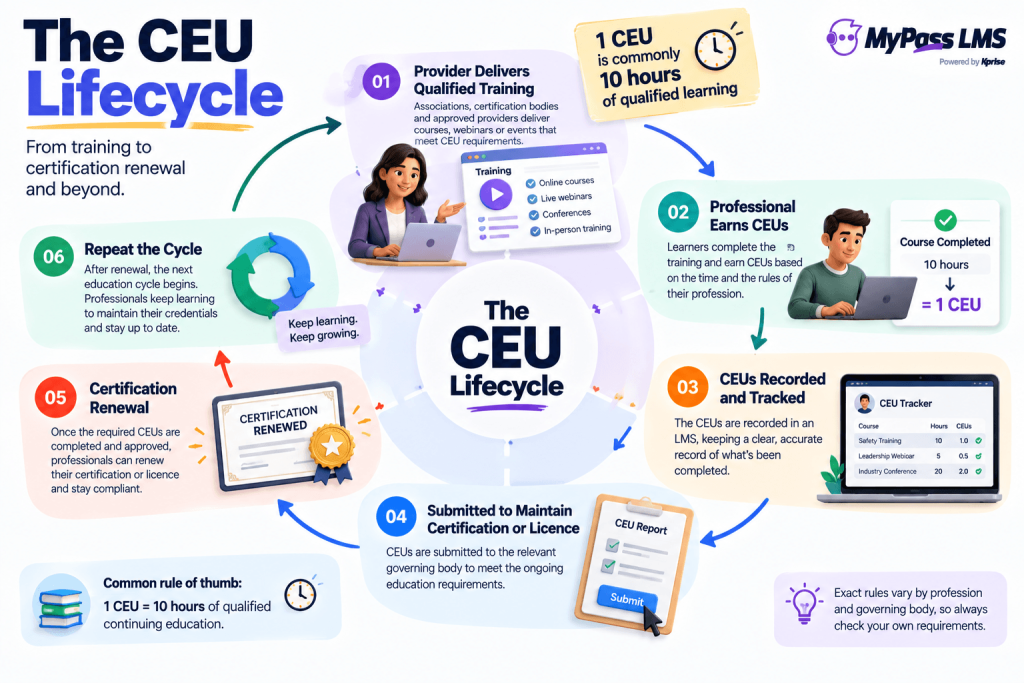
| A CEU (Continuing Education Unit) is a standard way to measure continuing education, most commonly one CEU for every 10 hours of a qualified program, though exact rules vary by profession and body. Professionals earn CEUs to keep certifications and licences current. Associations and providers issue and track them, and that tracking is what an LMS makes far easier. |
What a CEU Actually Is
If you work anywhere near professional training, you see 'CEUs' constantly, usually with no explanation, as if everyone already knows. So here it is plainly: a CEU, or Continuing Education Unit, is just a standard way to measure continuing education. It gives a profession a common currency for saying 'this much learning happened', so ongoing education can be required, counted and checked in a consistent way.
The most widely used standard is that one CEU equals 10 hours of a qualified continuing education program, but that's a general rule, not a universal law, the exact definition and requirements vary by profession and governing body. CEUs exist because a lot of professions don't let you qualify once and coast; you have to keep learning to hold onto a certification or licence, and CEUs are how that ongoing learning gets measured. Whether you're the professional earning them or the body issuing them, it pays to understand how they actually work.
| A CEU is simply a standard unit of continuing education, usually 10 hours of a qualified program per CEU. But 'usually' is doing real work in that sentence: the exact rules differ by profession, so always check your own body's. |
How CEUs Work in Practice
The CEU system has a few moving parts, and they're worth knowing whether you earn them or hand them out.
- The measure: commonly 1 CEU for every 10 contact hours of a qualified program (but confirm your profession's rule).
- Why they exist: many professions require ongoing learning to keep a certification or licence active.
- Who earns them: professionals who have to maintain credentials, nurses, accountants, engineers, and plenty more.
- Who issues them: associations, certification bodies and approved training providers.
- What's required: a set number of CEUs within a renewal window, tracked and reported to the governing body.
CEUs vs CE Credits: Clearing Up the Confusion
This is where people trip up, so it's worth slowing down. 'CEU' means the specific, standardised Continuing Education Unit, the 10-hour measure. But you'll also run into 'CE credits', 'contact hours', 'PDUs', 'CPD' and a pile of profession-specific units, and they are not all the same thing. Different fields use different systems, and a 'credit' in one profession may be defined completely differently in another.
The practical lesson is simple: don't assume. If you're a professional, check exactly what your certifying or licensing body wants, the unit they use, how many you need, and over what period. If you're an association or provider issuing continuing education, make sure you understand the standard your learners are held to, so the credits you award actually count for them. The system makes perfect sense once you know your specific rules; the mistake is assuming everyone plays by the same ones. (This is general information, not professional or regulatory advice, confirm the details with the relevant body.)
The Hard Part Isn't Understanding Them, It's Tracking Them
For associations, certification bodies and training providers, the challenge with CEUs isn't the concept, it's the admin, at scale. Every learner who earns CEUs needs them recorded accurately, usually with proof of completion, tied to the right program and the right number of hours, and available whenever they, or their governing body, want to verify them. Do that by hand across hundreds of members and dozens of programs and it becomes a slow, error-prone grind, and getting it wrong means someone's credits don't count, which is a serious failure for an organisation whose whole job is credentialing.
This is exactly where an LMS stops being a nice-to-have. The right platform delivers the qualified training, records completion and the CEUs earned against each learner automatically, issues certificates as proof, and lets both the learner and the organisation pull up and report on credits earned. It turns a records nightmare into something that mostly runs itself, which is why associations and certification bodies lean on an LMS built for them.
| Understanding CEUs is the easy bit. The real work is issuing and tracking them accurately across a whole membership, and credits you can't reliably verify are as good as credits nobody earned. |
How MyPass LMS Handles Continuing Education
MyPass LMS was built with associations, certification bodies and training providers in mind, the organisations that live and breathe CEUs. You deliver your continuing education through the platform, and completion plus the credits earned are recorded against each learner automatically, so the tracking that's so painful by hand just happens in the background.
It issues branded certificates as proof, supports certification and recertification programs, and ties credits to the right member record. Learners can see their own progress, and you can report on credits across your whole membership, the evidence a governing body or an audit will ask for. Because pricing is flat with unlimited registered users, serving your entire membership's continuing education doesn't quietly inflate your bill as you grow. If this is your world, the fastest way to judge it is to try it on your own continuing-education programs.
| If you issue CEUs, get one thing right above all: accurate, automatic tracking. Credits that can't be verified don't count, so let the same system that delivers the training also record and report the credits. |
The bottom line
A CEU is a standard measure of continuing education, commonly 10 hours of a qualified program per unit, though the exact rules vary by profession and body. Professionals earn them to keep certifications and licences current; associations and providers issue and track them. The real challenge isn't grasping what a CEU is, it's administering them accurately at scale, which is where the right platform earns its place.
Frequently asked questions
What are CEUs?
A CEU (Continuing Education Unit) is a standardised way to measure continuing education, a common currency for counting and verifying ongoing learning. The most widely used standard is one CEU for every 10 hours of a qualified continuing education program, though the exact definition and requirements vary by profession and governing body. Professionals earn CEUs to keep certifications and licences current, and associations, certification bodies and approved training providers issue and track them.
How are CEUs calculated?
The most common standard is one CEU for every 10 contact hours of a qualified continuing education program, so a 10-hour qualifying course would typically be worth 1 CEU. But this is a general rule, not universal: the exact calculation, and what counts as 'qualifying', can vary by profession and governing body, and some fields use different units entirely (CE credits, contact hours, PDUs, CPD). Always check the specific rules of the relevant certifying or licensing body rather than assuming the 10-hour standard applies to you.
What is the difference between CEUs and CE credits?
'CEU' is the specific, standardised Continuing Education Unit, commonly the 10-hour measure. 'CE credits' is a looser, broader term, and different professions define their credits differently, so a CE credit in one field may not equal a CEU or a credit in another. You'll also meet contact hours, PDUs and CPD. The key point is not to treat them as interchangeable: check exactly which unit your certifying or licensing body uses, how many you need, and over what period, because the terms and their definitions really do vary.
How do you track CEUs?
Professionals track CEUs by keeping records of the qualifying programs they complete, the credits earned and proof of completion, then reporting them to their governing body within the renewal window. For associations and providers issuing CEUs, tracking at scale is the real challenge, and doing it by hand is slow and error-prone. An LMS makes it manageable: it delivers the qualifying training, records completion and the associated credits against each learner automatically, issues certificates as proof, and lets both learners and the organisation see and report on credits earned.